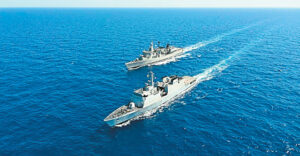
It wasn’t just the 26th President of the United States, Theodore Roosevelt, who deeply understood that without projecting naval power, his country would never gain a hegemonic position in the international system. On a smaller scale and adapted to the needs of the 21st century, the staff of the Greek Pentagon reportedly share the same concern, as the new armament program of the Armed Forces hides behind the curtain a new fleet aiming for 16 main surface units by 2035, as a response to the “Blue Homeland.”
Judging by Turkey’s revisionist narrative, as well as the constant reproduction of the “Blue Homeland,” and the claims accompanying the Turkish-Libyan memorandum, the “existing threat,” about which the Minister of National Defense, Nikos Dendias, has repeatedly warned, is largely based on the danger from the sea, which the new Greek fleet is decisively coming to prevent. This fleet will have taken shape by the end of the next decade. By 2035, Greece will undoubtedly be ranked among the leading naval powers in the Mediterranean.
The Hellenic Navy’s plan includes both large strike units, such as frigates, corvettes, Fast Attack Craft Missile (FACM), as well as coastal patrol boats, new submarines, smaller support ships, and an extensive upgrade program, as well as unmanned systems, creating a notional effective barrier on the watery horizon.
All Shipyards in Play
Already, the latest meeting of the Government Council for Foreign Affairs and Defense (KYSEA) gave the green light for the acquisition of the fourth FDI (Belharra) frigate, aiming for it to carry strategic weapons (SCALP Naval), as the consent of the countries participating in their construction consortium is reportedly secured. The Pentagon’s intention is for three of the four FDI frigates to carry strategic weapons, maximizing the operational capabilities of the Hellenic Navy. In terms of cost, according to reliable information, official consultations are underway regarding the acquisition cost of the new frigate, so that there is room for a discount in favor of the Greek side.
The 4th Belharra Was Just the Beginning: The Super Frigate Constellation and 15 More Strategic Ships Are Coming for the Hellenic Navy
At the same time, in addition to the four FDI frigates, the upgrade of the MEKO-200HN frigates is expected to begin within the year, according to information, with the participation of Greek shipyards. After all, the Pentagon is not backing down an inch from its intention for a 25% Greek participation in the new armament program, while the goal remains for the work on the new fleet to proceed in all four of the country’s shipyards (Elefsina, Salamina, Skaramagas, and Chalkida).
The Eurocorvette Heats Up
In addition to the four MEKO frigates, two used Italian Bergamini-class frigates are expected to join the new fleet, which, according to the Minister of National Defense, constitute “the prologue to the Constellation, the next-generation frigate that we aspire to discuss and build together with the United States of America.”
In practice, the acquisition of FREMM frigates, on which the Constellation is also based, does not necessarily stop at the two Italian ones, as the Hellenic Navy staff are constantly on alert for finding new ships in good condition from neighboring countries. Furthermore, the gradual replacement of main fleet units with new ones will lead to the transfer use of several S-class frigates, with four of them remaining active at the end of the program.
On another track, the discussion for participation in the Eurocorvette program remains open for the Pentagon, a discussion which is reportedly gaining new substance after the rapid geopolitical developments, as well as the historic decisions at the European Union level. Specifically, it is not ruled out that the Eurocorvette program (MMPC) will be a bet for common European defense, absorbing part of the budget of the “ReArm Europe” program, amounting to 800 million euros.
At the same time, the 12-year Long-Term Defense Equipment Planning (MΒΑΕ) of the Armed Forces includes the procurement of new submarines, with the Pentagon considering the acquisition of four new units, and the modernization of some of the existing ones, while the staff are oriented towards the acquisition of a total of five coastal patrol boats, the used American Protector and Island-class patrol boats. Furthermore, the capabilities of the Hellenic Navy are expected to be enhanced with the modern Romeo anti-submarine helicopters, which Greece is already acquiring, with three already delivered and four more to be integrated in the near future.
There will also be a modernization program for the FACMs (Missile Boats) with the simultaneous acquisition of new vessels, while the Hellenic Navy is leveraging its bilateral cooperation towards saving resources for consumables. This was the purpose of the recent visit of the Chief of the Hellenic Navy General Staff, Vice Admiral Dimitrios Katara, to Egypt, securing state-owned Egyptian fuel for the Greek frigates, with the Hellenic Navy saving 80,000 euros just from the absence of an intermediary in the last refueling of the frigate “Hydra,” as part of its participation in the “Aspides” program.
Ask me anything
Explore related questions