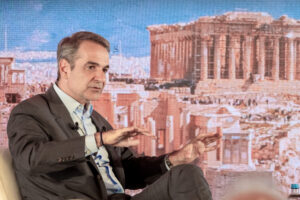
Kyriakos Mitsotakis, in a discussion with journalist Connie Loizos at an event hosted by the online newspaper TechCrunch, referring first to startups and human resources, said, among other things, that there was a perception that we don’t have a promising future ahead of us. “And I think we’ve been able to change that expectation and that’s not selfish,” he noted, noting that our biggest asset is our human capital.
The prime minister noted that the government from the beginning has provided incentives beyond stability and a state with a promising future. He referred, among other things, to stock options, the investor-friendly environment and initiatives to return people who had emigrated abroad. “We are now seeing them returning and investing especially in the AI sector,” he stressed.
“We have amazing talent. The question is: how do we build the bridge and bring those people back… Maybe we should talk a little bit more about our AI strategy,” he added.
“The idea is always to go beyond our capabilities. To use technology not only to make up for lost ground, but also to overtake many European countries,”
he noted, referring to a conversation he had with the new Chancellor of Germany, who told him that he would set up a ministry for digital policy, as happened in Greece.
“Technology – and especially AI – is also an opportunity to improve public services. It’s not just what a startup is, but what we can do, how we can be customers of these services, and how the state can also adopt startup logic. What does it mean to have a “startup state”? It’s not necessarily obvious. But sometimes we can operate much more progressively than the private sector. And beyond the tax breaks, people don’t just come back for that. They come back when there are good employment opportunities, when they see that they can do something important with their business.”
Elsewhere in the debate, he spoke about capital markets. “Why in Europe are we still exporting our savings to the US? What does it mean to list a company on the European stock exchange? I am very happy that we see the Greek stock market recovering again,” he said.
Mitsotakis stressed that we have made great progress in the digital state because the government’s decision in 2019 was a National Digital Transformation Strategy. “All applications were brought together under one umbrella, and we will get to gather all the data to provide digital services outside the ministries. If you as a Ministry of Digital Governance provide good services online, it is good for the minister – because it makes life easier for citizens,” he continued. He cited the vaccination programme during the pandemic season as an example. “It was fully digital. There was no paper at all. My friends from the US couldn’t believe it,” he said emphatically and agreed: “And then we moved on to European initiatives with the certificates so that people could travel. It was something really innovative.”
The future is artificial intelligence, Kyriakos Mitsotakis added, clarifying that for the government it means, for example, that it managed to run a pilot project and in the Land Registry, where it took two hours for employees to check a contract, now AI pre-processes it and the check is done in 10 minutes.
He also said that AI can be instrumental in areas like Civil Protection, and also in social issues, and made a special mention of health. “There, we have a big advantage: we already have a digital health system, and we have quality data. We conduct a lot of general population screening for preventive diseases, which gives us a lot of data. This is important both from the point of view of citizens’ health, but also because it provides opportunities for companies to develop applications to test in the local market and possibly export them.”
He stressed.
He also spoke about defence, noting that the landscape is changing and for the first time we have created an innovation centre in the Ministry of Defence, which can test products.
“So we can do small contracts, test technologies, and of course give Greek startups the opportunity to showcase their work, and then develop new products. If I were an investor, I would focus on this sector, because there is funding and a willingness to think ‘outside the box’. We are not just talking about traditional defence contracts for ships and planes – there is more to it,”
he said.
The prime minister also said we need broader reforms to speed up the justice system, while on investment he noted that the big picture matters. “Perhaps the most important thing – though ‘intangible’ – is confidence. When an investor looks at Greece, they don’t just see one company. He sees the overall context: is this a stable country? Is it going forward? The answer is ‘yes’. And I think investors recognise that. Who would have thought that Greece would have primary surpluses and discipline in public finances? The US can run huge deficits. We can’t. So the fact that we have fiscal discipline and structural reforms makes us credible. And most importantly, we have political stability. You know what to expect. If you come to Greece to invest, you don’t just look at one company. You look at the wider environment. And today, Greece is a stable country moving forward,” he stressed.
“We want to ensure that progress is irreversible. That we continue. We cannot waste any more time. The bet is to move forward dynamically, to move forward. And, of course, we have to be careful with misinformation, with AI-enhanced bots,” he also said.
“Finally, a topic that concerns me personally: the mental health of children and adolescents. What is the impact of living in a virtual world, of too much exposure to screens, on their health, education and future? Europe must rise to the occasion. It should harness the huge potential of AI, but not ignore its darker sides.”
Ask me anything
Explore related questions