






A few years ago, Revekka Palaiologou left Greece behind and traveled to Dubai in search of new professional opportunities. She gradually managed to integrate into the multicultural environment of the United Arab Emirates, and with the significant support of a well-known Greek entrepreneur, she contributed to the creation of Dion, a social networking app aiming to redefine the way connections begin—starting from something as simple and timeless as offering someone a drink.
The idea behind Dion is to give users the opportunity to make the first move in getting to know someone by sending them a drink through the app. If the gesture is accepted, a chat window opens within the app; if not, the amount is refunded to the sender. According to what Revekka Palaiologou recently stated to the Khaleej Times, registering on the platform requires an application and approval, in an effort, she says, to maintain a level of safety and quality in user interactions. Three months after its launch, Dion reportedly has around 1,000 active users, while several thousand more are on a waiting list. For now, the app is available only on the App Store and operates in partnership with 41 entertainment venues in Dubai. The goal is to increase this number to 47–50, focusing exclusively on top-tier venues. Among its partners, according to her interview, are well-known names such as Gaia, African Queen, and Coya Dubai.
Dion relies on a simple business model: there is no subscription or registration fee, only a small charge for each drink sent, which covers operational costs. Beyond traditional social networking, Revekka Palaiologou says that the platform is already planning to expand into the wellness space. She explains that soon, users will be able to offer infrared sauna or cryotherapy sessions instead of drinks, through partnerships with selected wellness centers in Dubai. “There’s a big shift toward wellness, and we feel it’s missing from the way we socialize. We want to change that,” she notes. This move is part of a broader trend where personal experiences and self-care are taking center stage in social activities. Whether this strategy will succeed in such a competitive environment remains to be seen.
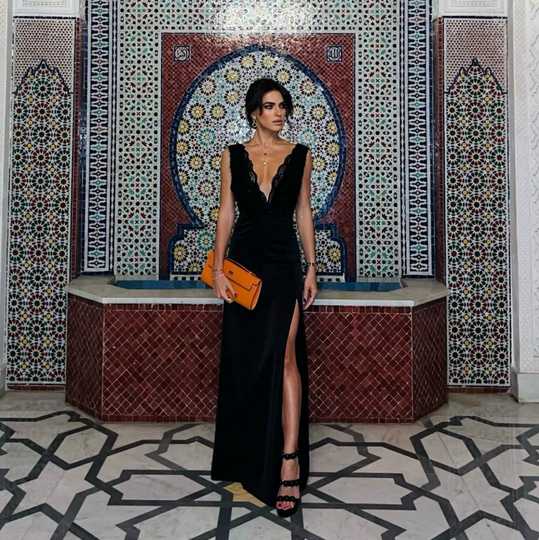
Palaiologou describes a demanding daily routine. The line between professional and personal life, she says, is nearly nonexistent, especially after deciding to expand Dion into the U.S. market. “The boundaries are very blurry for me. Since we started in Dubai and now that we’re moving into the U.S., it’s so exciting that my work is my life,” she says. To maintain her physical and mental stamina, she sticks to a disciplined fitness routine, scheduling 4–5 workout classes per week. At the same time, she has adopted a different work style: she works intensively for two to three weeks and then takes a few days off to travel and recharge.
She also uses sleep and fitness tracking devices, though she jokes that “they often remind me that I only slept five hours last night.” In her early professional steps, Palaiologou admits she struggled with what’s commonly known as “impostor syndrome,” the frequent feeling that she didn’t belong or wasn’t competent enough. “Many times, I thought I had no idea what I was doing and that I was going to get fired. Instead, I kept getting promoted,” she says. Today, with more experience, she says she has learned to better manage such thoughts, taking personal responsibility for her self-esteem.
Although Dion has attracted local attention and has been featured in Dubai’s lifestyle media, it is still in its early stages. The social networking and dating app market is especially competitive and complex—particularly in a place like Dubai, where image and exposure often play as important a role as substance. Whether Revekka Palaiologou’s venture can establish itself long-term and withstand the demands of the market remains to be seen.
The Informal Codes of Networking
Revekka Palaiologou’s initiative enters a landscape where methods of social interaction are already highly developed—both in-person and via social media. Dubai, in particular, operates according to its own unwritten communication codes, which are hard to ignore. In an environment where social encounters and connections follow informal but deeply entrenched norms, the need for social networking apps still exists. The influence of Instagram, in-person meetings, and most notably the distinctive culture centered around areas like the Dubai International Financial Center (DIFC) and, more recently, Jumeirah One (J1), make Dubai an unofficial high-stakes “marriage market.” In the city’s most exclusive dining and nightlife venues—from Zuma and Cipriani to Gaia and Amazonico—socializing doesn’t necessarily require digital facilitation. The atmosphere itself, along with powerful financial hubs and luxurious venues, encourages direct, often overt social encounters—whether spontaneous or strategically motivated by lifestyle and financial aspirations.

DIFC, one of the Middle East’s top financial centers, hosts the offices of major multinational corporations and attracts some of the wealthiest residents and visitors of the Emirates. At the same time, it’s a vibrant social hotspot, home to dozens of high-end restaurants and bar lounges where socializing often takes on the character of an informal matchmaking game. In these spaces, the presence of female companions—whether for professional or social purposes—is an open secret. Many establishments, fully aware of the value of image and presence, indirectly or directly encourage the entry of women who attract high-profile clientele, thereby boosting consumption and revenue. The latest hub of nightlife and social activity is the redevelopment of the J1 area, where new beach bar–club–restaurants such as Sirene, Gigi Rigolato, and Baoli have redefined the map of social interaction. Particularly on Saturday and Sunday afternoons, the scene evokes Mykonos summers: loud house music, stunning island-style decor, and spending that often requires a budget exceeding €400 just to participate in the festivities.
The Price Tag of “Connections”
In these venues, the dominant image is that of impeccably dressed women, adorned in expensive brands, seeking either self-promotion via social media or high-level social connections. The practice of “encouraging” customers to purchase costly drinks—such as champagne worth thousands of euros—is well known, often involving behind-the-scenes agreements that offer commissions to those who boost table spending. The cost of such “connections” varies. For less striking women or those outside the social media scene, fees start at €500, potentially dropping to €300 if the night proves “unsuccessful.” On the other hand, women with model-like looks, strong digital influence, or a prominent online presence can command €5,000 or more for a single evening. The more “well-intentioned” connections, however, are not made in clubs but in the elegant spaces of the Dubai Mall, especially within the Fashion Avenue. There, women of refined aesthetics and ambition seek stability rather than fleeting fun. In luxurious cafes and restaurants, relationships are cultivated with Emiratis or wealthy residents looking for more than a brief encounter—albeit always under strictly defined terms.
Ultimately, Dubai already operates as an open, fluid, and highly complex field of social interaction. In such an environment—where a connection might spark from a glance at a lounge bar or a simple Instagram “like”—the true effectiveness of a social networking app like Dion remains to be proven in practice.
Networking Through Padel
A recent trend in Dubai’s informal social networking scene is the rise of padel. This increasingly popular sport in the UAE has evolved into a new vehicle for connection between men and women who want to meet in a more natural and relaxed setting. Specialized apps now organize daily tournaments and friendly matches that attract not only sports enthusiasts but also those looking to forge new social or even romantic connections. Padel has succeeded in creating a new, informal meeting ground—offering direct contact and genuine human interaction, something often missing from the polished backdrops of Dubai’s high-end restaurants and beach clubs.
For Arab men in particular, padel serves as a more accessible avenue for meeting women of European or Eastern European backgrounds, within a context of play, collaboration, and light-hearted competition. The sport’s appeal is no coincidence—it blends physical activity, a casual atmosphere, small group engagement, and an opportunity for social approach free from the pretension or pressures often associated with luxury nightlife. In this way, padel now becomes part of the diverse and constantly evolving landscape through which Dubai shapes its unique “networking economy.”
Ask me anything
Explore related questions




