





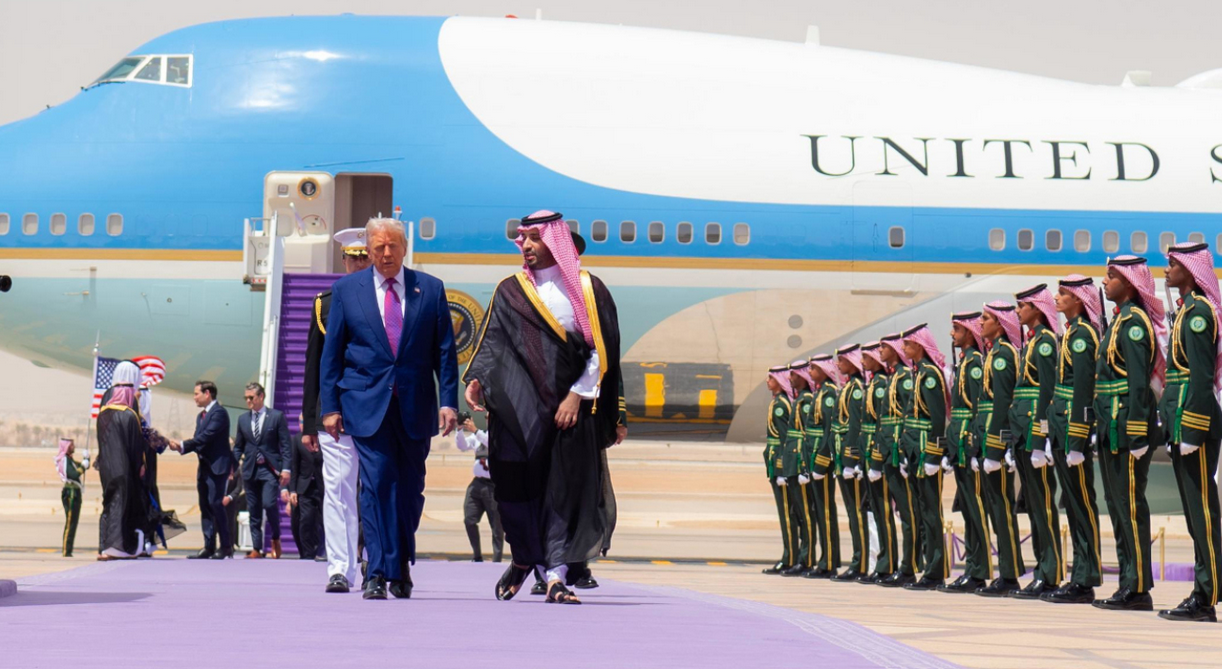
U.S. President Donald Trump arrived in Saudi Arabia, the first stop of his four-day tour of the Gulf region, which will focus more on economic deals than on the security crises plaguing the area—from the war in Gaza to the escalating threat posed by Iran’s nuclear program.
Accompanied by powerful business leaders, including Tesla CEO and close associate Elon Musk, Trump first visits Riyadh, where the U.S.-Saudi Arabia Investment Forum is being held. Tomorrow, Wednesday, he will travel to Qatar, and on Thursday, to the United Arab Emirates.
Trumpets blared as Donald Trump and Saudi Crown Prince Mohammed bin Salman walked across an outdoor purple carpet to stand under a pavilion during the arrival ceremony at the Saudi Royal Court in Riyadh.
Trump saluted during the U.S. national anthem and then stood with his hands at his sides for the Saudi national anthem. Later, he spoke with several Saudi royals.
Afterward, a cavalry unit escorted Trump’s presidential limousine to the Al-Yamamah Palace in Riyadh.
Crown Prince Mohammed bin Salman welcomed the CEOs of major technology companies at the royal palace in Riyadh as part of his meeting with U.S. President Donald Trump.
Standing beside Trump, bin Salman spoke with Tesla CEO Elon Musk, Nvidia CEO Jensen Huang, and OpenAI chief Sam Altman.
The business leaders are expected to participate in a joint U.S.-Saudi investment forum.
The American president has also stated that he may visit Turkey on Thursday, where a possible meeting between Russian President Vladimir Putin and his Ukrainian counterpart Volodymyr Zelensky may take place. This is Trump’s second trip abroad since assuming the presidency for a second term—the first being his visit to Rome for Pope Francis’s funeral—and it comes at a time of heightened geopolitical tensions.
Trump and the Geopolitical Chessboard of the Middle East
Beyond his pressure to end the war in Ukraine, the Trump administration is pushing for a new aid mechanism for war-torn Gaza and is calling on Israeli Prime Minister Benjamin Netanyahu to agree to a ceasefire in the region.
Over the weekend, American and Iranian negotiators met in Oman to discuss a possible agreement regarding Tehran’s nuclear program. Trump has threatened military action against Iran if diplomacy fails.
However, aside from the potential visit to Turkey, these issues are not the focus of Trump’s current Middle East tour, as it is presently scheduled.
The U.S., Saudi Arabia, Qatar, and the United Arab Emirates are expected to announce investments potentially amounting to trillions of dollars. Saudi Arabia already committed in January to investing $600 billion in the U.S. over the next four years, but Trump has stated he will push for that figure to reach one trillion dollars.
Alongside Elon Musk, other business leaders on the Middle East tour include BlackRock CEO Larry Fink and Citigroup CEO Jane Fraser. Secretary of State and National Security Advisor Marco Rubio and Defense Secretary Pete Hegseth are also accompanying the president.
While in Riyadh, Trump is expected to propose a defense deal to Saudi Arabia exceeding $100 billion, according to sources cited by Reuters. The deal may include a range of advanced weapons systems, including C-130 transport aircraft.
The U.S. and Saudi Arabia are expected to avoid discussing the normalization of Riyadh-Israel relations, according to Reuters sources, despite this being one of Trump’s longest-standing geopolitical goals in the region.
Trump’s envoy to the Middle East, Steve Witkoff, said last week he expects progress on the Abraham Accords—a series of agreements brokered during Trump’s first term under which Arab states, including the UAE, Bahrain, Sudan, and Morocco, recognized Israel.
However, Netanyahu’s refusal to end the war in Gaza or to support the creation of a Palestinian state makes progress in talks with Riyadh unlikely, sources told Reuters. Talks at Trump’s second and third stops—Qatar and the UAE—are also expected to focus on economic issues.
The Qatari royal family is reportedly planning to gift Trump a luxurious Boeing 747-8 aircraft, which will be converted for use as a presidential plane (Air Force One). The gesture has sparked controversy, as the U.S. Constitution prohibits officials from accepting gifts from “any king, prince, or foreign state.” Trump has said that after his term ends, he will donate the aircraft to his presidential library foundation.
Ask me anything
Explore related questions




