





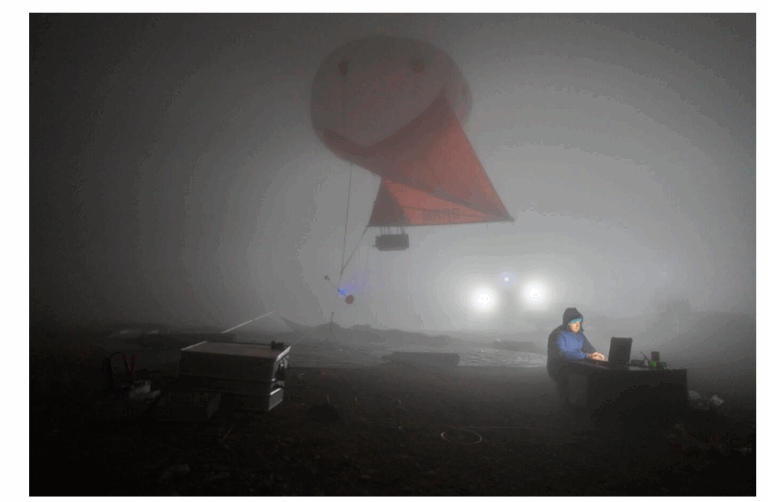
The demanding yet captivating fieldwork of scientists is the theme of the “Scientist at Work” photography contest organized by the journal Nature for the sixth consecutive year. Among the six winners of this year’s competition is a photograph capturing atmospheric measurements conducted under tough weather conditions by a Swiss research team on Helmos Mountain in the Peloponnese.
Lionel Favre, along with his team from the Laboratory for Extreme Environment Research at the Swiss Federal Institute of Technology (EPFL), participates in the European research project CleanCloud, funded by Horizon Europe. The project aims to better understand cloud formation across the continent and how clouds, even in remote areas, respond to pollution changes. One of the measurement sites is Helmos Mountain in the Peloponnese. There, researchers involved in the fieldwork titled “Chopin” had to wait nearly a month in disappointingly mild weather before clouds finally started forming for their measurements. When that moment arrived, they set up their equipment at the measurement site and began flights with a tethered weather balloon. In total, eight flights lasting several hours each were carried out.
A striking scene on November 5, 2024, shows colleague Michael Lonardi handling the weather balloon amid the fog, prompting him to raise his camera to capture the scene. This photograph was among the six recognized in the Nature competition.
In an interview with the Athens-Macedonian News Agency (AMNA), Lionel Favre describes the moment he captured as “magical.” He recalls, “It was a truly exhausting day because handling a weather balloon in low visibility is difficult; you have to ensure that the tether doesn’t get caught or break, and that all instruments are functioning properly.”
Despite the hardships, he shares that “we were really happy to fly in these conditions, because fog and low clouds are exactly what we’re looking for. We waited for this kind of weather for almost three weeks under the blue sky until we finally had some low clouds approaching Helmos Mountain.”
The scientist depicted in the photo, also from the same team, Michael Lonardi, emphasizes to the Greek News Agency (AMNA) that “in environmental science, experiments often take place in the most realistic laboratory we have—nature itself. We become part of the experiment as we see atmospheric processes unfold before us, observing a cloud form where there was just blue sky minutes earlier. I find this absolutely fascinating. Sometimes it can be exhausting, dealing with low temperatures and long working days to collect what might seem like just a bunch of numbers, but that’s also the challenge that motivates us as we seek to understand our planet.”
He adds that working in mountainous environments “is challenging due to the weather phenomena we want to observe. For example, sudden wind changes pose potential safety risks to our system. Our project partners faced the challenge of maintaining instruments during the winter months, reaching the mountain station despite snow cover.”
The CleanCloud research project
CleanCloud involves researchers from 20 institutions across twelve European countries. The goal is to understand and quantify the spatial and temporal impacts of aerosol-cloud interactions through a combination of in situ and remote sensing measurements, laboratory studies, and weather simulations. The fieldwork on Helmos Mountain is coordinated by Athanasios Nenes, professor of atmospheric processes at EPFL, visiting professor at the University of Patras, and researcher at the Institute of Chemical Engineering Sciences (FORTH/ICE) in Patras. From the same research organization, the Extreme Environment Research Laboratory team, led by Professor Julia Schmale, contributed by developing the weather balloon used to study the lower troposphere for detecting aerosol particles and cloud droplets.
As Michael Lonardi explains, Helmos was chosen because “it lies at an interesting crossroads between air masses transported through the Balkan Peninsula and maritime air masses from the Mediterranean Sea. These air masses carry particles of anthropogenic origin, natural sea salt, and Saharan dust, allowing us to explore the role of various particles in cloud formation.”
He also notes that “there is a long-standing atmospheric data monitoring station operated by Greece’s National Centre for Scientific Research ‘Demokritos’ on Helmos, which is an incredible asset for advancing research by providing data on the long-term evolution of phenomena and microparticle concentrations, whereas our study captured just a moment in time. Additionally, conducting extensive field measurements requires significant logistical infrastructure, so Demokritos’ experience has been essential for achieving our goals.” It’s worth mentioning that similar measurements for CleanCloud were also conducted in northern Greenland.
This particular photo from Helmos was one of the six awarded in this year’s “Scientist at Work” competition by Nature. Over 200 entries were submitted. The overall winner was a photo by doctoral student Emma Voggel from the University of Tromsø, showing biologist Audun Rikardsen braving the rough waves to locate whales in a fjord in northern Norway. Other recognized images include microscopic frogs in California, a telescope at the South Pole, drilling into an ice core in the Norwegian Svalbard archipelago, and the silhouette of a scientist entering a cabin under a starry sky.
Ask me anything
Explore related questions




