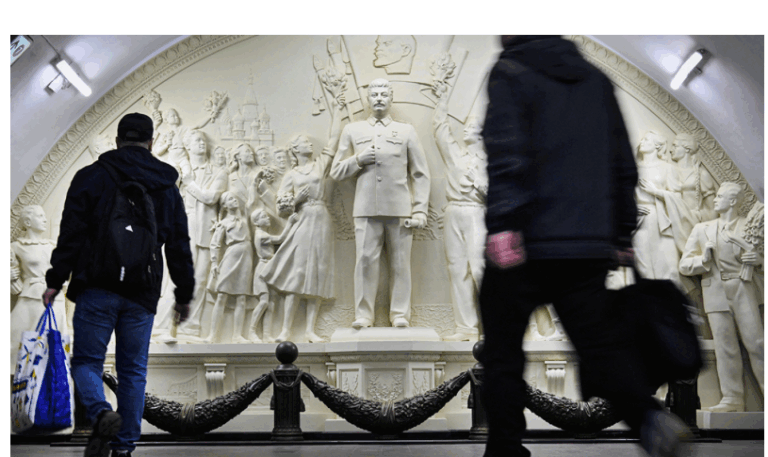
A Stalin monument has been reinstalled in the Moscow metro, amid a patriotic mobilization that lauds the strength of the USSR—fuelled by the Kremlin to support the attack on Ukraine, reports the French Agency (AFP).
The monument, located in a corridor connecting two lines at Taganskaya station, is a bas-relief depicting men, women, and children holding flowers and surrounding a sculpture of Stalin (1878–1953), which is mounted on a pedestal.
In a press release issued on Saturday, it is stated that this is a replica of a bas-relief that was present at the same station until 1966. It is also noted that the bas-relief was originally dedicated to the USSR’s victory in World War II.
Stalin, who remained in power from the late 1920s until his death in 1953, led massive repressions resulting in millions of deaths. However, in Russia, his memory remains ambiguous.
In recent years, several monuments in his honor have reappeared nationwide, often based on private initiatives and placed in less prominent locations.
The bas-relief on the pedestal is titled “The People’s Gratitude to the Military Leader.” Soviet architecture scholar Alexander Zinovie points out that this bas-relief is almost entirely a repeat of a previous relief, but it is not an exact copy of the sculpture titled “The People’s Gratitude to the Military Leader,” which was destroyed nearly 60 years ago during de-Stalinization.
While Russian President Vladimir Putin has occasionally condemned Stalin’s crimes, the Kremlin’s general stance has been to downplay them, and victims of Stalinist purges are scarcely mentioned in history textbooks.
Stalin is primarily presented as a hero of WWII and the defeat of Nazism, with an emphasis on the USSR’s military strength—especially after the invasion of Ukraine, where the Kremlin claims to be fighting “neo-Nazis.”
Critics of this approach are targeted by authorities. The Memorial organization, the most significant NGO documenting both Soviet and current government repression, was banned in late 2021.
The liberal opposition party “Yabloko,” which remains legally recognized but severely weakened, condemned the monument installed in the Moscow metro.
“The return of Stalinist symbols to Moscow discredits history, mocks the descendants of repression victims, and is a shame for Moscow,” the party stated in a release.
Conversely, the Communist Party of the Russian Federation described the restoration of the monument in the Moscow metro as “restoration of historical justice.” It also expressed hope that monuments honoring Stalin will appear in other parts of Moscow.
Most of the many Stalin monuments, which were objects of personality cult, were removed during the “de-Stalinization” period following his death and later after the collapse of the USSR in 1991.
Ask me anything
Explore related questions