





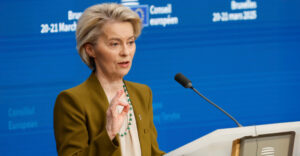
The Ursula von der Leyen has announced that the European Union is moving to prepare a new package of sanctions against the Kremlin as talks between Russia and Ukraine appear to be making no real progress.
The European Commission president, speaking to reporters on her arrival at the European Political Community meeting in Tirana, said that “we want peace and we need to put pressure”, stressing the need for tough measures.
New targeted sanctions on energy and banks
Von der Leyen revealed that the new sanctions being considered by the EU are more ambitious than the measures adopted on Wednesday, focusing on critical sectors of the Russian economy. The proposals include restrictions on the Nord Stream gas pipelines linking Russia to Europe, the banking sector and the so-called “shadow fleet” of old ships with questionable ownership and unclear insurance coverage that Moscow uses to circumvent sanctions on oil. In addition, the Commission intends to consider lowering the price cap for Russian crude oil, which is set at the G7 level.
Although targeting Russia’s energy and banking industries could have significant implications for the Kremlin, EU diplomats express reservations about implementing these measures, as they are expected to face resistance from Hungary. “These measures will have a real impact, but their adoption will be difficult due to Hungary’s objections,” an EU diplomat told Politico.
Working with the US on sanctions
Asked by Politico whether the US supports this new wave of sanctions, von der Leyen confirmed that she is in close contact with Republican Senator Lindsey Graham, a known critic of Russian President Vladimir Putin. Graham has proposed imposing 500% tariffs on Russia, which von der Leyen described as a “coordinated approach.”
Although Graham is a close ally of Donald Trump, the US president has yet to publicly state whether he intends to support such tough measures against Russia. On Thursday, Trump told reporters that there would be no progress toward peace in Ukraine unless he met with Putin, while long-awaited talks between Russia and Ukraine in Turkey appear to be falling apart as the Russian president sent a lower-level delegation instead of attending in person.
NATO Secretary General Mark Rutte, upon his arrival in Tirana, described Putin’s decision not to personally participate in the negotiationsas a “mistake”, while EU High Representative Kaya Callas, accused Moscow of “playing games.” “We see clearly that Russia does not want peace, while everyone else wants it,” Callas said on her arrival at the summit hosted by Albanian Prime Minister Edi Rama.
Ask me anything
Explore related questions




