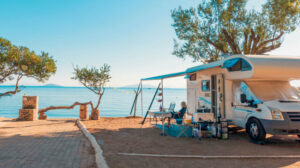
“Greece is putting an end to our caravans,” writes a German newspaper headline. The new law, which essentially puts a brake on vacations with motorhomes or campers, was recently revealed after the first fine was issued to three caravan owners who parked in Akrata. The law, passed last January and which effectively bans parking of motorhomes outside designated areas, has caused a “war,” with some arguing that freedom in vacations is restricted and alternative tourism is harmed, while others claim the regulation was necessary to protect areas from pollution and reckless behavior.
Fines
The new legislation for caravans and camper vans (motorhomes) enacted by Law 5170/2025 slows down uncontrolled parking and stays outside organized areas. According to the new framework, setting up tents and parking motorhomes or trailers in archaeological sites, beaches, forested areas, and generally in public spaces is prohibited, with restrictions also applying to hosting caravans on private properties. Violations are fined €300 per vehicle or person, with possible imprisonment up to three months. Exceptions exist for parking on highways (for obvious rest reasons) and free parking on private land (but not for more than one motorhome).
The Greek Camper Association (ELAT) characterizes the regulation as “absurd and disproportionate,” arguing that it restricts freedom of movement and stay by banning even simple parking in public spaces like municipal parking lots, without considering the specifics of motorhomes. Conversely, the Ministry of Tourism states that the sole goal of the regulation is to protect the environment, the safety of citizens and visitors, and public health, preventing the abusive use of public spaces by caravans and motorhomes, while also enhancing legality and the quality of travel experiences.
“Way of Life”
“Motorhome is a way of life. It’s culture,” say owners of campers, members of ELAT, explaining that those who accuse camper owners of polluting are wrong. “On the contrary, we clean the areas because we love nature. We do not leave trash, and we pick up any trash where we park. Our vehicles have chemical toilets.” This very culture, say camper owners, is being undermined by this law, which practically allows parking only in campsites, with fines ranging from €300 to €3,000 and even up to three months in prison for violations.
The idea of investing in such a vehicle, costing between €50,000 and €300,000, is for touring. The freedom to move with one’s mobile accommodation wherever one wishes, enjoying different destinations without renting tourist accommodations. More so, to enjoy the journey, the trip, and the destination with friends of choice, without mingling with strangers.
In Greece, it is estimated there are just over 2,000 caravans, with ELAT having 530 members. Especially in summer, the number of campers almost doubles with tourists arriving with their own or rented motorhomes from abroad, mainly from Germany, Austria, France, and Italy. It is estimated that this summer, 50,000 tourists planned to visit Greece with campers, with industry officials estimating that a large portion will head to neighboring countries (Albania, Croatia, etc.), where there are no restrictions on parking motorhomes.
Closing
This is one side. The other involves beaches being occupied by caravan and camper owners, mainly from abroad, for holidays, all heading to specific destinations. This causes disturbance to local communities and often blocks access for other tourists, along with environmental pollution from trash. Is this permitted? Since 2012, a relevant law clarified that parking of motorhomes on beaches, forest edges, and archaeological sites is forbidden. So, if those parking on beaches and in forests are illegal, what is new that caused reactions?
Reactions
“We don’t want to stay on beaches. That’s not our issue,” say owners of motorhomes. “We want to be able to park where cars can. No discrimination. We ask to park in municipal parking lots. To visit archaeological sites. Imagine wanting to go to Epidaurus to see the ancient theater and being unable to park.”
Greek camper owners call for the application of European practices. They state that in many European countries, e.g., Germany, there are designated camper parking areas on roads, often with amenities like electricity.
The main issue, say owners, is parking and stopping. Although campers are subject to the Traffic Code (KOK) and pay taxes like other vehicles (road tax, luxury tax, registration fees), the new law exempts them from such regulations. They cannot park (like a car) for 24 hours in one place.
Legal explanations clarify that this was done to prevent the use of a legal “loophole” that allowed parking on beaches and other sensitive areas if it appeared as casual parking without setup like tents or chairs, thus avoiding legal restrictions. Before 2012, if owners did not set up tents or make parking look “permanent,” police could not act against illegal parking. Now, with the new regulation, parking in these areas becomes impossible, as campers can only park in campsites. “This kills alternative tourism and deprives local communities of income,” say camper owners.
ELAT is even considering protests with their vehicles and has informed the European federation (FICN), planning legal action to challenge the new law and advocate for better infrastructure for travelers with motorhomes.
Recklessness
The “detail” that makes the difference is that this regulation was prompted by complaints and reports from municipal services about violations exceeding reckless behavior. For example, in Kavala, in the Sarakina beach area, over 70 caravans were found on nearby properties without permits, with issues of pollution and illegal waste disposal. Similarly, in Kalyves, Chalkidiki, police found tourists with makeshift toilets they dug on the beach.
The Ministry of Tourism clarifies that Law 5170/2025 “legislates the obvious,” protecting public health and safety, as in other civilized countries. It prohibits the abusive use of public and protected areas by caravans and motorhomes, ensuring legality and environmental protection.
It emphasizes that travelers with caravans can park in organized campsites that meet health and safety standards, ending illegal occupation of forests, beaches, archaeological sites, and common spaces.
Furthermore, the regulation aligns with previous laws (Articles 10 of Law 392/1976 and 7 of Law 4276/2014), which prohibit setting up tents or parking caravans in archaeological sites, beaches, forest edges, and public spaces, with the exception of a single caravan in private property.
Additionally, parking is permitted under the provisions of Article 34 of the Traffic Code (since 1999), which states that parking of trailers, caravans, and boats in residential areas is forbidden beyond 24 hours, but they can be parked in suitable enclosed areas designated by local authorities.
Finally, free parking of one caravan (for hosting) is allowed; further use of the space requires a business license, thus preventing illegal commercial activities.
The Ministry of Tourism continues to work, based on legality, to ensure quality travel experiences and to protect and upgrade the country’s destinations.
International Practices
Europe is divided regarding motorhomes. While most of the continent restricts free camping or limits it severely, there are provisions for camper parking.
In Scandinavian countries like Sweden, Norway, and Finland, the right to access nature freely applies, including overnight stays on private land under environmental and resident respect conditions. Some countries, like Spain and France, allow parking similar to Greece’s previous practice, provided campers don’t extend beyond the vehicle and don’t cause pollution.
Countries like Germany, France, Switzerland, and Austria generally ban free camping. Italy, Spain, and Portugal also restrict free camping, especially in tourist areas and protected zones.
Poland and Romania are more flexible, allowing stays in non-protected areas unless prohibited by signs. Czechia, Slovakia, and Hungary generally ban free camping with strict controls in tourist zones. Scotland has the “right to roam,” allowing camping in natural areas with environmental respect, while in England and Wales, free camping is generally prohibited unless explicitly permitted by landowners.
Ask me anything
Explore related questions