





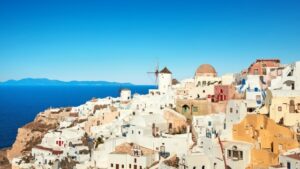
Greece’s tourism sector is sending positive signals for 2025, confirming its momentum even amid an environment of high uncertainty.
According to a new report by the Economic Analysis Division of the National Bank of Greece, the sector’s performance remains on an upward path, with air arrivals increasing by 10% in the first four months of the year and scheduled air seats for the May–October period rising by 4%.
Optimism is further supported by rising hotel expectation indicators. Specifically, the future activity index surpasses that of Mediterranean competitors (January–April: 45 points compared to 7 points above the long-term average). Employment figures are also positive, with the first quarter of the year closing with 27,000 net hires.
Small and medium-sized hotel enterprises (SMEs) expect a 5% increase in arrivals in 2025 (compared to a 10% increase in 2024). In this light, it is estimated that in 2025 Greek tourism could achieve a performance of 3%-5% (in line with the projected global tourism trend), continuing its upward trend of recent years despite the temporary “shock” caused by seismic activity in the Cyclades in February.
As noted in the NBG report, these expectations are accompanied by uncertainty, as international geopolitical and economic developments affect the willingness to spend on travel (e.g., the consumer confidence index in key European source markets—France, Germany, UK, Italy, Spain, and the Netherlands—is five points below the long-term average). With Greek tourism continuing its upward performance in terms of arrivals (+63% in the period 2013–2024), the focus is now shifting from breaking records to a new growth model.
The Importance of Long-Haul Source Markets
A key element in the medium-term strategy of outward orientation is Greece’s investment in so-called “long-haul” markets such as the USA and China. A coordinated strategy to attract tourists from distant markets is expected to enable Greece to increase arrivals and transition to a new tourism model with lower seasonality and higher spending per arrival—leveraging the qualitative characteristics of long-haul markets.
Recent winter performance:
- Maintained the trend of reduced arrival seasonality (+9% annually vs. +6% annually in summer 2024),
- Increased Greece’s share in the Mediterranean market (2.5% from 2.4% in winter 2024),
- Confirmed the positive trend in source markets.
In particular, higher momentum was recorded in arrivals from the USA (+33%)—a traditional long-haul market for Greek tourism—which contributed one-fifth of the increase. The U.S. market stands out compared to other “traditional” European markets for:
- Better seasonality profile, with half of tourists arriving outside the summer (vs. one-third for other markets),
- Double the spending per arrival compared to other markets, which even rose by 19% (real annual terms) in winter 2025—largely offsetting the 5% drop in major European markets (France, Germany, and the UK).
Catalyst: Strengthening of Air Connections
This outlook is boosted by the expansion of direct and indirect air connections with long-haul markets such as the U.S. (reaching about 100 flights/week in summer 2025, nearly double pre-pandemic levels) and China (about 12 flights/week in summer 2025, nearly triple pre-pandemic levels). The addition of new Chinese departure points not only exceeds 2019 performance but also strategically positions Greek tourism to capitalize on the strong momentum from this market over the next decade (nearly half of the new wave of tourists to Europe is expected to come from Asia).
Resilience of “Mature” Tourist Destinations
As new trends in tourism demand emerge from rising markets, the report analyzes how individual tourist destinations are responding to current challenges. The National Bank’s recent sectoral survey—conducted for the third consecutive year on a sample of 200 hotel SMEs—reveals a “two-speed” picture, with more “mature” tourist destinations showing higher mobility.
Focusing on the broader financial picture, mature tourist destinations (Aegean and Halkidiki) show greater resilience. While acknowledging the intense pressure the global situation exerts on the sector (79% vs. 91% overall), they are more optimistic about the future, exceeding in indicators like future demand (64 points vs. 38) and future growth ambitions (70% of businesses targeting growth vs. 49%).
This advantage is linked to their strategic investment choices over the past three years, focusing on business expansion. These SMEs stood out for:
- Higher investment activity (70% vs. 58% in the sector),
- Larger share of sales allocated to investments (21% vs. 16%),
- More emphasis on increasing resilience, with 31% aiming to scale up and 15% developing partnerships (clusters), compared to just 11% and 4%, respectively, among other SMEs.
Furthermore, these SMEs, despite already being more active in past investments, are more aware of the need for additional future investment. Specifically, 34% stated their implemented investments were lower than required (vs. 10% in other regions), with implementation delays cited as a major reason (22%).
Alignment with New Tourism Trends is Essential
Investment activity in mature destinations isn’t limited to scaling up but also aims to prepare businesses for new consumer trends in the sector.
Greek hotel SMEs recognize growing customer interest in:
- Digital services (72%)
- Local activities (61%) and products (59%)
- Environmental impact of accommodations (49%)
Hotel SMEs in mature regions have been more proactive in addressing these preferences over the last two years. For example:
- 59% implemented digital marketing actions (vs. 36% in other regions),
- 49% partnered with local businesses (vs. 28%),
- Resulting in a more comprehensive tourist experience enriched with local features (nature, gastronomy, culture),
- 54% implemented energy efficiency upgrades (vs. 25% in other regions).
As global tourism evolves due to changing traveler preferences and the rise of new markets, regional disparities in investment intensity are widening the gap between mature and other tourist destinations.
The Profile of the Modern Tourist Is Changing
The modern traveler is seeking authentic experiences and sustainable practices. Businesses that successfully incorporate these preferences are likely to play a leading role in shaping the country’s new tourism development model.
Ask me anything
Explore related questions




