





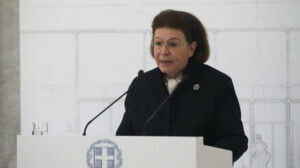
“The Ministry of Culture is fully aware of the enormous responsibility it bears—namely, the protection of cultural heritage—and has taken all the appropriate actions. At this point, the goal of inclusion on the World Heritage List must be a national one, and it must be singular. And it must be shared. And what is that goal? The Minoan Civilization must be highlighted and internationally established for what it truly is: The dawn of Western civilization,” said Lina Mendoni in Parliament.
The Minister of Culture was responding to the topical question posed by PASOK–Movement for Change MP, Fragkiskos Parasyris, titled “Knossos and the necessary conservation and restoration works,” and she noted that “on May 17, 2025, Knossos was struck by 9 Beaufort wind gusts in the form of a whirlwind. The Queen’s Megaron, where the replica of the fresco is located, is inaccessible. That is, it is closed to the public, but not to the winds. The Queen’s Megaron has large openings around its perimeter—the polythyra—facing outdoor spaces, as well as an open light well, through which strong air currents are created. Anyone who has visited the palace knows this, as the Megaron lies along the visitor path descending into the eastern wing.”
She emphasized that “the royal apartments, the King’s and Queen’s Megarons, are part of the palace and have been closed to the public since the 1980s.” Lina Mendoni stated that “the restoration of the King’s Megaron was completed with funding from the Crete Regional Operational Program under NSRF 2014–2020. The project was incorporated in September 2019, during our administration, with a budget of €1,000,000 and the Heraklion Ephorate of Antiquities as the implementing authority.”
“In 2019, when we assumed office, there were no mature studies for Knossos. A race against time and coordinated efforts followed to prepare the studies, with a budget of €350,000 from Ministry of Culture funds. Restoration studies for a monument are no simple matter. Scientific and epistemological issues must be resolved during the drafting process, and of course, the monument itself often dictates the timeline,” the minister stressed, noting that “the competent services of the Ministry of Culture developed a comprehensive set of studies that enable funding of corresponding works under NSRF 2021–2027. Moreover, during the current programming period, in excellent collaboration with the Region of Crete, we developed a strategy for an Integrated Territorial Investment involving emblematic routes in Crete, with the main objective of enhancing visitor experience at Minoan palace centers, focusing on Knossos, Phaistos, and Malia.”
As Lina Mendoni informed, €900,000 is secured from the Crete ROP NSRF 2014–2020, while €8 million has been secured from the integrated territorial investment for the following projects:
– Reception buildings and upgraded entrance areas to the archaeological site of the Minoan palace of Knossos (budget: €3,300,000)
– Restoration and enhancement of the Queen’s Megaron and visitor paths (budget: €1,800,000)
– Installation of a permanent water supply and fire protection network (budget: €2,000,000)
Simultaneously, under the Recovery and Resilience Fund, the project “National strategy for adapting the protection of cultural heritage monuments to the effects of climate change” is being completed, with a budget of €2,000,000, and includes Knossos. Also funded by the Recovery Fund is the project “systems for recording and monitoring the impact of climate change on the microenvironmental conditions for the preservation of monument materials,” with a budget of €2,500,000. Monitoring systems have already been installed at Knossos as part of this project. With €750,000 from the Recovery Fund, the total renovation and upgrade of the souvenir shop—operational since May 2024—was completed. Since April 2024, visitor zones using e-ticketing have been implemented and have significantly improved visitor flow management.
Finally, responding to part of the PASOK MP’s question regarding the programmatic agreement with the Region of Crete signed in 2019, Lina Mendoni said:
“Indeed, in April 2019, a Programmatic Agreement was signed with the Region of Crete, with a budget of €140,000. However, due to an error in the drafting of the agreement on the part of the Ministry of Culture, which created incompatibility with the institutional framework at the time, the agreement could not proceed, and only €38,500 of the allocated budget was absorbed. In order to advance the preparation of the nomination dossier, the Ministry of Culture allocated €145,000 from its own budget. The project began on November 30, 2020, and was completed on September 30, 2023.”
“All this,” the minister concluded, “so that ‘Caesar is given what is Caesar’s’, and to dispel any misconceptions.”
Ask me anything
Explore related questions




