





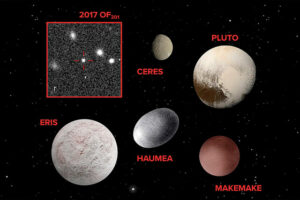
For years, scientists have been engaged in the hunt for the mysterious “ninth planet”. Instead, they believe they have discovered a new dwarf planet on the edge of our solar system.
The icy rocks found in the Kuiper Belt, beyond Neptune, all tend to follow a certain orbit together. Twenty years ago, astronomers theorized that this phenomenon was due to the gravitational pull of a “ninth planet” that could have a mass ten times that of Earth and until now has been hidden from all observers.
In exploring this mysterious world, whose existence is a matter of debate, three American astronomers claim to have discovered a new “candidate” for the title of “dwarf planet”. The object, dubbed 2017 OF201, is about 700 kilometers in diameter, according to a preliminary study released last week and has yet to be examined by other experts. It is three times smaller than Pluto, but large enough to be included in the category of “dwarf planets”, the study’s lead author, Shihao Cheng of the New Jersey Institute for Advanced Studies in the US, told Agence France-Presse.
The object is at three times the distance from Earth compared to Neptune. However, due to its extremely ellipsoidal orbit, it reaches as far as the Oort cloud, at the outer limits of our solar system, at a distance of 1,600 times the distance of the Earth from the Sun. On this 25,000-year journey, the object can be observed from Earth only 0.5% of the time, or about a century.
“It’s becoming more and more elusive,” noted Cheng, who said the discovery suggests there could be “many hundreds of similar objects in similar orbits” in the Kuiper belt.
Researchers are now asking for more time to point the James Webb, Hubble and Alma telescopes toward their discovery.
A 23-year-old amateur observer from California, Sam Dean, had already managed to track the dwarf planet based on old databases. “OF201 is, in my opinion, probably one of the most interesting discoveries in our solar system in a decade,” he told Agence France-Presse.
Pluto was discovered in 1930 and for a time carried the title of the “ninth planet” of the solar system. However, in 2006 it was demoted to dwarf planet because of its small size – it is smaller than our own Moon. There are four other “dwarf” planets in the solar system: Ceres, Eris, Haumea and Makemake.
When researchers studied the orbit of 2017 OF201, they found that it does not follow the trend of similar objects in the Kuiper belt. This could cast doubt on the hypothesis of the existence of a ninth planet. Cheng stressed that additional data is needed for this reason.
This “astonishing discovery” and others like it mean that the original hypothesis of a ninth planet is getting further and further away, Samantha Lauer, a researcher at Canada’s Regina University, assessed for her part.
“We live in an age when large telescopes can almost see the edge of space” but “our own backyard” remains a mystery, noted Cheng, who hopes to get some answers thanks to the Vera Rubin Observatory, which will open this year in Chile.
Ask me anything
Explore related questions




