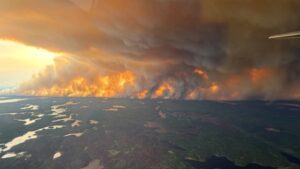
Saskatchewan (west) yesterday (Thursday) became the second Canadian province to declare a state of emergency due to wildfires, following Manitoba (central), where the day before, authorities ordered 17,000 people to be evacuated from their homes in a hurry.
“We are facing a very serious situation,” Scott Mow, the provincial premier in Saskatchewan, explained during a news conference.
Some 4,000 provincial residents were hastily evacuated from their homes at the beginning of the week, and, with no rainfall expected, “we are taking all possible measures to prepare our communities,” he said. “The weather forecasts are not good. It looks like the situation will get even worse,” he added.
Manitoba, which is experiencing its worst start to the wildfire season in years, declared a state of emergency the day before Wednesday and ordered the hasty evacuation of residents of several small communities.
In two isolated indigenous communities in the north, “air force aircraft” were “deployed” to “evacuate people in a hurry,” Canadian emergency management minister Elinor Olshevski said yesterday.
Large numbers of people who had to flee their homes arrived by road in Winnipeg, the provincial capital, after a long overnight drive.
People “are exhausted,” said Luke Mullinter, a Red Cross official in Manitoba. “They’ve travelled far from home and they don’t know if they’ll find it again when they return, or if and when they’ll be able to return,” he added.
The mayor of Flynn Flon, a mining town of about 5,000 people about half a mile north of Winnipeg, said yesterday afternoon that the last bus was preparing to leave while the flames were only 500 metres from the community boundary.
The situation “is very tense,” Mayor George Fontaine told Agence France-Presse. Firefighters were trying to contain the blaze, but “visibility is very poor because of the smoke, and it is impossible” for firefighting aircraft to operate, he explained.
According to forecasts by Canadian authorities, the current wildfire season may be “above normal” in central and western Canada in June and July and “well above average” in August, particularly because of the severe to extreme drought that continues to affect sectors of the country, much of which is covered by forests and vegetated areas.
Ask me anything
Explore related questions