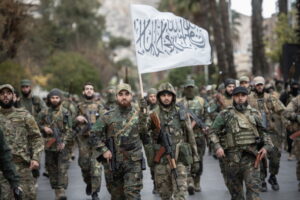
The United States has approved the new Syrian leadership’s plan to integrate thousands of foreign jihadists, former rebel fighters, into the national army on condition that it does so transparently, the president’s special envoy Donald Trump said.
Three Syrian defense officials said that under this plan, about 3,500 foreign fighters, mostly Uighurs from China and neighboring countries, would join a newly formed unit, the 84th Division, which would also include Syrian soldiers.
When asked by Reuters if Washington approves of foreign fighters joining the new Syrian army, Thomas Barak, the US ambassador to Turkey and Trump’s special envoy for Syria, replied, “I would say there is an agreement, transparently.”
According to Barak, it is preferable that these fighters, many of whom are “very loyal” to the new Syrian administration, join a state project rather than be excluded.
The fate of foreigners who joined the Hayat Tahrir al-Sham rebels during Syria’s 13-year civil war has been one of the issues considered a “thorn in the side” of Damascus’ rapprochement with the West since the overthrow of Bashar al-Assad’s regime last December. Hayat Tahrir al-Sham (HTS) was once an offshoot of al-Qaeda. At least until early May, the US demanded that the new Syrian government exclude foreign fighters from the security forces. But Washington’s stance on Syria changed completely after Trump’s Middle East tour last month. The US president agreed to lift sanctions on Syria, met with interim President Ahmed al-Saraa in Riyadh and appointed Barak, a close friend, as special envoy for Syria.
Two sources close to Syria’s defence ministry told Reuters that Sharaa and his associates were arguing to their Western interlocutors that incorporating foreign former rebels into the army would pose less of a security risk than abandoning them, which could lead them into the arms of al-Qaeda or Islamic State.
The State Department and a Syrian government spokesman did not respond to a request for comment.
China’s concerns
Thousands of foreign Sunni Muslims joined Syria’s rebels early in the civil war against Assad, who was backed by Iranian-backed Shiite militias. Some of these fighters formed their own groups while others joined organisations such as the Islamic State, which attempted to establish a “caliphate” in Syrian and Iraqi territory but eventually disintegrated, being attacked by US- or Iranian-backed forces.
HTS foreign fighters had a reputation as loyal, disciplined and experienced soldiers and formed the backbone of the organisation’s so-called “suicide units”. They fought the Islamic State and other factions of Al Qaeda after 2016, when HTS distanced itself from the organization founded by Osama bin Laden.
The Uighur militants from China and Central Asia are members of the Turkistan Islamic Party (TIP), an organization designated as terrorist by Beijing. A Syrian official and a foreign diplomat said China was seeking to ban the group’s influence in Syria.
“China hopes that Syria will resist all forms of terrorism and extremist forces in response to the international community’s concerns,” a Chinese Foreign Ministry spokesman said.
Osman Bughra, a TIP civilian official responded in writing to Reuters that the group has been officially disbanded and integrated into the Syrian army. “It operates fully under the orders of the defence ministry, adheres to national policy and has no ties with external entities or organisations,” he added.
In December, the appointment of foreign jihadists, former HTS leaders, to top positions in the armed forces alarmed Western governments. Demands to freeze these appointments and expel low-ranking foreign fighters were multiplying until Trump’s meeting with Sharaa. The latter has said that foreign fighters and their families may be given Syrian citizenship because of the role they played in toppling Assad.
Abbas Sharifa, an expert on jihadist organisations based in Damascus, said the fighters being integrated into the army have proven themselves loyal to Syria’s leadership and “ideologically filtered”. But “if we abandon them, they will fall prey to Islamic State or other radical groups,” he said.
Ask me anything
Explore related questions