





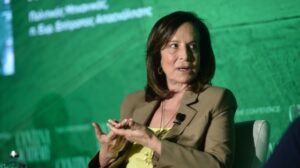
The need for a radical change in the country’s agricultural policy and the adoption of a national strategy based on the pillars of land management, digital transformation and halting the demographic collapse was discussed by Anna Diamantopoulou at the 2nd Cantina Academy, criticizing the shortcomings, delays and pathologies that – as she said – have led the Greek countryside to desolation and production to a dead end.
The former commissioner and minister, and current head of political strategic planning of PASOK, pointed out that the country is far behind both in the field of agricultural land management and in the use of digital tools. Citing the case of Ilia as an example, he referred to the draining of the Agoulinitsa lake in Krestena, which took place 70 years ago and has since created a framework of informal land rental, with the result that farmers – such as those producing peanuts in the region – cannot join programmes or invest with stability, as ownership regimes remain murky. At the same time, the population decline in many areas is rapid and alarming: 40% in Krestena, 70% in Pogoni, while in Drama, where agricultural land has been absorbed by photovoltaics, the decline is also reaching 40%.
Pharma, which has been planted in 40% of forests, has also been reduced by 40 %.
As Ms Diamantopoulou stressed, agricultural policy has never been a coherent national priority, and this chronological failure weighs on the entire political system. The Greek periphery is experiencing double pressure: on the one hand, the food industry shows remarkable dynamics, but on the other hand, the human and natural resources are running out. Although the Recovery Fund foresaw actions for green growth and digital transformation, only 18 projects have progressed,d while most remain inactive, with time pressing on.
The former minister was directly critical of the lack of continuity in government policies, questioning how it is possible to address contemporary challenges when a minister changes every nine months and a coherent national strategy is absent. In this context, she also commented on Hatzidakis’ statements on the water management strategy, saying that in Europe, annual reports have been presented since 2004, while in Greece, intentions are still being announced.
He also referred to important education and training programs for farmers, which have been legislated since 2014 but have not been implemented in any part of the country. He wondered why the available scientific potential, such as agronomists and veterinarians, is not being utilized, noting that there is a shortage of skilled personnel in the livestock sector, while the market is flooded with professionals for pets.
Ms Diamantopoulou stressed the need to renew the rural population, noting that with farmers over 65 years old and without technical training, the prospects are limited. She stressed that a new plan of education and support for young people is needed, through the creation of institutes and partnerships with universities. At the same time, he described reforestation and the concentration of agricultural land in exploitable and competitive areas as an absolute priority, breaking away from the fragmentary logic of 10-15 acres.
Referring to technological advances, she noted that new solutions are already entering agriculture, such as robots for harvesting, drones for irrigation and land monitoring, and tools that require investment and skilled human resources. He recalled, however, that in the country, subsidies have been largely consumed without strategic planning, and stressed that the crisis Greece went through should have taught us that we cannot continue in the same way.
Regarding OPEKEPE, he spoke of institutional distortion and administrative weakness, arguing that if full digital surveillance had been installed, there would not have been instances of circumvention such as those revealed with the breeding of lambs in Crete. He wondered why the government had not proceeded to reform the agency when the European Commission itself had judged that it could not continue to operate in its current form.
In closing, Anna Diamantopoulou stressed that the answer to the enduring culture of mismanagement is digital surveillance and accountability. She noted that for PASOK, agricultural production is a spearhead, as it is directly related to sufficiency, demographic reconstruction, and national resilience. He stressed the need for policies to boost large-scale farming, specialised programmes for areas with population collapse, and deep cuts in the cooperative model to create a new framework for cooperation. As he said, “co-operativism is necessary, but differently – otherwise, we simply cannot move forward.”
Ask me anything
Explore related questions




