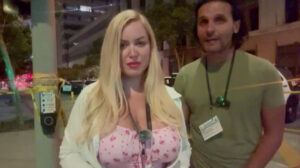
“It’s like living in lockdown again. No one is out. The streets are empty, the silence deafening,” say Vicky Dali and Marios Lazaridis, two Greek actors who live and work permanently in Los Angeles, speaking to protothema.gr. On the evening of Thursday, June 12, the two found themselves outside the city hall. The scene they witnessed directly recalled the strictest days of the pandemic: absolute calm, desolation, and police roadblocks in every direction. A curfew had been imposed from 8 p.m. to 6 a.m., and all freeway exits were closed. The city seemed “frozen.”
Vicky Dali, a Greek-American with law studies in Greece and acting studies at the Strasberg Theatre & Film Institute in Los Angeles, has participated in more than 30 film productions. Marios Lazaridis, a graduate of the Ivana Chubbuck acting school, has been working as an actor and singer in the US for over a decade. They live just three kilometers from the city center but describe an entirely different daily reality. “Even our neighborhood, which used to be full of life, now feels like a desert. You hear nothing. It’s like time has stopped.”
What Greeks in Los Angeles fear
Immigrant crackdowns in Los Angeles
The silent tension stems from Donald Trump’s tough immigration crackdown policies. As the second largest city in the US and a gateway for hundreds of thousands of immigrants — especially from Mexico and Latin American countries — Los Angeles lies at the heart of this policy shift. The state of California borders Mexico, and the flow of people trying to cross the border for a better future is constant. Among them are also Greeks who are currently in the process of obtaining residency permits. But now, they feel everything is up in the air.
Notices to students not to travel outside the US
Students, in particular, face greater insecurity. As Vicky and Marios mention, universities themselves have sent written notices to their students, explicitly advising them not to travel outside the US during the summer, as there is a serious risk they may not be allowed back into the country, even if they hold temporary permits. “The uncertainty is immense,” says Marios. “We live in a country where no one knows what will apply tomorrow. Every week something changes. Students, workers, artists awaiting legalization are afraid to move, to make plans, to go on vacation,” he adds.
The transformation of Los Angeles: ‘It’s not the same anymore’
Vicky adds that the problem is not only legal or administrative. It’s psychological and deeply social. “Los Angeles was a city that embraced diversity, built by immigrants, that offered opportunities. Now it seems to have lost its identity.” And indeed, what the two artists describe is not a temporary image but a gradual transformation that started, as they say, over the past five years for different reasons.
It all began with the coronavirus pandemic. The city experienced prolonged lockdowns and economic suffocation. Then came the massive wildfires that severely impacted many areas of California, causing damage, displacements, and a widespread sense of climate threat. And now, the third blow: the immigration tension, which has brought with it restrictive measures, inspections, and a social fatigue spreading through every neighborhood.
“Los Angeles is no longer the same. It has changed. It has lost its character,” says Vicky. “The American dream seems more and more distant. And society is divided. Not only ideologically, but also practically. Fear has entered everyday life. In the silence on the streets. In the neighbor’s glance. In the thought that tomorrow you might not be able to return home just because you took a trip to Greece.”
Marios agrees. “It’s no longer the land of opportunity. It’s a country wondering what it is. And we, as immigrants, are at the center of this search — or rather this identity crisis.”
Los Angeles, once shining as a global symbol of creativity, cinema, progress, and multicultural coexistence, is now experiencing an existential crisis. And the two Greek artists, from the streets of the city that became their second home, describe a state of silent isolation, social insecurity, and police surveillance, with an unknown end date.
Ask me anything
Explore related questions