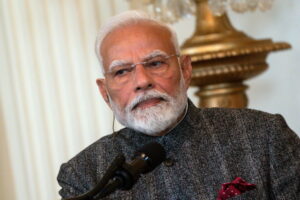
Against the backdrop of geopolitical turbulence in South Asia and the Eastern Mediterranean, Indian Prime Minister Narendra Modi is visiting Cyprus today. Although the visit may seem diplomatically routine, it carries a far more complex political and geostrategic significance. This is not simply a ceremonial stop in a Mediterranean island by one of the world’s most powerful leaders. It is Modi’s first visit to the Republic of Cyprus at a time when India seeks to boost its global influence and restructure geopolitical alignments.
Strong Political Symbolism
Narendra Modi will be welcomed at Larnaca airport by President Christodoulides, at a time when security measures in Cyprus are particularly tight due to the Israel-Iran crisis. From Cyprus, one can even see the flashes of missiles exchanged between the two countries. Meanwhile, Cyprus has activated special contingency plans to host civilians if necessary. Despite the tense situation and a recent tragic air accident in India, Modi has not altered his schedule.
Christodoulides and Modi will attend a roundtable in Limassol with business leaders from both countries, followed by an informal working dinner. Tomorrow, the Indian Prime Minister will receive an official welcome at the Presidential Palace in Nicosia, hold a private meeting with President Christodoulides, and will be awarded the Grand Cross of the Order of Makarios III.
There will be extended talks between the two delegations and a joint press conference. The discussions are expected to cover, among other things, bilateral relations and ways to further strengthen them, particularly in the areas of economy, trade, infrastructure, and investments. EU-India relations will also be addressed, as well as the India-Middle East-Europe Economic Corridor (IMEC), the situation in the Middle East and South Asia, and the latest developments on the Cyprus issue.
The Indian Prime Minister is also scheduled to speak at the University of Cyprus on the “historic relationship of two peoples with shared colonial experiences and aspirations for independence and progress.” Intergovernmental agreements will be signed for cooperation in various fields, and the establishment of an “Indo-Cypriot Strategic Cooperation Council” will be announced.
A Message to Ankara, via Nicosia
The visit has not gone unnoticed in Ankara. Modi’s presence in Cyprus is an indirect but clear response to President Erdoğan and his government, which have long supported Pakistan in all international forums, particularly regarding the Kashmir issue. In return, Islamabad supports Turkey’s rhetoric on the breakaway state in Northern Cyprus, frequently referring to the “Turkish Republic of Northern Cyprus,” despite not officially recognizing it.
Modi’s visit comes at a time when India is intensifying its campaign to internationally isolate Pakistan and counters Turkish-Pakistani ties by “diplomatic penetration” into regions of strategic importance for Turkey, with Cyprus being one of them.
For Ankara and the Turkish-occupied north, Modi’s visit is not only bothersome; it is almost offensive. The presence of the Indian leader on territory Turkey considers within its sphere of interest serves as a clear reminder of the legitimacy of the Republic of Cyprus and a rejection of any proposal for a “two-state solution” with recognition of the breakaway state.
India, a key UN member, BRICS nation, and nuclear power, sends a strong message that the Republic of Cyprus is the sole legitimate interlocutor on the island.
Geostrategic Interests
India’s interest in Cyprus is not merely symbolic. The island’s geographic location offers India a “gateway” to Europe, the Middle East, and North Africa as part of its strategic planning. Cyprus lies at the crossroads of sea routes that are important for the new Silk Road and the India-Europe axis via the Red Sea and the Mediterranean.
Moreover, the island is a hub for energy projects, and India is interested in accessing natural resources, investing in LNG infrastructure, and participating in European energy programs aimed at reducing dependency on Russian energy.
Added Value Due to EU Membership
It is no coincidence that Modi’s visit takes place just months before Cyprus assumes the Presidency of the EU Council in the first half of 2026. India sees Cyprus’s presidency as an opportunity to increase its political influence in Europe through a partner that can promote its interests within EU structures, without the geopolitical entanglements of larger countries such as France or Germany.
India seeks European recognition of its geopolitical role, particularly on trade, security, technology, and migration. In this context, Cyprus may serve as a “power multiplier” for India’s positions in Brussels.
In recent years, Cyprus has emerged as a pillar of stability in the Mediterranean, with strong alliances with the U.S. and Israel. Although India is a member of BRICS and traditionally more independent from the Western bloc, it sees no conflict in strengthening ties with Cyprus. On the contrary, it seeks balance, as it does not wish to align itself with Russia’s choices, and even less so with China, which remains a competitor in Asia.
Modi’s visit delivers a dual message: first, that India can cooperate with NATO and Western partners without jeopardizing its BRICS relationships; and second, that it can pursue a global role without playing on just one “chessboard” — particularly one of questionable and unstable value. Cyprus, thanks to its geographic position and its external policy stance, is ideal for such “flexible alliances.”
Historical Ties
The Indian Prime Minister’s visit also has a historical dimension. India and Cyprus share common roots as former British colonies and were close partners in the Non-Aligned Movement. Archbishop Makarios had repeated contacts with Nehru and Indira Gandhi, while India was one of the first countries to recognize the Republic of Cyprus in 1960 and has been a steadfast supporter at the United Nations.
Today, the two countries are entering a new phase of relations — a “strategic partnership between small and large players” in a multipolar global system. No longer defined by a colonial past, but by a common pursuit of international stature, regional security, and economic development.
Ask me anything
Explore related questions