





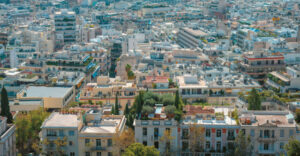
Koukaki never had much of a reputation. From the 1950s to the late 1980s, it was a working-class, semi-industrial neighborhood with workshops, body shops, small machine shops, carpentries, and warehouses.
Its old identity began to fade in the 1990s, and from 2000 onward, with rising property prices, the arrival of the metro, pedestrianization projects, and the advent of Airbnb, the area started taking on its current form — today, it has everything: cafés, bars, restaurants, galleries, concept stores, bookstores, laundromats, thrift shops, barbershops, pastry shops, art studios, pet shops, pharmacies, supermarkets, gourmet delis. Yet not everything is rosy, as locals reveal.
Airbnb
The story begins in 1897, when the first section of the area (Areopagitou – Makrygianni) was included in the official City Plan, with the rest following in the 1930s, driven by the massive urbanization and the influx of Asia Minor refugees.
“Koukaki began to be built in earnest in the early 20th century with the late neoclassical style of that era. Its rapid development in the 1960s and 1970s gave it the dominant urban material character defined by six-story apartment buildings,” explains architect and local resident Manolis Anastasakis.
“The part of the neighborhood near the Filopappou Hill retains lower-rise buildings and a milder urban character, with a greater number of neoclassical houses. In contrast, the dense development toward Syngrou Avenue and Kallithea shows a modern aesthetic, with neoclassical buildings scattered and isolated,” he adds.
Geographically, Koukaki is defined as the area between Syngrou Avenue (east) and Filopappou Hill (west), with Lagoumitzi Street as its southern border and Jean Moreas and Panaitoliou Streets as its northern limit. Its core includes streets like Veikou, Dimitrakopoulou, Olympiou, and Falirou. In practice, the boundaries are fuzzy. To many visitors and residents, Koukaki also includes the adjacent neighborhoods of Gargaretta and Makrygianni.
“I say I live in Makrygianni, not Koukaki,” says Nikos Karalekas, an interior architect and builder, laughing. He speaks passionately about the neighborhood where he grew up — and its adjacent areas that were loosely absorbed into “Koukaki.”
“It was never a wealthy place. Just a simple urban neighborhood with a family-oriented character, single-family homes inspired by neoclassical styles, the first apartment blocks of the ’60s and ’70s, a wave of residents leaving for northern and southern suburbs in the ’90s, and the arrival of workers and immigrants.”
Experiences
The area’s transformation began in earnest with the rise of Airbnb around 2015, peaking in 2017–2018, in parallel with Greece exiting its economic crisis and a boom in construction activity. Until then, says Mr. Karalekas, Koukaki was a quiet area populated by students, laborers, public employees, and mostly low-income residents.
“Airbnb met the growing need for tourist beds, making use of vacant or abandoned homes and upgrading the area’s commercial appeal. The center became more attractive, and Koukaki began to ‘sell’ an experience of the old Athenian neighborhood,” he explains.
Beyond short-term rentals, the recent development boom, according to Mr. Anastasakis, has led to the renovation of old buildings (both neoclassical and interwar) as well as new constructions — some with notable architectural value.
The Problems
However, not everything is positive. Permanent residents face significant day-to-day problems.
“The sidewalks are in poor condition. Streets are full of potholes and badly maintained. Garbage is another major issue — due to the many eateries and Airbnb apartments, large amounts of waste accumulate and collection is delayed. Parking is also problematic, as most apartment buildings have no garages, and the issue worsens when events are held at the Herodion theatre. The area needs special attention,” says Mr. Karalekas.
In parallel, it seems the revitalized Koukaki is no longer welcoming to those looking for housing or forced to move out. Graffiti saying “Airbnb everywhere, no neighbors” on walls near Filopappou and a woman’s remark last Friday at the sparsely attended street market on Zacharitsa Street confirm this:
“Have you seen this before? We have market stalls, but no residents to shop. Airbnb drove them away!”
Real Estate Prices
Mina Charbali, owner of Katoikia Real Estate and Vice President of the Attica Realtors Association, shares the market perspective:
“Koukaki is one of the most popular neighborhoods in Athens today, offering high quality of life and quiet. It has seen rapid tourism-driven growth due to Airbnb, pushing up rental and property sale prices. Purchase prices have reached or exceeded €2,500 per square meter, and the limited availability of quality properties makes it hard to find housing — especially for permanent residents.” Currently, about 625 properties are for sale and around 120 for rent.
“Tourism overload — especially around the Acropolis, Makrygianni, and Filopappou — has changed Koukaki’s character, with short-term rental investors (Greek and foreign) and digital nomads replacing long-term residents. The area has reached saturation, but it still attracts a youthful and artistic crowd, mostly from the middle or upper-middle class, interested in culture, art, and city living,” she notes.
To Nikos, Koukaki is a beautiful miniature of old Athens, blending elements from antiquity to modern times. A colorful and diverse neighborhood — with families, children, the elderly, digital nomads, retirees from abroad, and students — it retains the warmth of familiar faces, where people greet each other and don’t isolate themselves in their apartments.
With a “Koukaki spirit” that’s been omnipresent for decades, from the “Little Paris” of preserved buildings on Filopappou and Tsami Karatasou streets to the cramped working-class homes lower on Veikou and Dimitrakopoulou, and from there to the “banks of the Seine” on Syngrou Avenue — in areas where, like Parisian women of the 19th century, travesti (as trans women were called in the ’80s and ’90s) once sold love to men seeking their company.
Stories
Despite the sweeping renewal brought by Airbnb, some old businesses and hangouts maintain the air of another era, like the two “Takis” — the dry cleaner on Odyssea Androutsou Street, since 1967, and the bakery on Misaraliotou, since 1971, the “Akrites” of a Koukaki that is lost in time.
“It was the only shop among workshops and spare parts,” says Giorgos Mourikis about his parents’ dry cleaner, Anastasia and Panagiotis, which he now runs himself. Raised in the neighborhood, he remembers Falirou as a vacant lot up to Syngrou for playing football, and the fragrant pies made by housewives with the fruit from the “laden” mulberry trees.
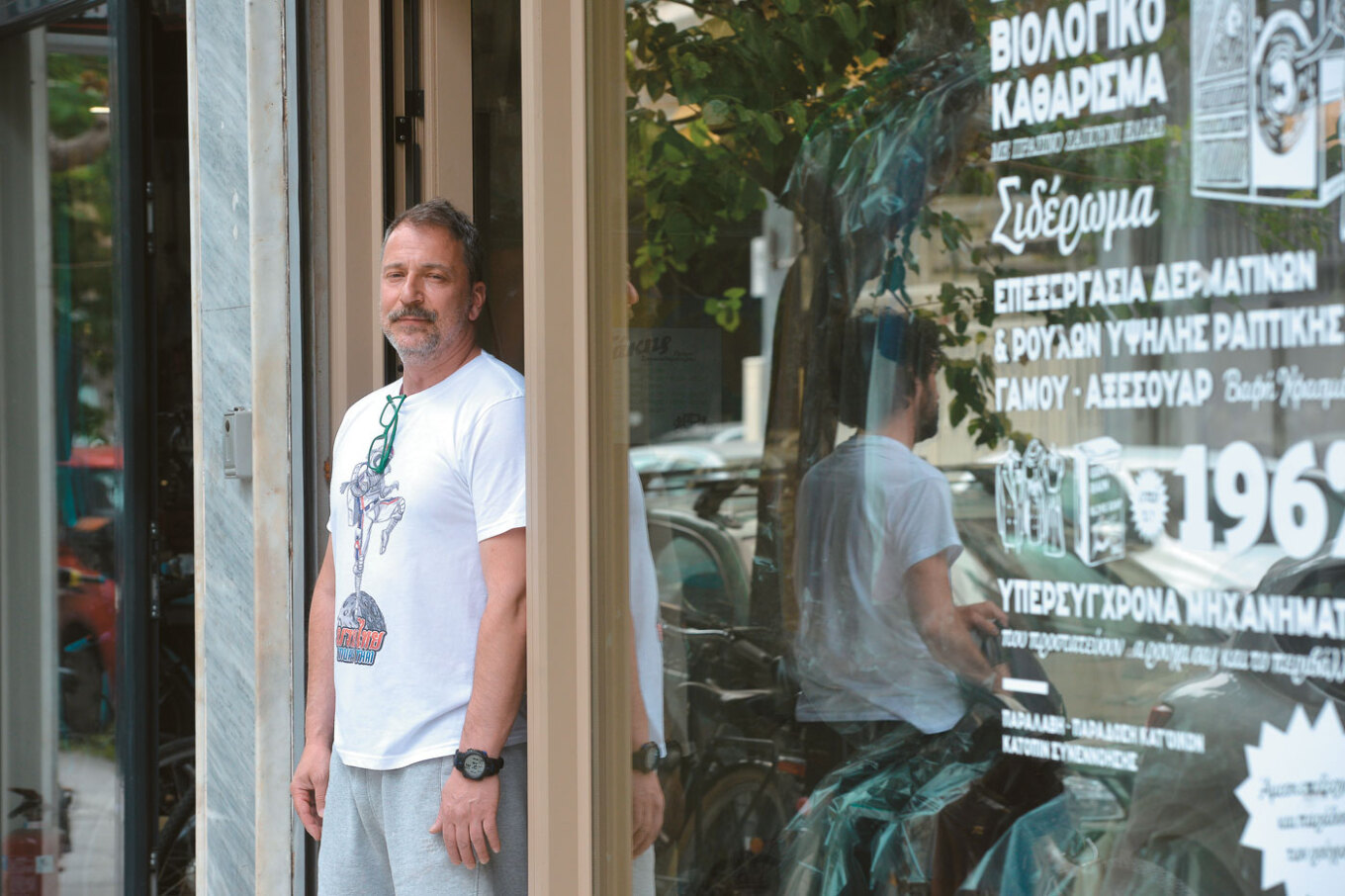
Giorgos Mourikis / entrepreneur
“Our dry cleaner was the only shop among workshops and spare parts”
He recalls stories from his father, who as a boy used to swim in the large open water tanks at Perivolaki, and also a phrase from a customer of his grandfather about how Koukaki filled with tables and chairs when in his days “the only chair was at Mary’s pharmacy to take your blood pressure.”
Dirt roads
The people of an area are the guardians of its history, like roots holding the soil. Such a precious “root” for Koukaki is Michalis Kosmidis, owner of the eponymous pastry shop on Drakou Street:
“Our first store was opened by my father, Nikos Kosmidis, in 1963, a little higher up, and since 1985 we are in our current location. It also operated with service, when cafés as we know them today didn’t exist yet. Boys and girls would come after school for coffee, sweets, or ice cream. The lemon pie, with my father’s recipe for years, was and remains our signature product. Before that, my father had created the first food truck in Greece — an ambulance left by the British in 1953, which was set up at the Acropolis — until it was stopped in 1967 due to the junta — and when there were no tourists, he went to festivals.”
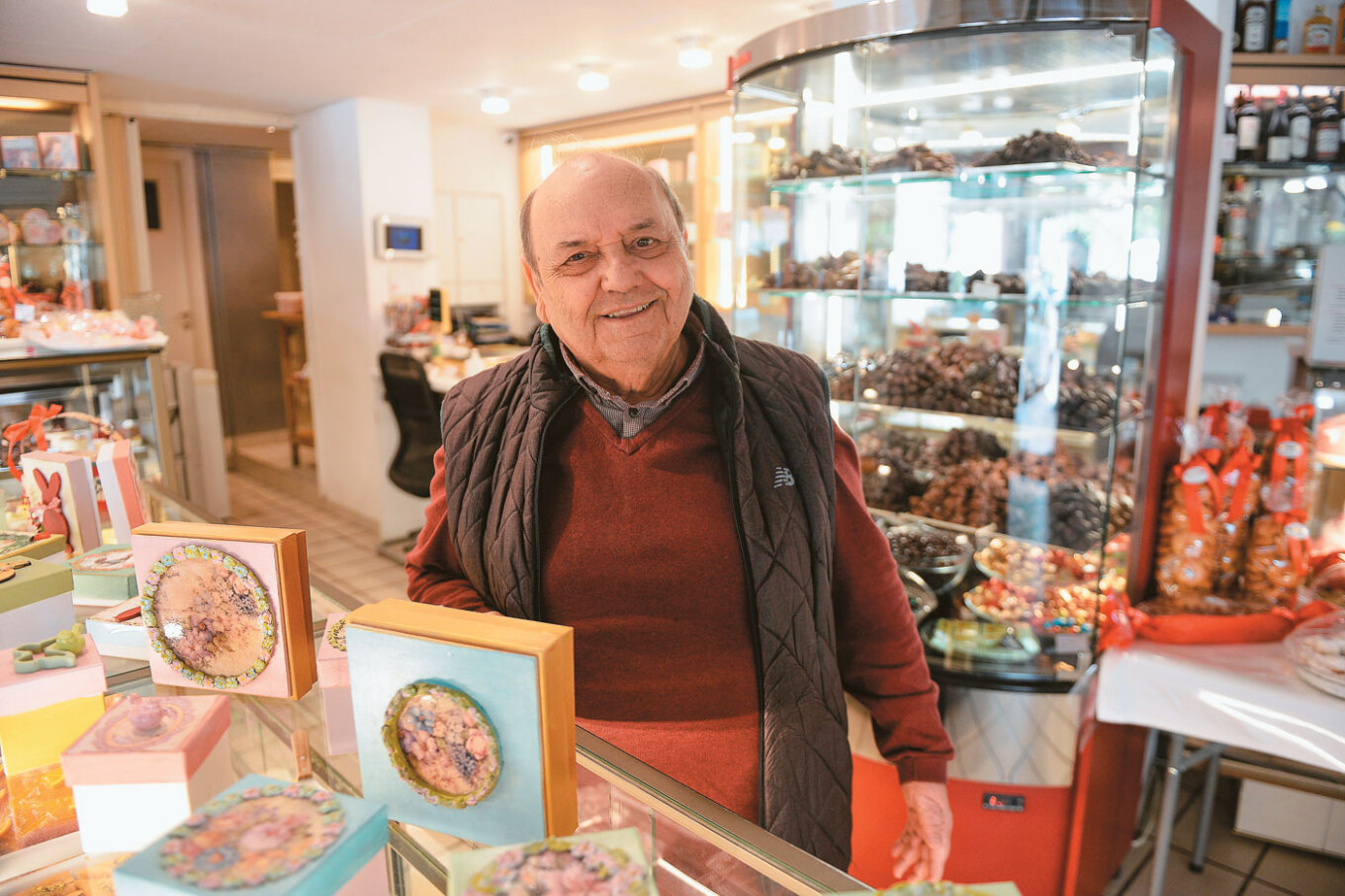
Michalis Kosmidis / pastry shop owner
“The shop has been operating since 1963. When we came here it was still a dirt road”
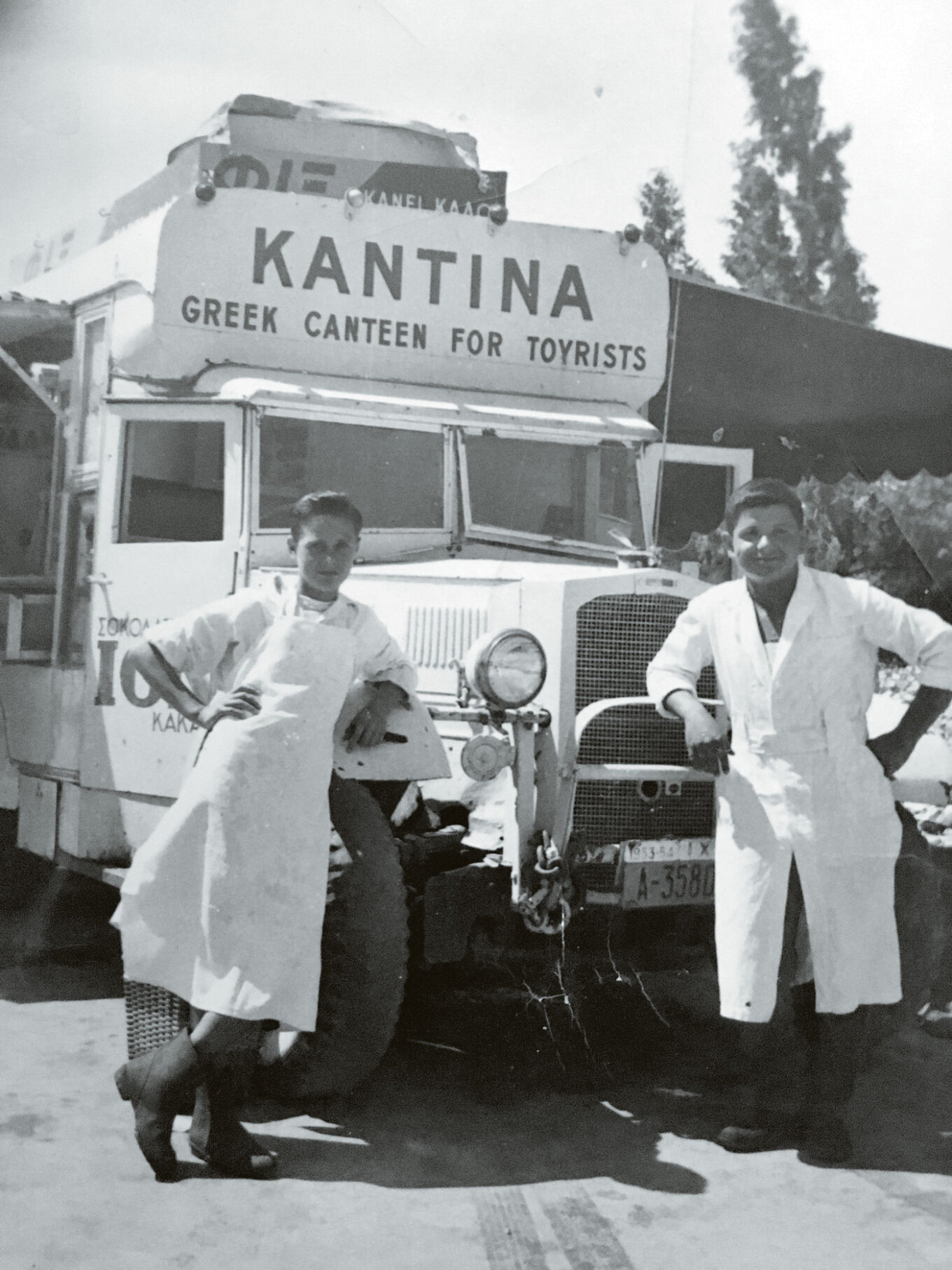
The first food truck in Greece — an ambulance left by the British in 1953 set up at the Acropolis
Mr. Kosmidis introduces us to his old neighborhood:
“When we came here it was still a dirt road. The tram used to pass by, starting from Makrygianni and going to Kallithea, then the yellow buses and trolleys. Opposite was the Fix factory, and in Kallirrois the Ilisos river was still open. There was a small path next to the factory for loading trucks, and outside, in the middle of today’s museum, the ice sellers came with tricycles and loaded ice blocks to drop them off with rakes at homes with wooden refrigerators.”
He sees the change in his area but doesn’t feel uncomfortable. Quite the opposite. Evolution is a word intertwined with Koukaki and its residents.
A bohemian community
The artistic tradition of a neighborhood under the Acropolis
Since the early 20th century, Koukaki has been home and creative refuge for artists such as Parthenis, Vasileiou, Bouteas, Koch, Theodorakis, Kakogiannis, Kavakos, Theodoros, Mylona.
In the ’80s and ’90s the neighborhood breathed a bohemian air, which you still feel slipping through the narrow streets, among museums, small studios, artistic hangouts, and workshops like Art Toutou by visual artist Katerina Christopoulou.
“I have lived in Koukaki for the last 30 years. At first, it was a typical working-class neighborhood in the center, below the Acropolis rock, where people of arts and letters lived and live. Relationships were loose and friendly, without a core forming. After 2000, the neighborhood was renewed attracting new people, families, couples, even artists who wanted to live downtown.”
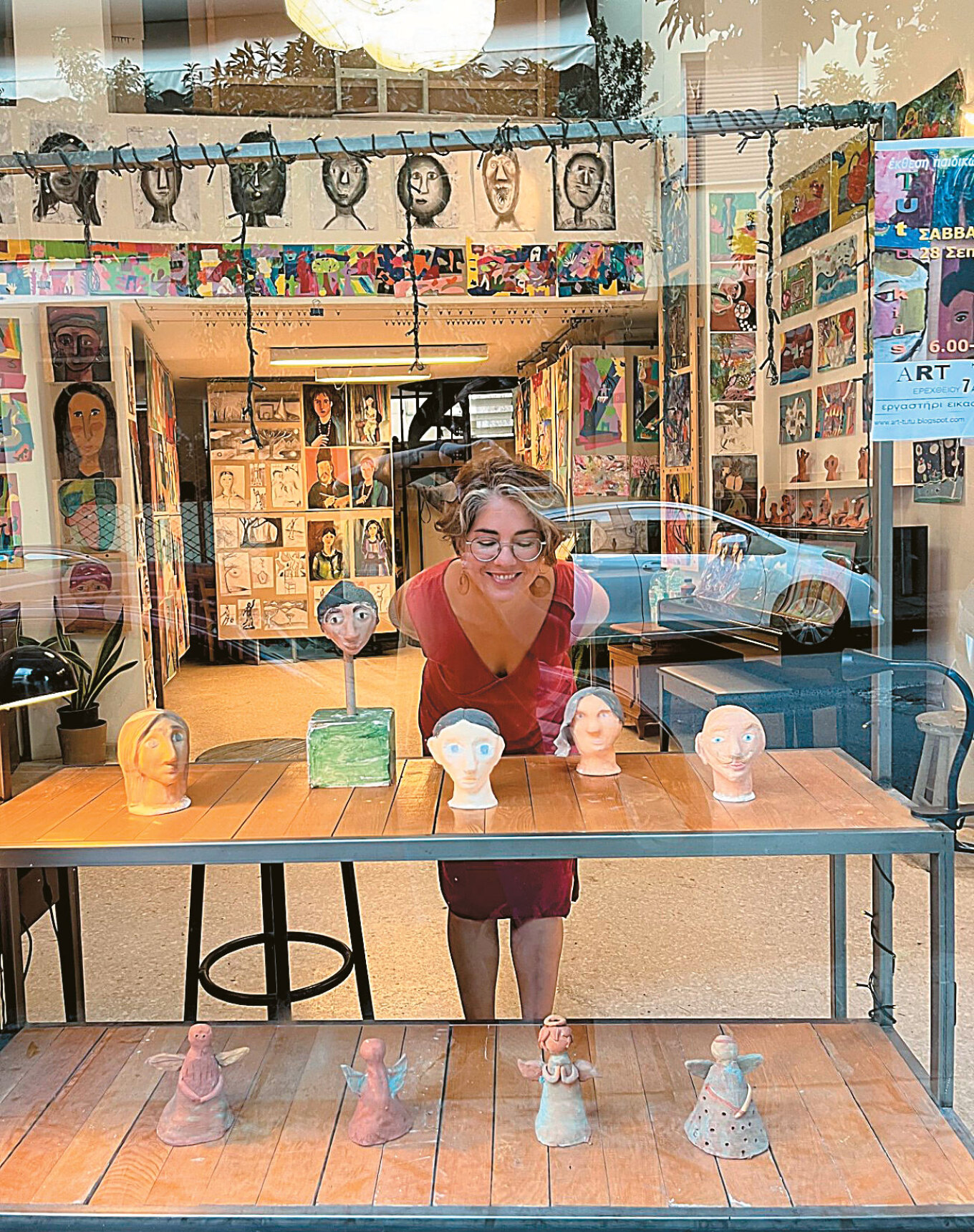
Katerina Christopoulou / visual artist
“After 2000, the neighborhood was renewed. Gentrification came quickly, and with it, tourism”
But gentrification came quickly, and with it, tourism,” she notes.
The EMST
Katerina refers to Fix and its many-year renovation into the National Museum of Contemporary Art (EMST), which raised hopes for a meaningful dialogue between ancient glory and contemporary artistic life.
“But rents rose, permanent residents diminished, and available spaces for art disappeared under Airbnb and boutique hotels. The hopes we had as artists to somehow use the closed car workshops on Falirou Street or Mitsi — a landmark building on Veikou — as parallel centers of art and culture, were lost in renovation and easy money.”
She and colleagues and friends reacted creatively against the rapid change:
“In this climate, we started with Virginia Axioti and Xanthippi Tsalimi the ‘Art Toutou,’ an open, non-profit art workshop, initially on Parthenonos and now on Erechtheiou. It is a space for exhibitions, children’s workshops, artistic collaborations, and visual actions, still resisting the pressures of tourist commerce and defending the real, living cultural identity of the neighborhood.”
Cultural pillars
It is the same identity shaped and sustained by major and minor cultural pillars: the Acropolis Museum, the Ilias Lalaounis Jewelry Museum, EMST and Spyros Vassiliou’s House, the “Mikrokosmos” cinema with love for quality and independent cinema, the underground theater of Rallou Michalopoulou under the bakery “Mama Psomi,” the Onassis Foundation’s Stegi and the theaters of Neos Kosmos close by, the “Koukles,” the historic venue that introduced drag show art to the Athenian public 30 years ago.
A stroll for food and gossip
Koukakis and the traditional and hot spots of a once working-class neighborhood
Dimitrakopoulou Street, Koukaki stop, weekday morning. A young man waits for the trolley while at the laundry across the street the first loads start spinning. Clothes in the basket as colorful as the buildings along the street, the striped apartment block at the intersection with Georgaki Olympiou, where at the beginning of the 20th century lived Dimitrios Koukakis, the iron bed maker from whom the once humble and now hip neighborhood takes its name.
At the end of the street, towards Petralona, two women chat from their balconies, their voices doubling the honks of cars from Syngrou and inside. Above, on Veikou, two students leave with coffee and homemade bread from the tireless — open 24/7 — “Tzante” and walk straight to Panteion University. Meanwhile, shops are ready to welcome their first customers.
The taste
The walk in Koukaki starts in the morning. Coffee and brunch at “This is Loco,” “Hippy Hippo,” “Bel Rey,” or “KINONO” or at “Little Tree Books & Coffee” for book lovers. For food, at “Tziant” for authentic Italian pizza, for an American experience at “Sam Burgers” and “Tarantino Burgers,” at “Veganaki” and “Peas Vegan & Raw Food” for vegan flavors, ice cream at “Django Gelato,” at the café “Syngroumeno” and “Potami” for relaxed meze, for souvlaki at “Kalyva,” “Kalamaki bar” and the historic “Oi Gynaikes,” at “Vulkanizater,” “12 Piata,” “Esthio,” “ManiMani,” and Efrosynou’s “Fabrika” for more special flavors, at “Drupes and Drips” for Aperol, and at “AnthropAS” for dancing. For those who love travel, a stop in Thailand at “Tuk Tuk Thai Street Food” and at night Hawaii at “Tiki Bar Athens.”

The restaurant Gallina has earned a place in the Michelin Guide
However, for genuine working-class neighborhood experiences one should visit the traditional cafés, like “Koukaki Billiards” on Orlof, “Archontikon,” which added billiard tables and was “revived” by young regulars, or for food at “Lolos,” on Georgaki Olympiou.
“We took over this place from Mr. Thodoras, who had it for 35 years, and it passed to us, my mother, me, and Thanasis Grassos,” says Nikolaos Athanailidis. In recent years, the renewed “Lolos” offers a unique experience “mainly for the way of service.
All the kids working here are incredibly polite, they give a nice vibe, which Thanasis and I built from scratch, maintaining the village feeling, freer, not so staged.”
Just like when he first came to the neighborhood.
“You’d pass by, get bread, they’d write it down. After the butcher shop, the same. We paid once a month. It was like a village and I said ‘let’s try it.’ We’ve kept it as a café for all those old folks who supported us from the start, it’s their hangout. Then young people started coming, mainly from Dora Stratou’s theater, and now after noon most of our customers are 30-35 and older, but also students, mainly from Panteion.”
The pedestrian street
On the same pedestrian street is “Avli,” the hangout that 22-year-old Evelina doesn’t give up, who remembers the carnivals on Olympiou, hanging out with friends at the 70th school on Kallisperi and then on the stands at the playground, her favorite neighborhood she would “betray” only to find friends on the metal benches outside Panteion, chilling late into the night.
Most likely, before the group “breaks up,” Koukaki will already have fallen asleep.
When dawn breaks, a sun in the Attic sky will light the area from end to end, sparkling on the forgotten tram tracks at Makrygianni, on the fountain waters at Perivolaki, on the wires and basketball hoops at the Kountouriotis Square court.
Ask me anything
Explore related questions




