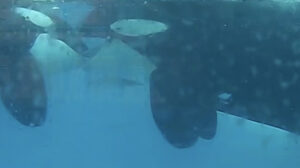
For the first time, a pair of whales was filmed kissing in the wild.
The amorous orcas were spotted while diving at Kvænangen Fjord in northern Norway, according to the study published in the journal Oceans.
The action, described as a “kiss” by observers, may play a role in social bonding, researchers speculate, according to livescience.com.
The whales’ interaction lasted less than two minutes and involved three periods of mouth-to-mouth contact between the two orcas. The pair then swam separately.
The phenomenon was first observed in captive orcas in 1978 and described again in 2019 at Loro Parque, a zoo in Tenerife, Spain, which is home to three captive orcas.
Tenereo de la Cruz, in Tenerife, Spain, where a captive breeding facility in Tenerife is held in a captive breeding facility in Tenerife.
“It’s extremely rare,” study author Javier Almunia, a marine mammal researcher and director of Loro Parque, told Live Science. “Orca caretakers at various facilities are aware of this behavior, but its frequency is extremely rare – it can occur and then not be seen again for several years,” he added.
Mouth contact between animals is seen in a large number of species and can represent a variety of different social cues. Many animals use mouth contact to strengthen bonds, such as primates, which kiss or touch their lips as a sign of trust and friendship. In dogs and wolves, mouth licking, especially by younger or subordinate individuals, can be a sign of respect or submission to a superior person.
Researchers speculate that this is a form of social bonding, similar to that seen in beluga whales.
“Tongue licking has not been documented in other species, but similar social interactions involving the mouth have been observed in white whales (e.g., mouth-to-mouth contact). This could suggest that, given the anatomy of cetaceans, oral contact may be a more flexible means of social communication compared to terrestrial mammals,” Almunia said.
“This behaviour may play a role in strengthening social bonds or resolving conflicts, similar to grooming or reconciliation behaviours in other species with strong sociality.”
He added.
However, we can’t be sure exactly what drove orcas to exhibit this behavior without further investigation.
The researchers speculate in their paper that the observed tongue biting may be a behavioral “tendency” of orcas, similar to placing dead fish on their heads, which was observed in one orca population.
Ask me anything
Explore related questions