





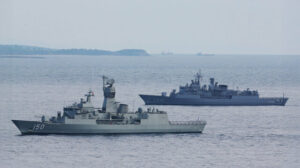
A letter signed by Turkey’s Foreign Minister Hakan Fidan confirms for the first time that secret negotiations are underway to define a maritime border between Turkey and Syria following the overthrow of the Assad regime by pro-Turkish jihadist groups last year.
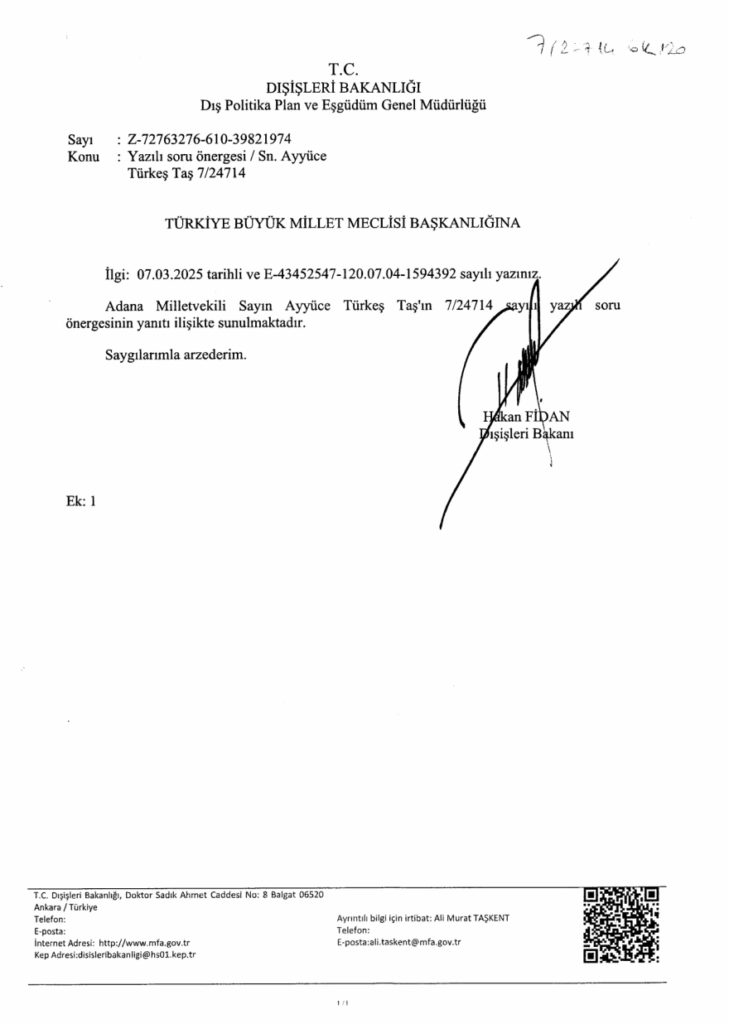
The letter, obtained and published by the Nordic Monitor, reveals that several Turkish entities have been instructed to draw up an Exclusive Economic Zone (EEZ) agreement with Syria. The aim is to safeguard the interests of both Turkey and the pseudo-state-namely, the “Turkish Republic of Northern Cyprus” (TRNC), which is recognized only by Ankara.
“With the overthrow of the Baath regime and the transfer of power to a transitional government, work is being carried out in coordination with our relevant institutions to determine the maritime boundaries with Syria and the delimitation of maritime zones beyond territorial waters in a way that protects the rights and interests of our country,” Fidan said in his letter, dated June 16, addressed to the presidency of the Turkish National Assembly.
Fidan also stresses that Turkey remains committed to defending the rights and interests of the pseudo-state in any future maritime delimitation agreement with Damascus.
The letter is the first official confirmation that preparations for such a maritime agreement are already underway, despite previous public statements by Turkey’s transport minister, who had hinted that Ankara was considering such a possibility only for the future.
Hakan Fidan also rejects claims that Turkey pledged not to seek a maritime delimitation agreement with Syria during his January 12, 2025, meeting in Riyadh with Kaya Kalas, EU High Representative for Foreign Policy and Vice President of the European Commission.
“It would be appropriate to take into account the official statements and announcements of our ministry on this issue,” Fidan said in the letter, adding that “the EU has no right to comment on a possible agreement between two sovereign states on their maritime jurisdictional zones.”
A Turkish-Syrian maritime agreement could significantly change the geopolitical balance in the Eastern Mediterranean, which in recent years has become a field of fierce regional disputes. The discovery of rich hydrocarbon deposits has led to overlapping claims by many coastal countries, with Turkey at the centre of disputes with Greece, Cyprus, and Egypt.
Given the region’s complicated history and overlapping EEZ claims, any deal between Turkey and Syria could further escalate Ankara’s tensions with Greece and Cyprus, bringing Brussels a new focus of conflict with the troubled candidate, the Nordic Monitor writes.
Turkey appears to be seizing a strategic opportunity in post-Assad Syria, now under the leadership of President Ahmad al-Saraa, with whom Turkish officials reportedly have a long-standing, if behind-the-scenes, partnership. Since the start of the Syrian civil war in 2011, Ankara has supported and armed various jihadist groups aimed at overthrowing Assad. In the past, Ankara has attempted to conclude a maritime demarcation agreement with the Assad government, but these efforts were suspended with the outbreak of war in 2011.
This time, a successful agreement would formally define the Turkish-Syrian maritime border, strengthen Ankara’s legal claims in the region, provide de facto recognition to the “TRNC,” and potentially open up new areas for hydrocarbon exploration. The agreement could also pave the way for joint exploration and exploitation of cross-border hydrocarbon fields. As Damascus currently lacks expertise in offshore drilling, Ankara would likely lead the technical and operational procedures under such an agreement.
However, the proposed deal is expected to further complicate Turkey’s relations with third countries such as Cyprus, Israel, and Lebanon – all with their interests in disputed Mediterranean waters and wary of moves that could alter the balance of maritime claims.
Turkey has for years expressed its opposition to the maritime delimitation agreements signed by Cyprus with Egypt in 2003, Lebanon in 2007, and Israel in 2010, claiming they violate the rights of the “TRNC”. Ankara and the “TRNC” have also criticised Nicosia’s decision to grant licenses for offshore hydrocarbon exploration.
Turkey appears to be following the same formula it applied with the Libyan Government of National Accord (GNA), which led to the controversial 2019 maritime agreement. This agreement caused a sharp escalation of tensions with Greece and the European Union.
In response to the Turkey-Libya MoU, the European Council declared on 12 December 2019 that the pact violates the sovereign rights of third states, is not in line with the UN Law of the Sea and cannot have any legal effect on third states.
Ask me anything
Explore related questions




