





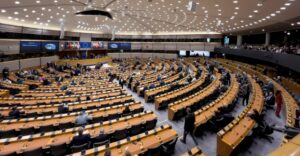
As reported by Bulgarian media and confirmed by Bulgarian MEPs, references to “Macedonian national identity” and “Macedonian language” from the draft Annual Progress Report to be considered and voted on next week by the European Parliament.
Bulgarian MEP Andrei Kovacev, in a post on social media, said:
“At the request of the European People’s Party group, the three largest political groups in the European Parliament – the European People’s Party, the Alliance of Socialists and Democrats and Renew Europe – agreed on Wednesday evening to remove from the draft Progress Report on Northern Macedonia all references to Macedonian identity and Macedonian language. I expect this amendment to be supported by the majority in the EP next week in plenary.”
According to Andrei Kovachev, issues of national identity and language have no place in a report on the progress of a country that is a candidate for EU membership.
The development with the removal of references to “Macedonian national identity” and “Macedonian language” provoked a strong reaction from North Macedonian Prime Minister Christian Mitskoski, who accused Bulgaria of using “Talibanic” methods.
“With methods that refer to Taliban methods, the Macedonian identity and the Macedonian language were removed from the European Progress Report. Unfortunately, we have experienced this as a people in the 21st century as well,” Christian Mitskoski said.
Last week, the European Parliament’s Foreign Affairs Committee approved by 40 votes “for”, 19 “against” and 10 “present” the draft Annual Progress Report on North Macedonia, which included references to “Macedonian national identity” and “Macedonian language”, despite strong opposition from Bulgarian MEPs. The government of North Macedonia, commenting on the adoption of the draft report by the European Parliament’s Foreign Affairs Committee, had called it a “historic breakthrough” and expressed its “great satisfaction”.
The rapporteur of the Progress Report on North Macedonia is Austrian MEP Thomas Weitz (Greens/European Free Alliance). The Bulgarian government has accused the Austrian MEP of being “biased” in favour of Skopje.
North Macedonia and Bulgaria have historical, ethnic and linguistic differences that go back decades.
Bulgaria has been blocking the start of North Macedonia’s accession negotiations with the EU. In the summer of 2022, the then governments of the two countries, after EU mediation, had reached a compromise proposal, which stipulated that Bulgaria would lift its veto on the start of North Macedonia’s accession negotiations with the EU, after Skopje had amended its constitution to include the Bulgarian minority living in the country.
The proposal was accepted by the previous centre-left government of North Macedonia, but it failed to secure a two-thirds majority in parliament to amend the constitution due to opposition from the country’s right-wing and current ruling party, Prime Minister Christian Mitzkowski’s VMRO-DPMNE. The latter says his government does not accept the proposal and there will be no such amendment to the country’s constitution.
Both Brussels and Sofia have repeatedly told North Macedonia that it will be able to open the chapters of accession negotiations with the EU after amending its constitution.
According to the latest population census conducted in 2021 in North Macedonia, Bulgarians make up only 0.2% of the country’s population (a total of 3,500 people), a fact that official Sofia disputes and considers the percentage of Bulgarians in North Macedonia to be much higher.
North Macedonia’s troubled relations with Bulgaria have worsened particularly since VMRO-DPMNE took power in Skopje a year ago.
Ask me anything
Explore related questions




