We have covered the Asia Minor campaign and especially the Greek Army’s advance toward Ankara in several articles. However, certain specific events within the campaign hold particular significance. Among them is the last Greek victory across the Aegean, at the Battle of Afyon Karahisar (September 1921).
Conditions in the Afyon Karahisar Area in September 1921
Afyon Karahisar had gained great military importance after the Greek Army’s summer operations of 1921. After the halt of the advance toward Ankara, maintaining control over the strategic hub of Afyon Karahisar became a major concern for the Army of Asia Minor and Lieutenant General Papoulas. Holding the city ensured control over the communication lines from Afyon Karahisar to Smyrna and Eskişehir.
On 7 September 1921, the movement of units toward their assigned defensive positions was finalized. By 10 September, troop movement was complete, and army reserves were fully assembled by 11 September. The II and III Army Corps took positions on 8 September along the line Don Tepe – Uzun Burun – Buruklu Tepe – Tserkes Tsalés, although the latter was not included in the territories held by the Greek Army.
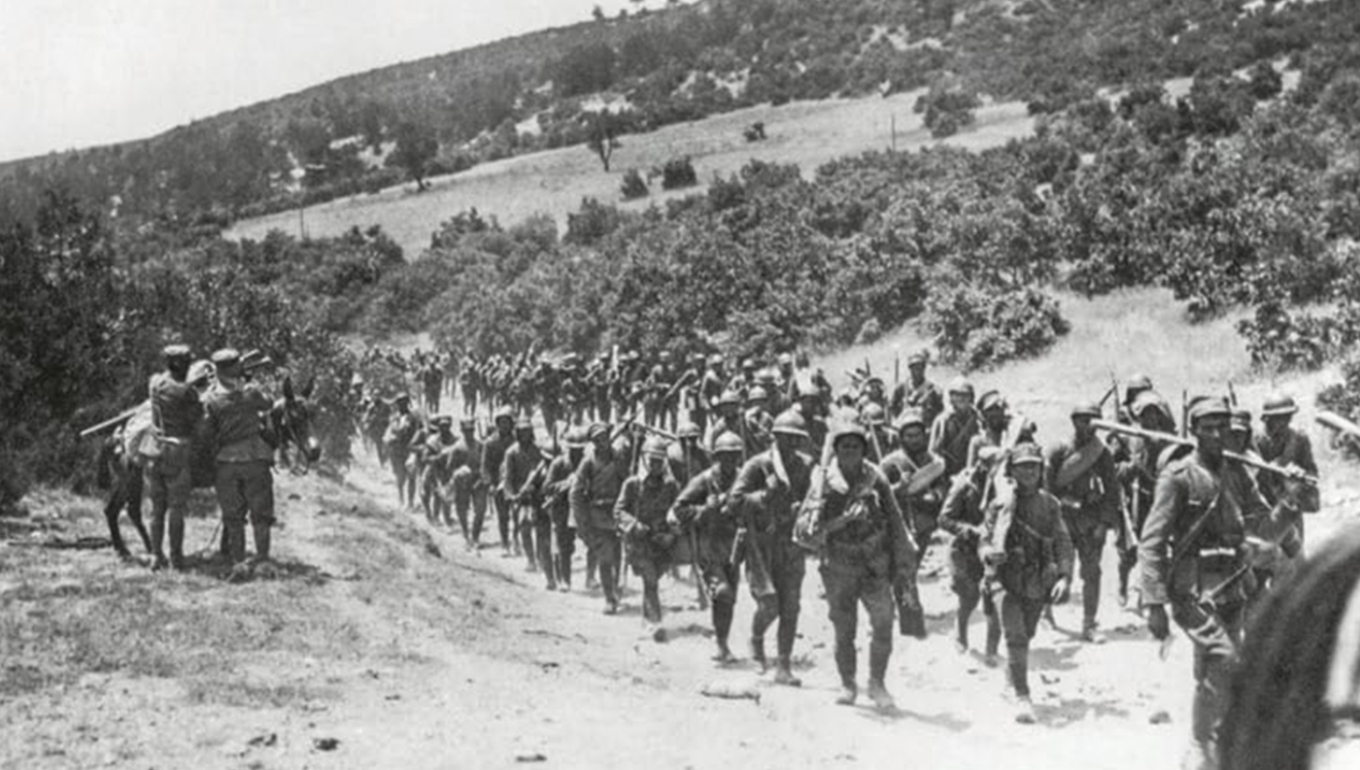
Greek Army movement in Asia Minor
Various small-unit redeployments were also completed by 14 September 1921. On the Turkish side, following the Greek Army’s second crossing of the Sakarya River in late August 1921, the Turkish Western Front Army restructured its forces and replenished losses in men and supplies. After a failed raid by the Turkish V Army Corps into the Greek Army’s rear, Turkish forces advanced south of the Sakarya toward Afyon Karahisar to join with the V Army Corps and the VI Division.
The front at Afyon Karahisar formed a salient at an almost right angle, marking its most vulnerable point. The front stretched from the Gulf of Cius to the mouth of the Maeander River, via Eskişehir and Afyon Karahisar, over a distance of more than 700 km, requiring a significant force to hold it.
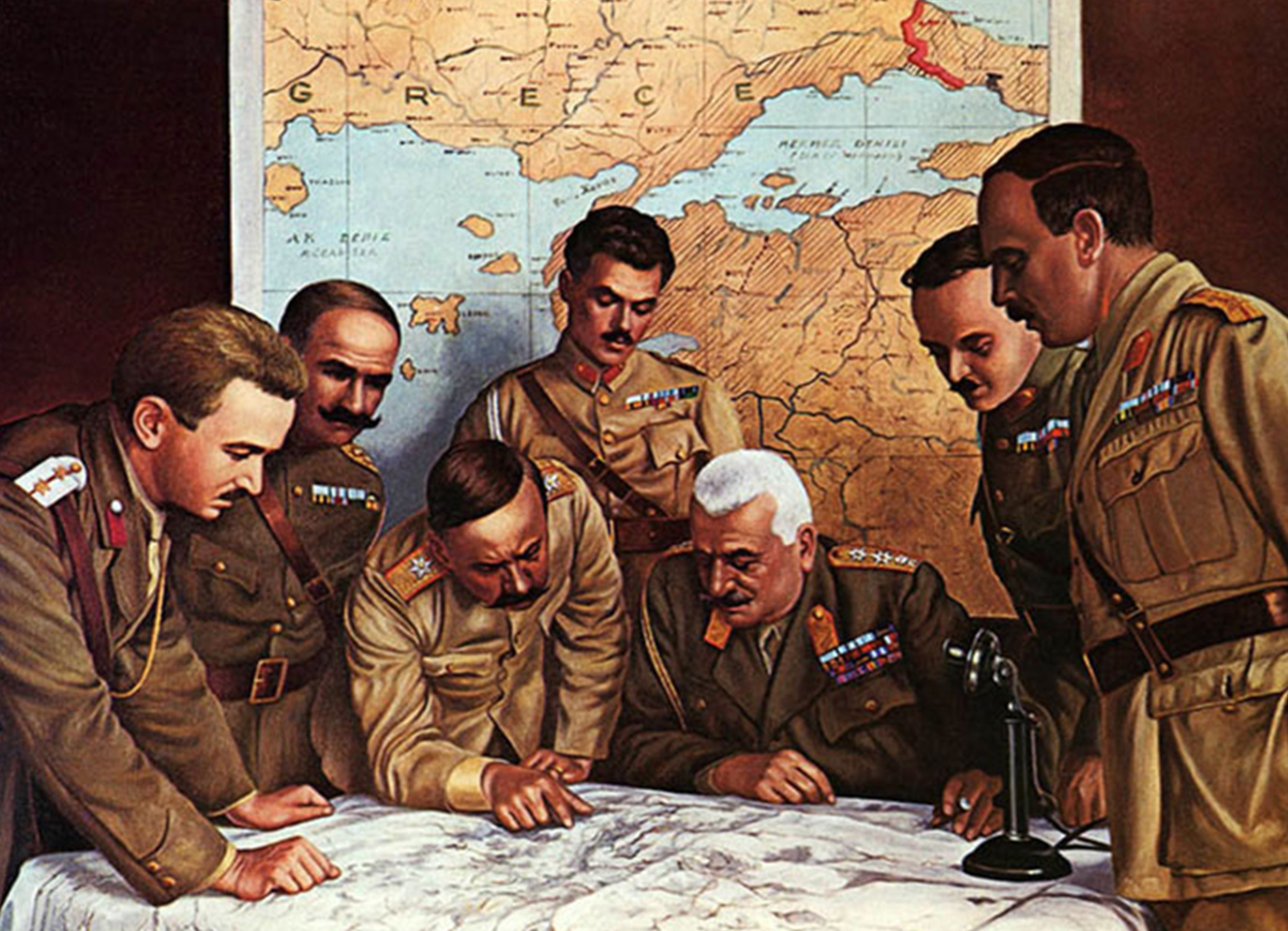
Conference of high-ranking Greek military officers in Asia Minor
Opposing Forces and Plans of Action
The Greeks fielded the I and II Army Corps, with six divisions in total and one Cavalry Brigade. Supporting them was divisional and corps artillery, as well as three aircraft squadrons. The Turks fielded six infantry divisions and three cavalry divisions, supported by divisional artillery.
The Greek plan aimed to defend the occupied positions, ensuring control of the strategic hub of Afyon Karahisar and the communication lines to Eskişehir and Smyrna. The Turkish plan aimed to isolate and destroy the Greeks at Afyon Karahisar and then cut off their supply routes to Smyrna.
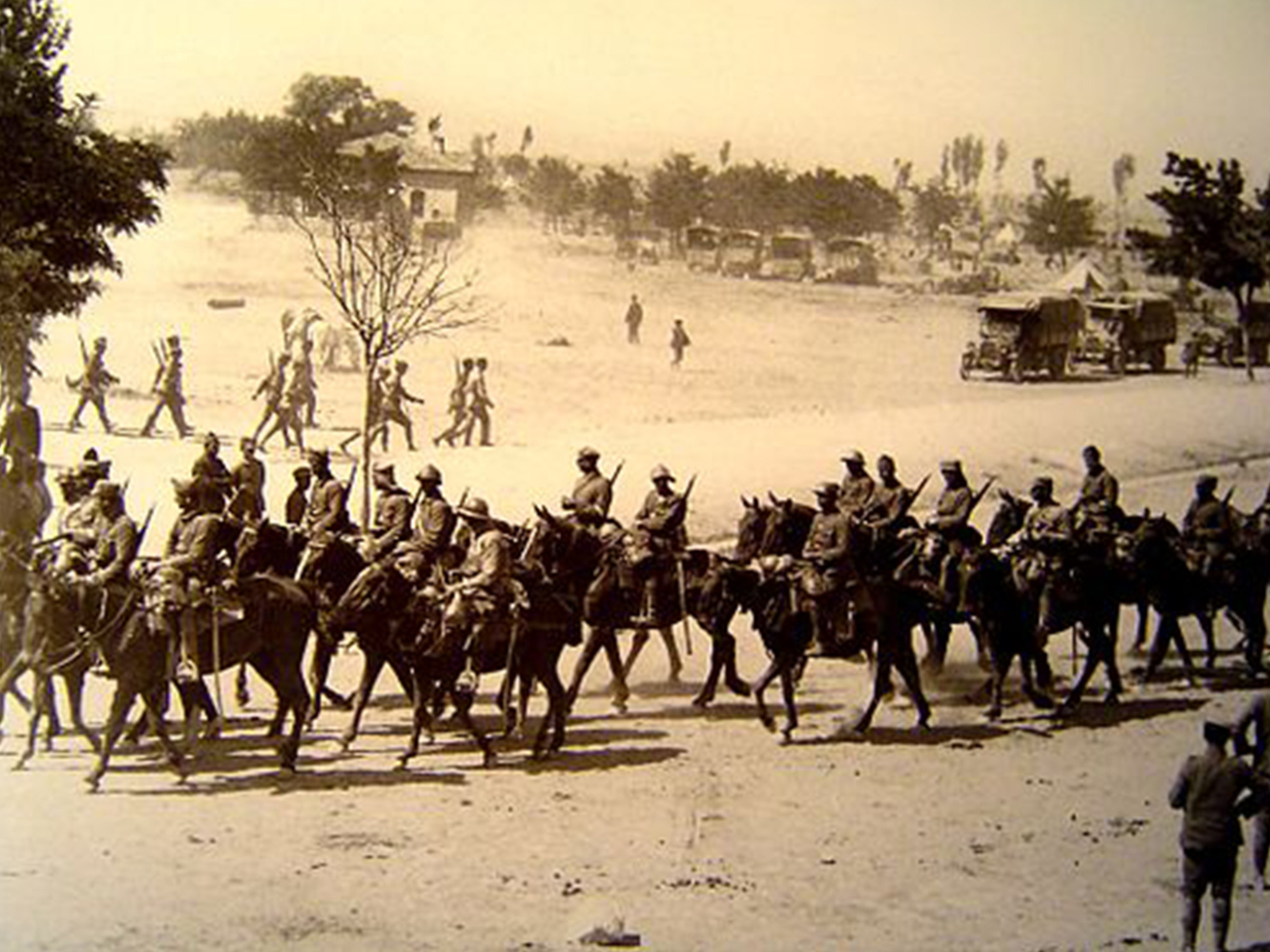
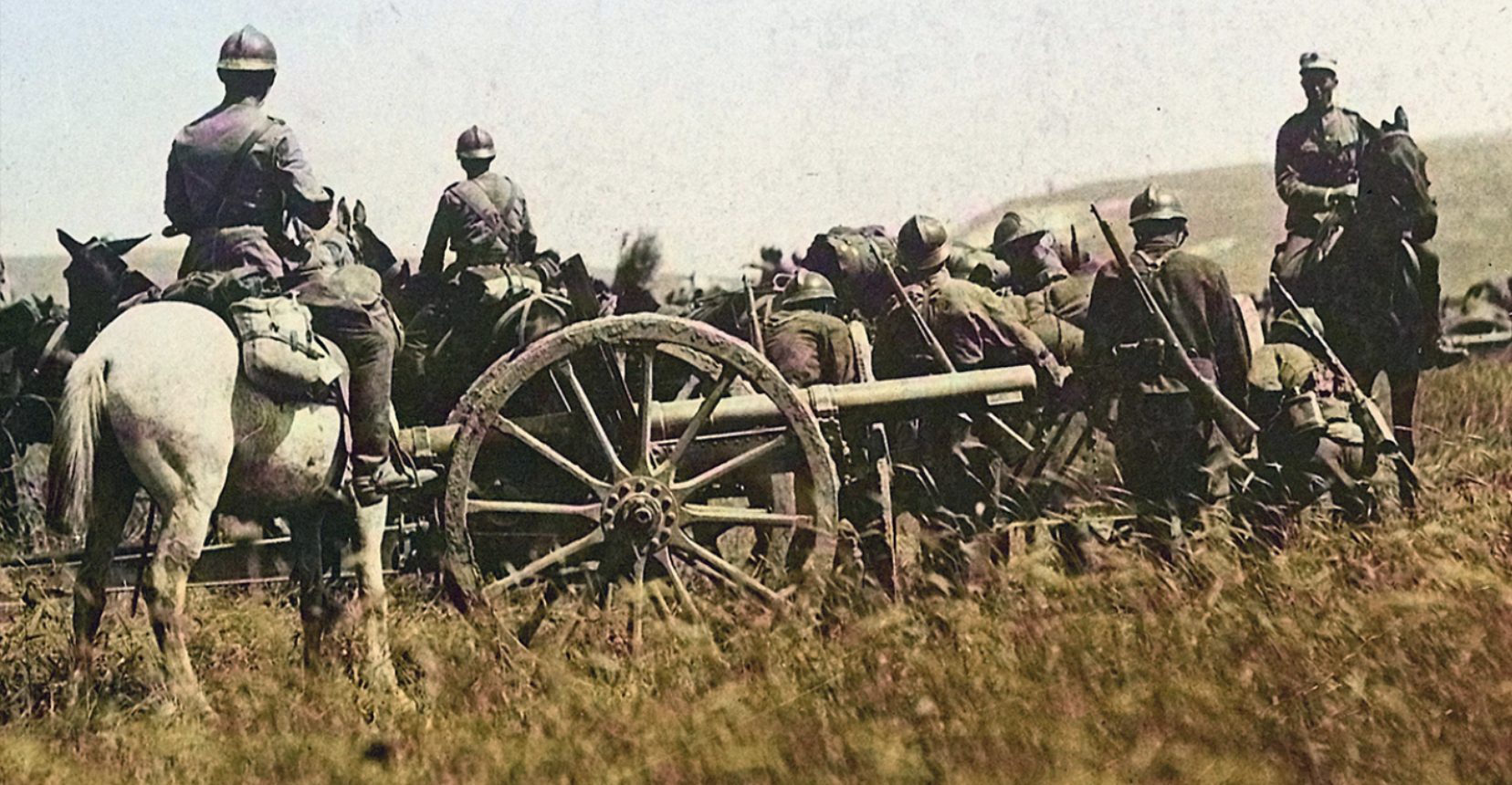
The Greek Cavalry in Eskişehir, 1921
The Battle of Afyon Karahisar (17–25 September 1921)
The Greek Army learned from its Air Force of Turkish movements westward. It immediately began to regroup, completing this on 18 September, with the I Corps assuming command of all units in the area.
On 16 and 17 September, Turkish cavalry units attempted to engage Greek forces. On 17 September, the 2nd Division advanced the 7th Infantry Regiment (Cmdr. Lt. Col. Michail Sachinis) to Ampanaz. After taking the heights east of the village, the 7th Regiment repelled the Turks, who retreated eastward after a brief battle.
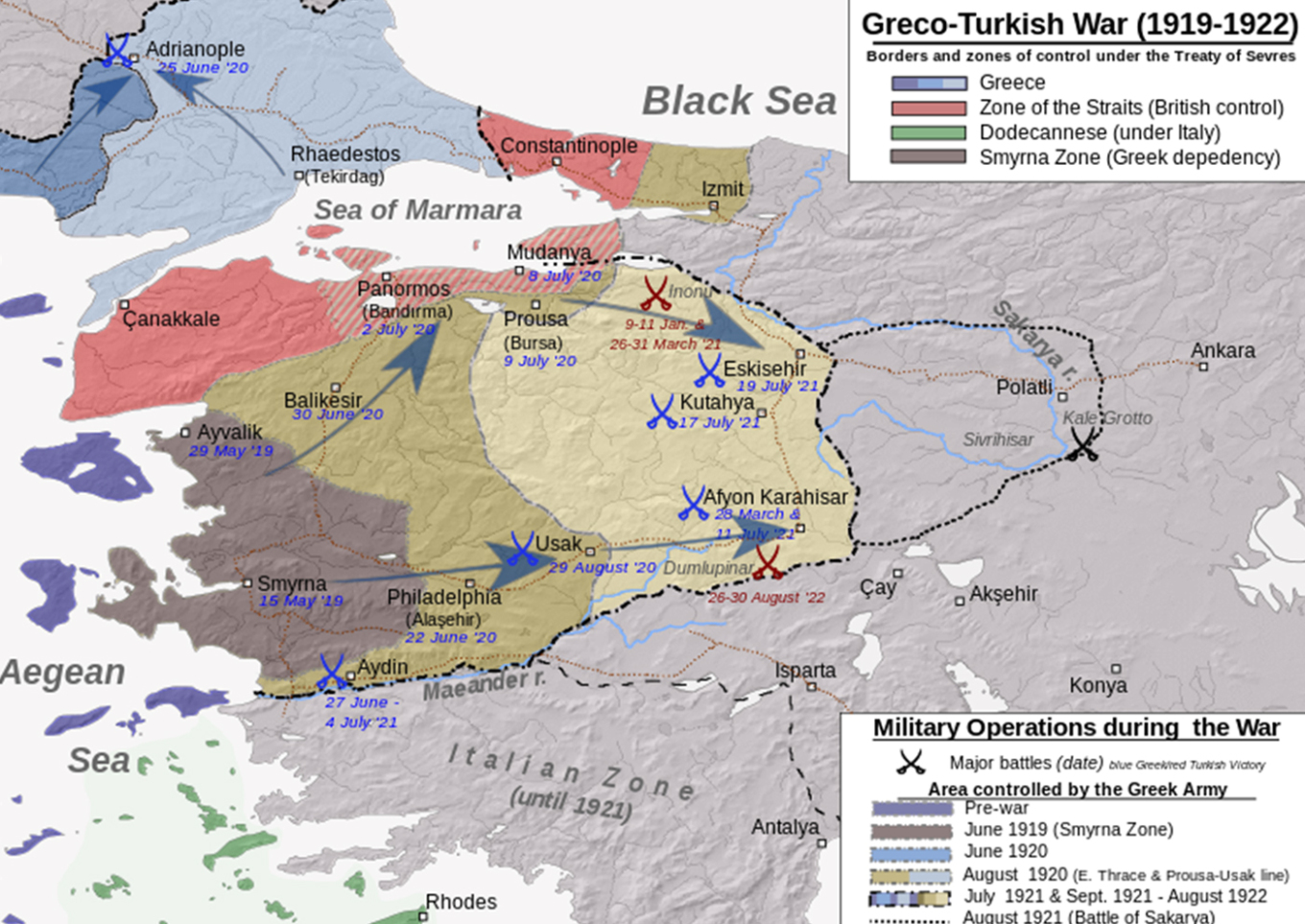
Map of operations in Asia Minor from 1919 to 1922
On 18 September, the 2nd Division command advanced with the 1st Infantry Regiment (Lt. Col. Odysseas Maroulis) to the Tchikrik–Ampanaz line, taking the position after repelling strong forces. The Turks moved about 9,000 men toward the Greeks. By midday, the Commander of I Corps, Major General Alexandros Kontoulis, arrived in Afyon Karahisar with part of his staff and took full command. With ample forces at his disposal, Kontoulis planned the next day’s operations.
The Greek attack was launched late in the morning of 20 September. The 4th Infantry Regiment (Lt. Col. Panagiotis Kotoulas), the right column of the I/38 Evzones Regiment (Lt. Col. Panagiotis Soumilas), the 7th Infantry Regiment (Lt. Col. Michail Sachinis), and a detachment from the 4th Division seized key positions.
The place names—detailed by Brigadier General (ret.) Charalambos Nikolaou—are Turkish, and we considered that listing them all, even with a map, might confuse readers. While I Corps advanced, a strong force of the Turkish VI Division attacked a battalion of the 35th Regiment holding Mutatib Dag and overran it. The Turks advanced toward the villages of Erikman and Tsakir, west of Afyon Karahisar, which came under Turkish artillery bombardment.
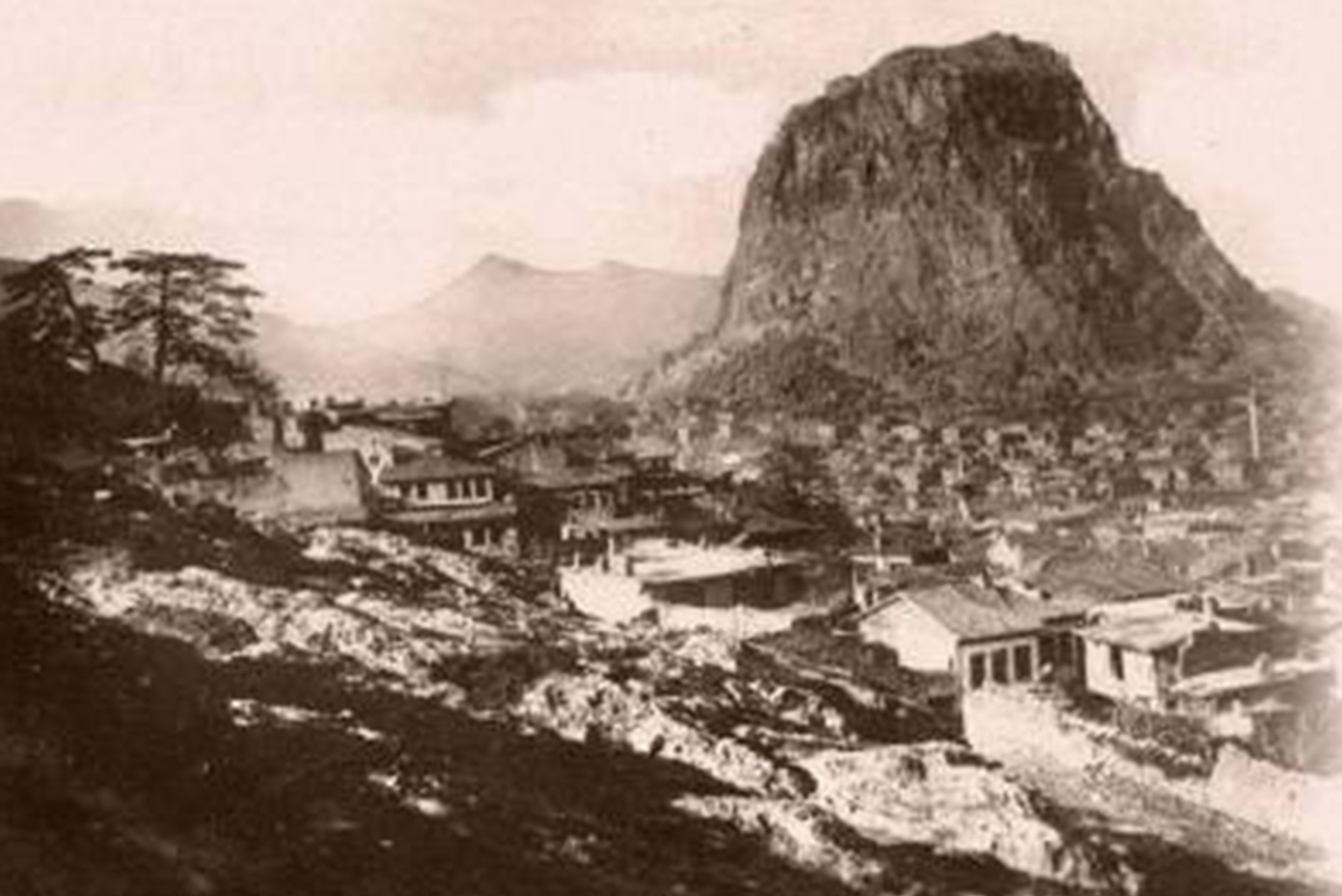
Afyon Karahisar in 1921
The 4th Division urgently dispatched a battalion from the 8th Regiment—the only available unit in Afyon Karahisar—to Tsakir. This battalion, with help from elements of the 35th and 49th Regiments, launched a fierce counterattack, forcing the Turks to retreat toward Kaletzik Dag. Meanwhile, the Greek battalion that had withdrawn from Mutatib Dag (Dag means “mountain” in Turkish, e.g., Ak Dag = White Mountain) rejoined its units. On the evening of 20 September, the 41st Regiment of the 12th Division (Cmdr. Lt. Col. Triantafyllos Vlachos) also arrived in Afyon Karahisar.
The Greek attack continued on 21 September. The 1st, 2nd, and 4th Divisions advanced significantly, pushing back Turkish forces. On 22 September, further attacks failed due to strong Turkish resistance and Greek casualties. On 24 September, I Corps held its positions in preparation to coordinate with II Corps, maneuvering toward Bordi.
The Greek Army, eager to resolve the situation in Afyon Karahisar, committed II Corps to battle. The Corps, excluding the 4th Division (which held the sector from Seyit Gazi to the Cevisli heights), regrouped at Seyit Gazi.
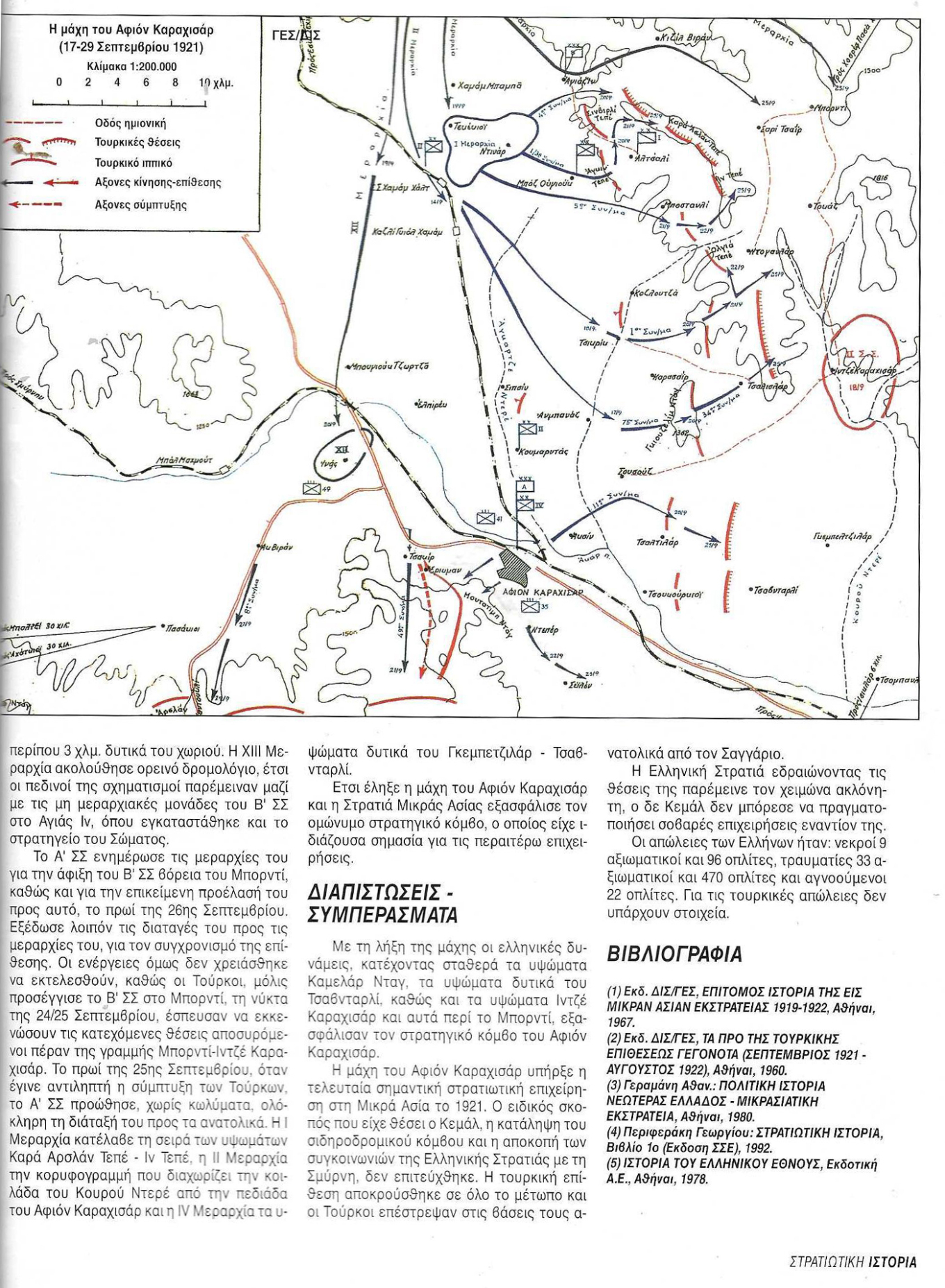
Map of the Battle of Afyon Karahisar
On the morning of 23 September, II Corps moved toward Bordi with two columns along the Seyit Su River. Major General Nikolaos Trikoupis, replacing Prince Andrew, now led II Corps. The columns advanced unimpeded and, by nightfall on 24 September, the left column was south of Yapuldán and the right on the Kyóroglou Kale pass.
Only the left column of the 5th Division encountered enemy resistance, which it repelled. On the night of 24–25 September, the 5th Division bivouacked in a 15-kilometer gorge, the exit of which was just 4 km from Bordi. On the morning of 25 September, it exited without trouble, brushed aside light resistance, and camped near Bordi.
The right column of the 8th Division camped 3 km west of Bordi. I Corps notified its divisions of II Corps’ arrival north of Bordi to coordinate an attack for the morning of 26 September.
However, observing the Greek approach on the night of 24–25 September, the Turks hastily withdrew beyond the Bordi–Ince Karahisar line. Thus, on the morning of 25 September, the 1st, 2nd, and 4th Divisions secured key positions around Afyon Karahisar, securing this strategic hub.
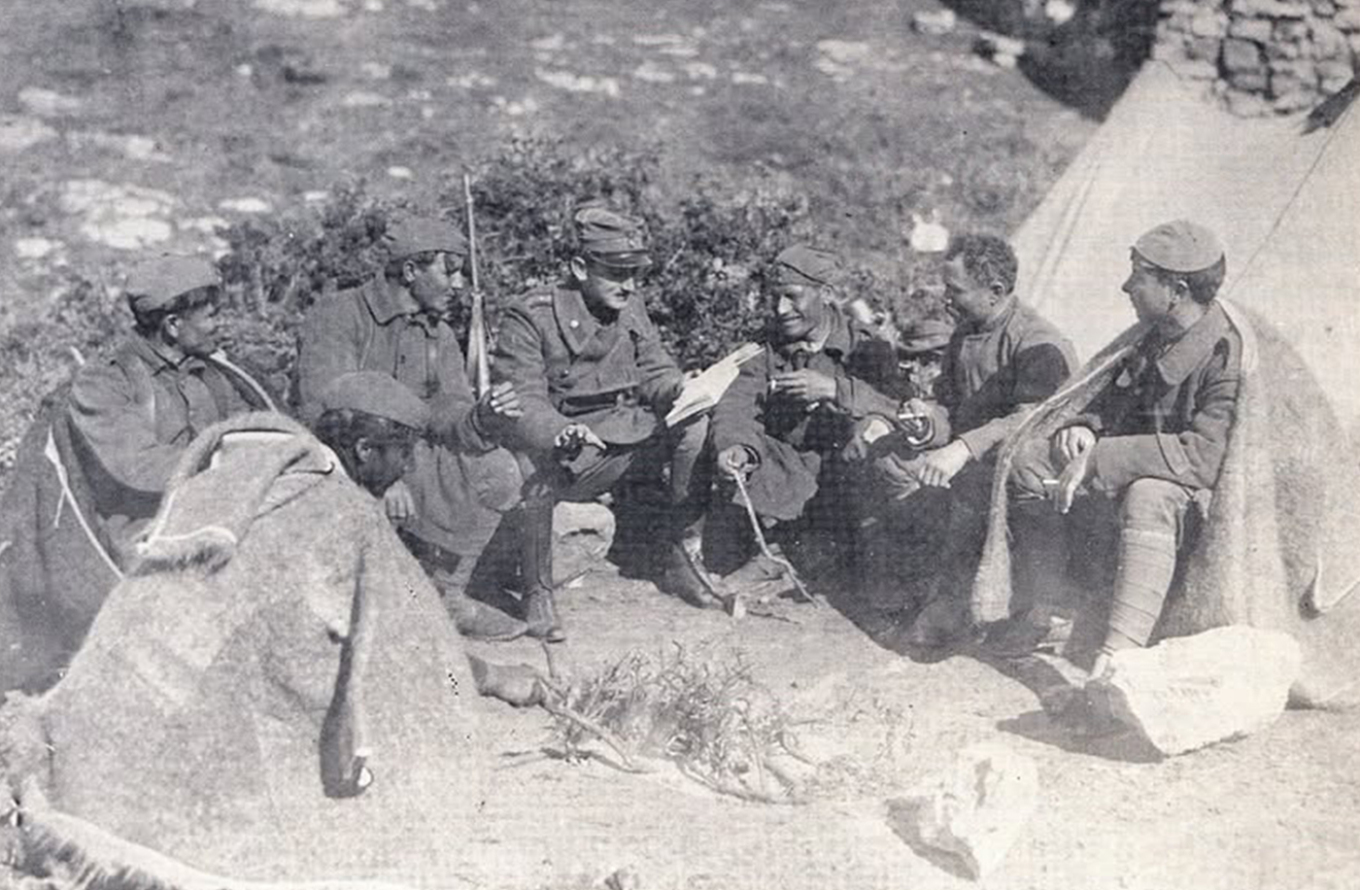
Greek soldiers in Asia Minor
Epilogue
Following the end of the battle on 25 September, the Greek forces held firm control over the heights of Kamelar Dag, west of Tsavdarli, and around Ince Karahisar and Bordi, securing the strategic node of Afyon Karahisar. This was the final major military operation of 1921 and the last Greek victory in Asia Minor. Kemal’s efforts to seize Afyon Karahisar and cut the Greek Army’s lines to Smyrna had failed spectacularly.
The Turks returned to their bases empty-handed. The Greek Army solidified its positions and remained firm throughout the winter, with Kemal unable to mount any serious operations. Greek casualties: 9 officers and 96 soldiers killed, 33 officers and 470 soldiers wounded, and 22 soldiers missing. No data is available on Turkish losses.
Source: Charalambos Nikolaou, Brigadier General (ret.), “The Battle of Afyon Karahisar”, Military History Magazine, Issue 94, June 2004. The map of the Battle of Afyon Karahisar is also from this article.
Ask me anything
Explore related questions