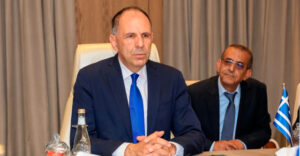
In Tripoli, Greek Foreign Minister Giorgos Gerapetritis is expected to address the major dispute over maritime zones, a matter recently highlighted in Libya’s Note Verbale to the UN.
With all diplomatic cards on the table, Gerapetritis is scheduled to arrive in Tripoli this morning, in the second phase of a difficult mission to restore channels of communication with both factions in Libya. His visit aims to offer a concrete response to Libya’s challenge of Greek maritime boundaries, and to address the broader issue of migration. Meetings are planned with Presidential Council President Mohamed al-Menfi, Prime Minister Abdul Hamid Dbeibah, and Foreign Minister Taher al-Baour.
However, the visit remains contingent on external security conditions, due to frequent armed clashes between militias competing for territorial and political control—even in Tripoli’s outskirts.
Greek Maritime Zones Disputed
Athens had prior knowledge of Libya’s Note Verbale to the UN, which disputes the Greek median line and implies a claim based on the Turkey-Libya Memorandum of Understanding (MoU). Still, the Greek side judged that the existence of this serious disagreement should not delay the visit.
Historically, Greek absence from Libyan affairs has led to unpleasant surprises. Additionally, following Gerapetritis’ recent visit to Benghazi, a cancellation of the Tripoli visit could signal bias toward Eastern Libya, undermining neutrality.
Delicate Balances & Turkey’s Expanding Role
Greece must maintain a precarious diplomatic balance, despite a smoother relationship with Eastern Libya since 2019. The stakes are high, as Turkey intensifies its influence even in Benghazi. Just days ago, Saddam Haftar—son of General Khalifa Haftar—met with the Turkish Consul to discuss reopening Turkey’s consulate in Benghazi. Meanwhile, the Tripoli government signed a new military cooperation agreement with Turkey.
Turkey is working to rehabilitate relations with General Haftar, while maintaining strong support for the Tripoli government—trying to ensure continued leverage regardless of future political shifts.
This Turkish strategy has sparked mistrust on both sides: Haftar remembers that he was prevented from capturing Tripoli in 2019 due to Turkish military intervention, while Tripoli leaders now view Erdogan’s overtures to Haftar with suspicion.
Internal Unrest & Political Crisis
Gerapetritis is arriving at a time when Western Libya is in political turmoil, with various tribal leaders and militia heads calling for the resignation of Prime Minister Dbeibah.
Focus on Maritime Zones
In Tripoli, Gerapetritis will raise the critical issue of maritime boundaries, as reflected in the recent Libyan UN correspondence. He is expected to propose, as he did in Benghazi, the formation of expert-level teams from both sides to begin technical talks on delimitation.
Though Libya has signed—but not ratified—the UN Convention on the Law of the Sea (UNCLOS), such talks could pave the way for referring the dispute to the International Court of Justice in The Hague. The disagreement is already documented through official UN communications from both countries since 2019.
Greece’s Strategy: Diplomacy vs. “Offers”
Greece believes that in response to Turkey’s aggressive diplomacy of “offers” to both Libyan sides, its most potent asset is its EU membership, its seat on the UN Security Council, and its strategic coordination with Egypt and Arab states. These alliances provide persuasive arguments for both Tripoli and Benghazi about the risks of provoking Greece.
Despite Libya’s participation in the Turkey-Libya MoU, it has not taken concrete steps on the ground to enforce its maritime claims. For example, all exploration blocks it has defined lie at or south of Greece’s median line, indicating no active territorial challenge.
Greece’s Position: Creating “Facts on the Ground”
Through Law 4001/2011, and especially the designation of exploration blocks and the licensing process, Greece has established real and strategic claims in the disputed area. This is reinforced by the involvement of ExxonMobil in blocks southwest of Crete and Chevron’s interest in southern blocks.
While corporate participation doesn’t confer sovereignty or sovereign rights, Libya could also offer blocks that overlap the Greek median line to foreign firms. Ultimately, exclusive economic zones (EEZs) can only be established via bilateral agreement or international court ruling.
Looking Ahead
The situation remains uncertain. Any escalation—especially if Washington decides to engage—would be complicated by the presence of major American oil companies like Chevron, who seek a dominant role in the region regardless of regional state rivalries.
In this complex and shifting environment, Greece is trying to maintain presence, balance, and legitimacy—not only through diplomacy, but also through legal and energy strategies with long-term implications.
Ask me anything
Explore related questions