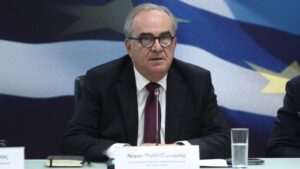
The sixth disbursement request from the Recovery and Resilience Fund, amounting to 2.1 billion. euros in grants, was submitted today to the European Commission by Nikos Papathanasis, the Deputy Minister of National Economy and Finance, Nikos Papathanasis, following the meeting of 39 new milestones and targets.
To date, Greece has successfully completed 5 payment requests and the total amount of disbursements of Recovery and Resilience Fund resources to the country amounts to €21.3 billion, which is more than 59% of the total budget of the National Plan Greece 2.0. With the completion of the 6th request, submitted today, the total disbursements to Greece will now amount to €23.4 billion, i.e. 65% of the total resources allocated to Greece, while disbursements, especially of grants, will reach €12.04 billion, i.e. 66% of the available resources. The request for the €1.8 billion loan tranche will be submitted in September.
The milestones met for the submission of the 6th request reflect implementation progress on projects and reforms in a number of key areas to improve the daily lives of citizens, such as public education, health, social care, reducing energy costs and transport safety.
Including, but not limited to:
– The installation of over 36200 interactive whiteboards in the classrooms of general and vocational secondary schools and high schools as well as in sections of primary schools.
– The completion and operation of the 1st phase of the Electronic Health Record.
– The improvement of the institutional framework for the Personal Doctor.
– The launch of the provision of social benefits to almost 1.3 million eligible citizens through a prepaid card.
– The contracts for the installation of smart LED lighting systems on road networks, as well as for all road safety improvement projects in 7,780 dangerous points of the provincial and local road network. These are more than 150 projects for which regions and municipalities in the country are receiving funding from the Recovery and Resilience Fund.
– The installation of 11,580 photovoltaic systems for which private individuals and farmers were subsidized through the “Photovoltaics on the Roof” and “Photovoltaics in the Field”
Also, with a view to upgrading infrastructure, contracts were signed for the building infrastructure of 9 research centers and funding was approved for 30 proposals for tourist ports. The efficiency of the justice system is being enhanced with the launch of the judicial police and the training of over 7000 judges and court officials in digital skills. The central objective of modernising the public administration is contributed to by the 95% completion of land registration and the completion of the new structure of the Land Registry, while the improvement of the tax administration is supported by the fulfilment of milestones such as the completion of the integration of 400,000 cash registers and POS and their interconnection with Mydata, as well as broader reforms to codify tax legislation and fight tax evasion.
In addition, a series of interventions to promote the country’s energy autonomy were promoted through the REPowerEU project, such as the institutional framework for the installation of storage units in existing or new RES power plants, for self-consumption and licensing the installation of RES power plants in apartment buildings, the provision of incentives to increase the installation and use of smart meters, and the approval of 175MW of electricity storage installation projects.
State Minister, Akis Skertos, stressed: “The timely submission of the 6th request for the disbursement of €2.1 billion from the Recovery and Resilience Fund, following the fulfillment of 39 new milestones and targets, confirms that our country – apart from the implementation of many major projects – continues to fulfill at an intensive pace and many important reforms that change the lives of citizens for the better and are commitments of the “Greece 2.0” plan. This follows the approval by the Commission and ECOFIN of the Revised Plan “Greece 2.0” which added investments and projects that benefit the economy and society, such as the integrated upgrade of the safety infrastructure of the ten largest railway tunnels of OSE using smart systems, the creation of smart crossings in schools and the development of autonomous smart lighting networks on roads under the supervision of the 13 Regions of the country, as well as the supply of an additional 175 electric buses in Athens and Thessaloniki. Furthermore, digital services in the public health sector are being strengthened and the implementation of the Single Digital Map is being extended, with the addition of the system for recording arbitrary construction via satellites and drones. To date, Greece has successfully completed 5 payment requests and the total disbursements of €21.3 billion represent more than 59% of the total budget of the National Plan “Greece 2.0″. With the successful assessment of the 6th tranche, the total disbursements to our country will reach €23.4 billion – 65% of the funds allocated to us and returned to society through projects of substance and vital importance. We aim to continue at the same pace and with the same faith in the many positive changes that the Recovery Fund brings to the lives of citizens, especially the most vulnerable groups of the population.”
Deputy Minister of National Economy and Finance, Nikos Papathanasis, said: “The 6th request for the disbursement of resources from the Recovery and Resilience Fund, following the completion of 39 additional milestones and targets, is the continuation of the Government’s daily effort so that every available euro is directed to the benefit of society and the economy, and the country remains among the top positions among EU member states in terms of absorption of European funds. With plan and determination we accelerate the reforms that the country needs, we implement our commitments to our fellow citizens, with the central goal of further increasing investment and jobs, double convergence both in terms of income with the rest of Europe, and in terms of balanced regional development throughout the country’s territory.”
The Deputy Minister to the Prime Minister, Thanasis Kontogeorgis, noted: “With the submission of the 6th request for the disbursement of 2.1 billion euros in grants, under the National Recovery and Resilience Plan “Greece 2.0″, confirms the achievement of important milestones linked to reforms and investments aimed at strengthening the business environment, improving the daily life of citizens in the critical areas of education, health, transport safety and social cohesion, as well as easing the burden associated with energy costs. We continue our intensive cooperation, with determination and responsibility for the successful completion of the programme within the agreed timeframes for the benefit of all our fellow citizens.”
Recovery Fund Governor, Orestis Kavalakis, said: “The 6th payment request for €2.1 billion in grants from the Recovery and Resilience Fund has been submitted to the European Commission. The fulfilment of 39 milestones and targets demonstrates the consistency with which investments and reforms are being implemented in areas such as health, education, public administration and energy independence. We remain committed to making full use of the available resources.”
Secretary General for Coordination, Evi Dramalioti stressed: “The submission of the 6th payment request of €2.1 billion, covering almost 70% of the reform commitments of the National Recovery and Resilience Plan “Greece 2.0″, demonstrates the effective coordination of government agencies and our determination to make substantial changes. The 6th payment request includes a wide range of reforms implemented through 22 reform milestones. Among the key interventions stand out the institutionalisation of the personal physician, the adoption of the new spatial strategy for the maritime space, the adoption of legislation on the professionalisation of public procurement, the implementation of the framework for self-consumption of energy and the simplification of licensing procedures for the installation of renewable energy plants in multi-family houses. Our goal is to continue to work systematically towards the successful completion of the Programme, ensuring that each reform multiplies the value of investments to maximise their impact on society.”
Ask me anything
Explore related questions