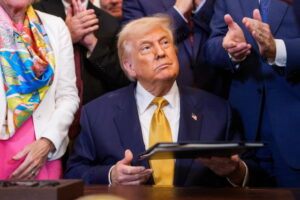
Republican President Donald Trump signed an executive order yesterday (Thursday) calling on municipalities and states to dismantle any homeless encampments and transfer people living there to treatment centers, a move that advocates for people living in trouble warn will only make it worse.
The order instructs Attorney General Pam Bodie to overturn legal precedents at the state and federal levels and to consent to local initiatives to dismantle homeless encampments.
It is unclear, however, how Ms. Bodie could overturn such decisions.
The ordinance follows a 2024 federal Supreme Court ruling that allowed municipalities to outlaw homeless camps.
The collective National Coalition for the Homeless denounced the ordinance, stressing that it undermines legal means to protect the homeless and mentally ill.
According to the organization, the Trump administration has a “troubling track record” as it tends to “defy civil rights and due process of law.” The coalition warned that with this executive order, the asthma crisis is likely to get worse.
President Trump said in the executive order that those living in camps should be transferred to mental health treatment centers or rehabilitation centers. He made no mention of any plans to expand these centers, or to provide cheap housing in the long term.
In 2024, it was estimated that homelessness in the US was over 770,000. That’s an 18% increase, according to a relevant public authority, the Interagency Council on Homelessness.
Of those people, 36 percent were living on the streets, in vehicles or in camps, according to official data.
According to a National Homelessness Law Center, this ordinance, combined with budget cuts to funds earmarked for housing and health care, will further increase the number of homeless people.
He also stressed that the mandatory transfer of homeless people to treatment centers is “unethical, inefficient and illegal” and that the White House plan will turn even more people into homeless people while depriving resources from people who need them.
Other organizations believe the order threatens to criminalize homelessness, as it will force people off the streets without any guarantee that housing will be found for them.
Some scholars of the phenomenon believe that the homelessness crisis began when mental hospitals were closed in the 1960s and 1970s and community-based care was promoted. They explain that this transition was made without adequate funding and inefficiently, leaving people with serious mental health problems without treatment and shelter.
Other causes are thought to include an acute shortage of cheap housing, an increase in the proportion of people plagued by poverty, and cuts to assistance programs that provided access to workforce housing and publicly subsidized housing programs, according to these experts.
The executive order prioritizes donations and funding to cities that have imposed and enforced bans on camping in public spaces, substance abuse, and squatting.
It also prevents funding for the creation of controlled drug use sites.
Ask me anything
Explore related questions