





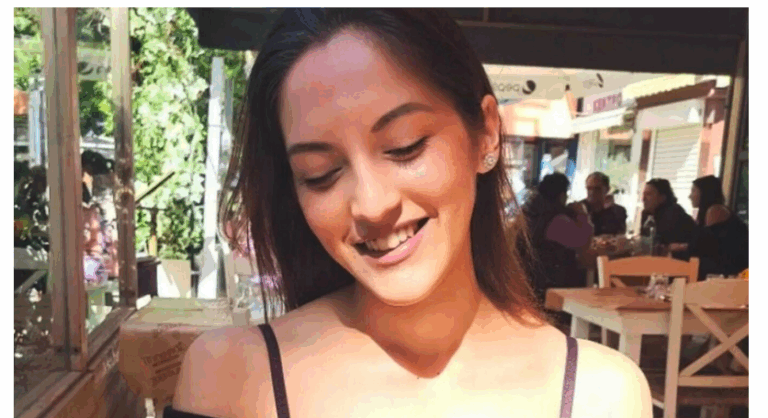
In a powerful and emotional address to the Athens Mixed Jury Court, prosecutor Vasiliki Demopoulou laid out the case against the 40-year-old man accused of brutally murdering 28-year-old Kyriaki Griva outside the Agioi Anargyroi Police Station.
Demopoulou began by painting a picture of Kyriaki’s life — her childhood, her values, and the dreams she carried. Despite her parents’ separation, Kyriaki grew up in a loving, supportive environment. The prosecutor described her as a kind, honest, and moral young woman who was full of hope and deeply connected to her community. “She was a child with dreams, good-natured, with clear intentions,” Demopoulou said. “She had dreams — so many dreams — and a pure heart.”
Turning to Kyriaki’s relationship with the accused, the prosecutor revealed that it ended in 2024, primarily due to his abusive behavior. Family members testified to his violent outbursts and controlling nature. One especially telling quote came from Kyriaki herself, who once told her mother: “Mom, he’s jealous of me, so he loves me.” Demopoulou pointed to this as a tragic example of how deeply psychological manipulation had taken hold.
Witnesses spoke of repeated abuse, the man’s use of alcohol and drugs, and his need to control every aspect of Kyriaki’s life. Her sister recalled seeing bruises on her face and described a time when he attacked Kyriaki simply because she had gone out without him.
The most serious testimony came from Kyriaki’s sister, who said that in the final year of her life, Kyriaki lived in constant fear. Multiple witnesses described the accused as manipulative and controlling. “He viewed her as his property,” the prosecutor said, detailing how he tried to cut her off from friends and family. He even gave her a smartwatch — not as a gift, but as a way to track her every move. “He knew when she boarded the bus and exactly where she was,” Demopoulou added.
The prosecutor also addressed an incident involving a terminated pregnancy, revealing two conflicting accounts: one suggesting rape, the other pointing to emotional trauma inflicted by the accused. Despite this, the couple reunited a month later — part of what Demopoulou described as a troubling cycle of separation and reconciliation.
In 2023, the accused reportedly attempted suicide three times and was hospitalized in Dafni Psychiatric Hospital. During this time, Kyriaki was emotionally drained, often left to manage his mental health crises while sacrificing her own well-being.
One of the most heart-wrenching moments in court came when Demopoulou read aloud from a letter Kyriaki had written in a pink notebook. It was a quiet plea for freedom:
“I wanted us to live a lot together, but I can’t take any more in this relationship. I gave everything I had, but I can’t take it anymore. I tried to want you, to love you, to not be afraid of you. Do you care if I wear a skirt or jeans? If I’m late for the bus? You want me to think that’s normal… I don’t want someone who swears and yells and breaks things at the first opportunity. I really wanted you to change… I don’t know if you’ll change in the future, but I won’t be there to see it.”
Demopoulou paused before adding, “And she wasn’t. That’s the tragic irony.”
The prosecutor then described the final moments of Kyriaki’s life in chilling detail. “That’s when the last two minutes of her life began,” she said. The accused had already parked his motorcycle before launching the fatal attack — just two meters from the police station guard post. He stabbed her repeatedly with such force that her bones were broken. She collapsed in the street, bleeding.
Digital forensic evidence showed that the attack was planned and methodical. “The accused acted with full awareness and control,” Demopoulou said, breaking down his movements in chilling precision. In just 28 seconds — the brief window before a security guard appeared — he delivered five stab wounds. The prosecutor dismissed his claims of diminished responsibility, insisting the murder was premeditated and not the result of a mental health crisis.
Demopoulou also addressed the superficial neck wounds the accused inflicted on himself after the murder. “Why did he injure himself?” she asked. “Because he knew exactly what he had done. He didn’t want to die — or he would have. He wanted to appear mentally unstable, to earn sympathy. But make no mistake: this man is obsessed. His jealousy isn’t just extreme — it’s pathological. Is it love? I don’t even know what to call it,” she said, her final words echoing through the courtroom.
Ask me anything
Explore related questions




