A tougher strategy against Turkey is being adopted by the Greek government, recognizing—19 months after the signing of the Athens Declaration—that Ankara is not willing to take the next step toward resolving the continental shelf/EEZ delimitation dispute. Turkey seeks to exploit the rapprochement process so that the “calm waters” are perceived as the… quid pro quo for Greece voluntarily abstaining from exercising its basic sovereign rights.
Athens, amid a highly fluid international environment that favors Turkey’s pursuit of a stronger regional role—along with the tolerance even from European partners due to Turkey’s upgraded strategic position—recalibrates its strategy to exercise its sovereign rights. This is being done in a way that, so far, avoids tension and escalation on the ground, something Athens wishes to prevent for multiple reasons.
Even more so, when in the White House, Donald Trump is not among those leaders who particularly heed arguments concerning International Law and the Law of the Sea, but rather has a transactional, business-oriented approach to resolving interstate disputes and crises.
Greek-Turkish relations have been marked over the last three decades by four major Turkish actions: the declaration of casus belli (1995) over a possible extension of Greece’s territorial waters to 12 nautical miles; the emergence of the “gray zones” theory through the Imia incident (1996); the Turkey-Libya memorandum (2019); and the unilateral submission of coordinates for the outer limits of Turkey’s EEZ within the boundaries of the “Blue Homeland” (2020).
The Mitsotakis interview
Prime Minister Kyriakos Mitsotakis, in his interview with SKAI last Wednesday, laid out the framework with which the government now approaches Greek-Turkish relations:
“Greece does not discuss issues of sovereignty with Turkey. Greece will never accept any theory of ‘gray zones’ and will never allow Turkey to dictate what we can or cannot do within areas of Greek sovereignty.”
The prime minister denounced the “doctrine of immobility” in Greek-Turkish affairs, indirectly criticizing the Karamanlis administration, and defended the policy of “calm waters,” emphasizing, however, that without resolving the continental shelf/EEZ delimitation issue, normalization of Greek-Turkish relations cannot occur.
Indeed, he did not shy away from referencing problems—even in convening the High Council for Cooperation (originally scheduled for January)—pointing to his upcoming meeting with President Recep Tayyip Erdoğan on the sidelines of the UN General Assembly in September, where, he said, all these matters will be addressed.
Athens is now focusing on promoting measures and decisions that affirm the exercise of sovereign rights, despite Ankara’s objections, warnings, and threats, while avoiding initiatives that could offer Turkey the opportunity to provoke even a hot crisis.
In a broader framework, these actions include: signing a partial EEZ delimitation agreement with Egypt, the EEZ agreement with Italy, extending territorial waters to 12 nautical miles in the Ionian Sea, establishing the framework for Marine Spatial Planning (the final form and submission to the Commission is still pending), announcing a licensing tender for plots south of Crete, and the Marine Park of the Southeastern Cyclades.
Thus, the government declares that it does not intend to abstain from exercising sovereign rights as long as no agreement with Turkey or Libya on maritime zones exists, while also marking the area of Greek interests under the Law of the Sea.
The possibility of an incident, while not excluded, seems remote—even if environmental plans involving the Marine Park’s islets or fishing bans (which concern territorial waters of 6 nautical miles) go ahead. Even if exploration begins—if the Chevron process proceeds for plots south of Crete—it might provoke diplomatic reactions from Libya, but would hardly legitimize Turkish action.
Kinaros and Levitha
It is equally difficult to justify to the international community a direct Turkish challenge of Greek sovereignty over the islet cluster of Kinaros and Levitha, east of Amorgos.
Athens now awaits Turkey’s announcement of its own Marine Parks, which will follow the delineations of Turkey’s Marine Spatial Planning map. It will then be revealed, in the first phase, how far Ankara intends to push, and whether it will attempt to include islets it contests Greek sovereignty over or maritime areas potentially belonging to Greece—something that would clearly trigger strong reactions and tensions.
The critical test, however, is the research for the Cyprus–Crete electrical interconnection cable.
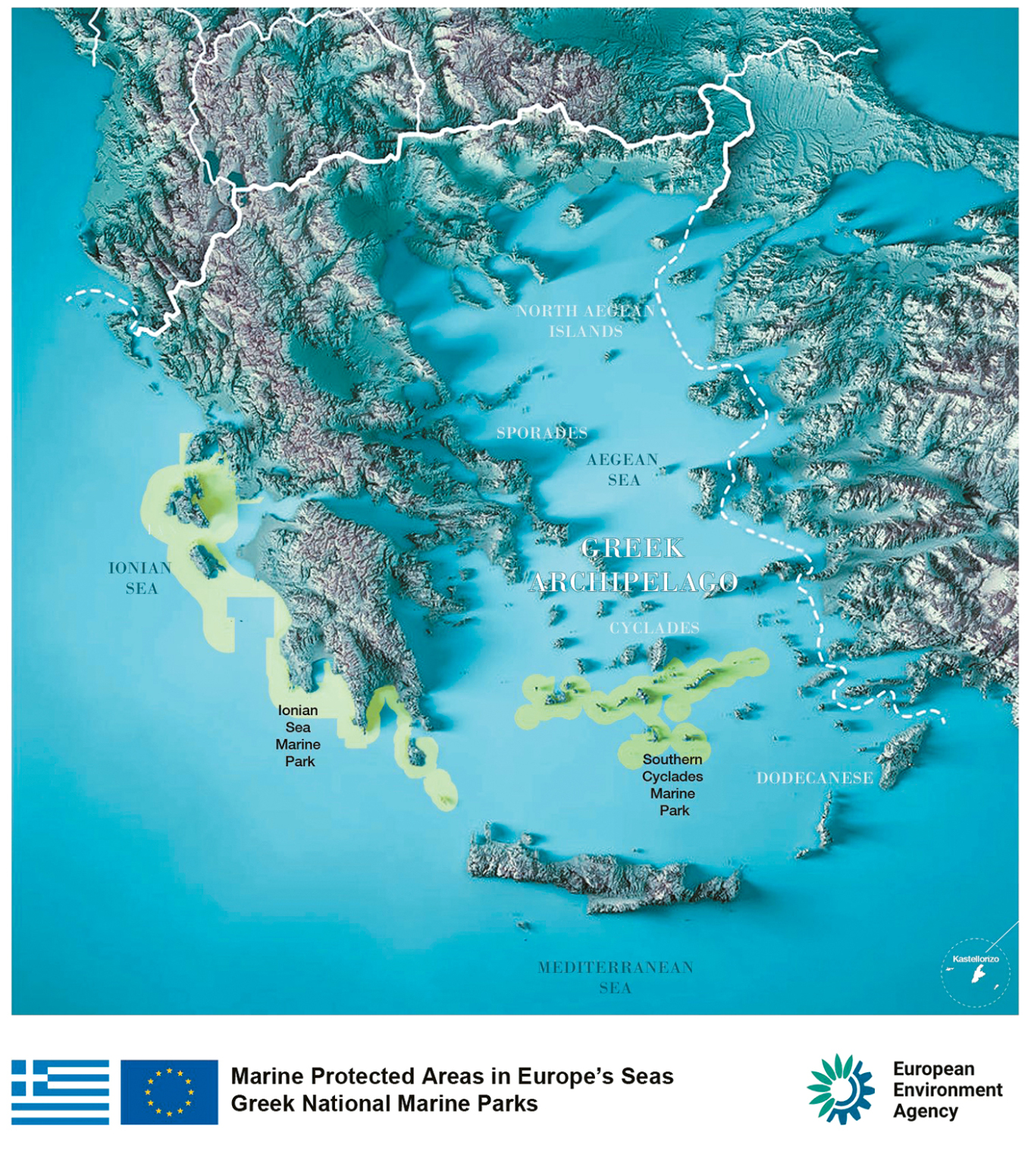
The maps of the marine parks announced by the government.
In the Southeastern Cyclades park, the islets of Kinaros and Levitha are included, along with the nearby rocky islets of Mavra and Glaros, which administratively belong to the Dodecanese and have been included by Turkey in its “gray zones.” Thus, Athens sends a clear message to Ankara that it will not accept any questioning of its national sovereign rights.
Last July, in this practical exercise of Greece’s sovereign rights, Turkey escalated tensions militarily by sending warships. In the case of the cable, Turkey is attempting indirect recognition of jurisdiction in an area it characterizes as “Turkish continental shelf,” demanding the related NAVTEX be issued from the Antalya station.
One year later, despite multiple meetings between Giorgos Gerapetritis and Hakan Fidan, no “technical” arrangement was found to allow work to continue. This creates a serious pending issue, not only with political and diplomatic, but also significant economic implications.
With Libya, the Greek government—albeit with great delay and under pressure from Tripoli’s unilateral submission of coordinates for the outer limits of its EEZ (as part of the Turkey-Libya Memorandum, overlapping a significant part of Greece’s continental shelf)—began the licensing process for plots south of Crete, aligned with Greece’s median line, as unilaterally defined under Law 4001/2011.
Thus, the Turkey-Libya Memorandum is practically challenged (as has also occurred with the southeastern Crete plots) on the Libyan side of the delimitation.
The Libyan reaction
Of course, how Libya reacts—given the country’s dire situation—will become clear once research begins in these areas and if exploratory drilling is eventually undertaken. It remains to be seen whether Tripoli will turn to Ankara once again for support.
However, the fact that Libya currently seeks foreign investors and oil companies, including Chevron and other American and European firms, makes the scenario of provoking a crisis by inviting Turkey for action on the ground unlikely.
Still, as long as the issue remains unresolved, it will be an “open front” for Greece. Athens’ effort to initiate negotiations for delimitation or referral to The Hague with both Tripoli and Benghazi—presented during Foreign Minister Giorgos Gerapetritis’ visits (where, according to Mitsotakis, technical committee meetings will be held soon)—is not an easy matter.
Libya insists that any process must accept the Turkey-Libya Memorandum as a given, something Athens categorically rejects.
There is, of course, the option of referring the matter to the International Court, including a request for a ruling on the memorandum’s legality.
For now, given Libya’s political situation, progress in such discussions seems extremely difficult—partly due to internal competition and also because there is essentially no reliable and legally valid counterpart with whom to proceed with an agreement or compromis.
In the coming period, Greece’s diplomatic note to the UN will be submitted in response to Libya’s two corresponding notes, providing a comprehensive reply: to the Turkey-Libya Memorandum and Libya’s unilateral claim to the continental shelf south of Crete.
There, answers will also be given on specific issues raised, such as: the Greece–Italy EEZ delimitation agreement, the Ionian territorial waters extension to 12 nautical miles, the rejection of Tripoli’s claim that islands are not entitled to maritime zones, and the closure of the Gulf of Sirte—violating the relevant provisions of the Law of the Sea.
Naturally, there will be an extensive presentation of the reasons why the Turkey-Libya Memorandum is not only illegal but also irrational. This carefully prepared document will essentially constitute Athens’ opening position in any negotiation with Libya.
Athens continues efforts to freeze the ratification of the Turkey-Libya Memorandum by the parliament in Tobruk, while the visit to Athens by the speaker, Aguila Saleh, remains pending—amid Ankara’s ongoing charm offensive toward Eastern Libya.
Close cooperation
Given that Libya has also turned against Egypt regarding maritime zones, there is now an opportunity for even closer cooperation between Athens and Cairo to confront these destabilizing moves encouraged by Ankara.
Mitsotakis and Abdel Fattah el-Sisi, in their recent phone call, emphasized the importance of continuing cooperation and coordination between the two countries on maritime zone issues in the Eastern Mediterranean, for the benefit of security and stability in the region—sending a clear message to both Tripoli and Ankara.
Another open front is in the EU, where Turkey, highlighting its geopolitical weight and strengthened defense industry, seeks exemption from obligations to accelerate EU-Turkey relations.
Regarding Europe’s rearmament program, Athens—as clarified by the Greek prime minister—will not accept deals allowing Turkey to participate in 65% of the program as long as challenges to Greek sovereignty remain on the table.
In this effort, Greece must also confront the stance of many EU partners who favor Turkey’s involvement in European defense, as seen in recent developments around Turkey’s purchase of 40 Eurofighter Typhoon jets.
Ask me anything
Explore related questions