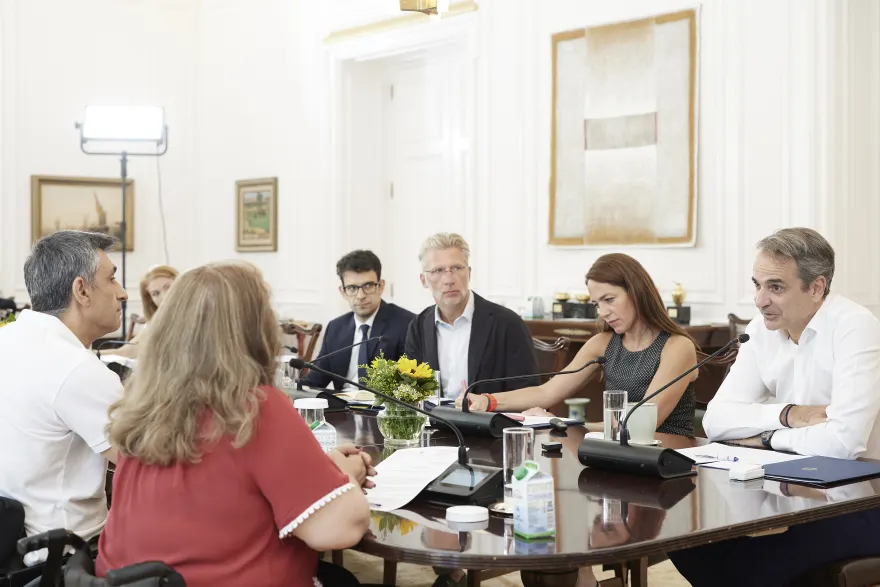
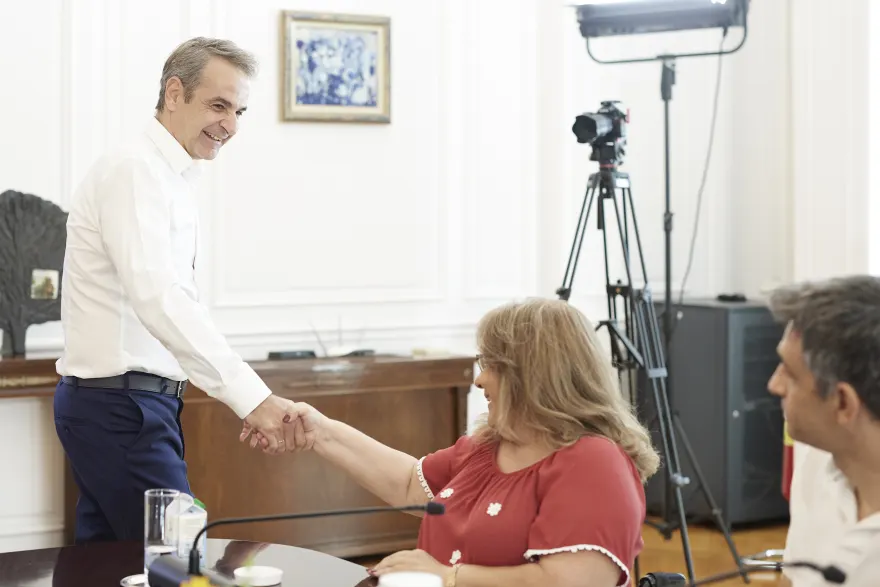
Prime Minister Kyriakos Mitsotakis met today at the Maximou Mansion with representatives of the disability community, with whom he discussed the progress of the “Accessibility at Home” programme, through which the state for the first time subsidises projects, such as the construction of a ramp or the installation of an access ramp, which ensure unhindered access for people with disabilities to their homes or workplaces.
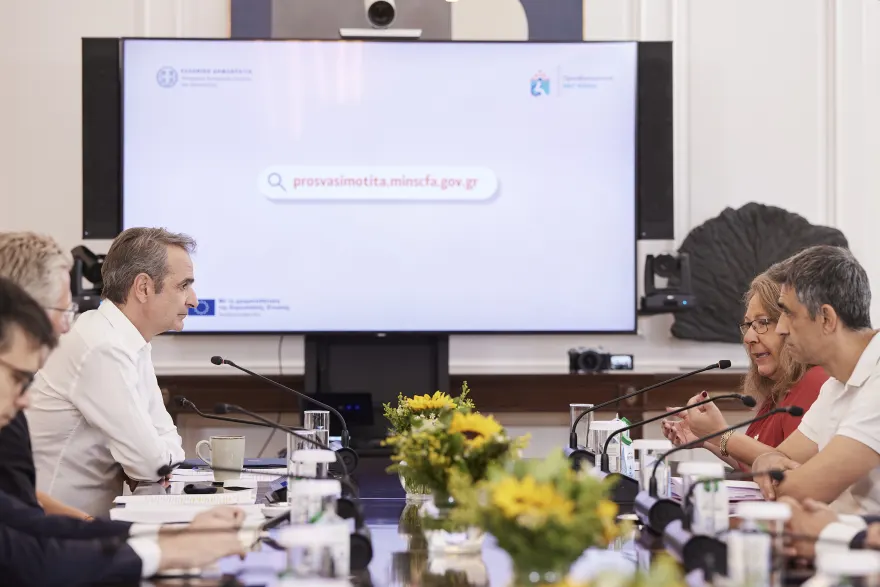
Government sources said that during the meeting, the Prime Minister noted that the programme’s budget will be boosted with national resources of €10 million, reaching €34 million, to serve more citizens, given that in just the first 24 hours after the relevant platform (https://prosvasimotita.minscfa.gov.gr/) went live last week, some 2,500 applications were submitted, representing almost all the funds initially available.
During the presentation of the programme’s progress, made by Social Cohesion and Family Minister Domna Michailidou, it was noted that the projects eligible for funding were selected after a dialogue with organisations of the disability community, so that they have the maximum possible impact on the daily lives of people with disabilities and people with chronic illnesses. In this context, “Accessibility at Home” covers work in main and holiday homes, both owned and rented, communal areas of apartment buildings, and workplaces.
“Our home is our sanctuary. Especially for our fellow citizens who have a disability, the ability to be able to move comfortably within their home without feeling like they are making discounts or concessions from what they would expect is extremely important. And I am glad that we have the opportunity to come as a state by utilizing European and national resources to meet this important need of yours,” the prime minister said, according to government sources.
“The direct beneficiaries should have the first say, so that they help us in the specificity of the design of the program, because only you can know the specificity of each case,” added Kyriakos Mitsotakis.
Eligible are accessibility interventions due to mobility disability, such as the construction or modification of a ramp, the installation of a passageway or a special lift, the reconstruction of a bathroom for use with a wheelchair and the adaptation of interior spaces, as well as interventions due to sensory disability (e.g.(e.g. vision, hearing), such as audio and light signage, call/alarm notification lights, hearing or sensory guidance systems and digital assistive devices (talking devices, screens with special functions). For interventions due to a motor disability, the subsidy is up to EUR 12,000, and for interventions due to a sensory disability, the subsidy is up to EUR 5,000. Where a combination of interventions is required, the amount of the grant is increased to up to EUR 14,500. 50 % of the grant is paid in advance upon approval of the application. Payment is made after confirmation of the completion of the works. Beneficiaries of the programme are persons with a disability rate of 67% or more and an individual income of up to 60,000 euros.
Representatives of the disabled community organisations welcomed the programme, stressing that it satisfies a long-standing request.
“It is a program that we have been asking for years, and as ESAMA, disability movement, and our associations, and everyone and in our conversations. It is very important because our disability is determined by accessibility,” noted Korina Theodorakaki, secretary of the National Federation of the Disabled with Mobility (EOKA). “It is a pioneering action and we have to say it, it has never been done before,” she added.
“The cooperation with the National Confederation has been excellent and productive. Besides, with the applications in such a short period, it is self-evident that its success is significant,” said, for his part, Vassilis Koutsianos, secretary general of the National Confederation of Persons with Disabilities (NCDD). “The National Confederation, and with its member bodies, has been claiming this program since 2015 Mr. Therefore, it is very important that it is being implemented, albeit belatedly, and we have to be fair and credit it to you, because it is your effort.”
He continued.
The ease of use of the platform was highlighted by Christos Koromilas from the Board of Directors of the “Lighthouse for the Blind”. It was so easy, three steps, all pre-filled and all ready to go.”
Dimitris Athanasiou, vice president of the Association of Rare Patients of Greece, expressed his satisfaction with the program. “We couldn’t believe it when we were informed about it,” he said, stressing the importance of prevention. “Disability for us is a path: prevention, early diagnosis, and treatment with these measures. We believe that measures in the field of prevention will also come.”
He said.
The “Accessibility at Home” programme is part of a wide range of actions for equal access of people with disabilities to the labour market and society. During the meeting, special reference was made, among other things, to the initiative for subsidised replacement of conventional wheelchairs with electric wheelchairs. It was also stressed that the interventions made in sanitary facilities of public schools, within the framework of the “Marietta Giannakou” programme, necessarily include the installation of access infrastructures.
Ask me anything
Explore related questions