





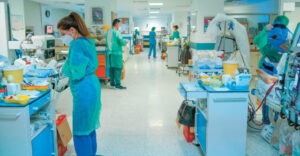
The Ministry of Health is systematically reconstructing the flow of patients through public hospital Emergency Departments (EDs) using data from the new electronic “bracelet” system, a digital tracking tool now in use at 10 hospitals across Greece.
According to data obtained by Proto Thema, since mid-May when the system was implemented at Evangelismos Hospital, nearly 29,600 people have worn the bracelet, supplying authorities with valuable real-time information about the functioning of Emergency Departments and laboratories — especially wait times.
The bracelet is a digital tracking device applied during hospital on-call shifts. It allows for the monitoring of a patient’s journey through the ED, and has been deployed in 10 major hospitals across the country.
The impact so far
Long waiting times in ERs have long been a persistent issue for Greek healthcare. Health Minister Adonis Georgiadis has made reducing ER wait times — especially in Attica — a key priority. The goal is to bring wait times closer to European standards, approximately 4.5 hours.
For the first time, data from this system provides a full picture of average patient wait times — from entry into the ER until either discharge or hospital admission — as well as wait times within individual hospital departments. The system also enables real-time monitoring so that immediate corrective actions can be taken where needed.
At hospitals using the system — including Evangelismos, Laiko, Agioi Anargyroi, KAT, Aglaia Kyriakou Children’s Hospital, G. Gennimatas, Sismanogleio, Attikon, and Patras University Hospital — the average time from patient arrival to triage and referral to a medical department is 32 minutes.
Variable wait times by specialty
Wait times vary based on the severity of the case and medical specialty. For instance:
- In Neurosurgery, Rheumatology, and Hematology, the average wait exceeds 2 hours (2:10, 2:11, and 1:55 respectively).
- For Internal Medicine, Neurology, Cardiology, Thoracic Surgery, Gastroenterology, and Ophthalmology, average wait times are around 1 hour.
Waits also increase due to necessary lab and diagnostic tests:
- X-rays: 12 minutes
- CT scans: 38 minutes
- Ultrasounds: 30 minutes
- EKGs: 6 minutes
- Microbiology: 43 minutes
- Biochemistry: 28 minutes
Given that many patients must visit more than one department and undergo multiple evaluations and test reviews, it’s easy to see how total time in the ED can stretch into several hours — even when hospital staff move quickly.
Breakdown of cases
Among the 29,592 patients who wore bracelets over the past two months:
- 11,162 visited Orthopedics
- 5,660 Surgery
- 5,634 Internal Medicine
- 2,486 Cardiology
- 2,168 ENT
- 1,804 Urology
- 1,458 Neurology
Since the system’s launch on May 16, hospitals recorded:
- 10,778 X-rays
- 3,529 CT scans
- 2,656 ultrasounds
Need for Primary Healthcare (PHC)
At Evangelismos, where the system has been active for over two months, the average total ED wait time is now 5 hours and 56 minutes — down from previous averages of 7 hours or even double that. This reduction is considered a significant achievement.
Still, data from last Tuesday’s on-call shift at Evangelismos illustrates the need for stronger Primary Healthcare services:
- 59 patients were tagged with a red bracelet (very serious cases)
- 181 with orange (serious)
- 256 with yellow (moderate), cases that could have been handled by PHC centers.
The average wait for yellow-tagged patients was 5 hours.
At the children’s hospitals “Aglaia Kyriakou” and “Agia Sophia,” the situation is calmer in the summer months. In recent shifts, no red-tagged cases were recorded, and most pediatric visits were of mild severity (yellow tags).
What’s next
The Health Ministry aims to expand the bracelet system to 100 hospital ERs by January 2026. While the digital system is a step forward, it doesn’t solve staff shortages or the lack of effective primary care, which are root causes of overcrowded ERs.
Nonetheless, the measure is part of a broader effort to improve Emergency Department operations and reduce both wait times and patient suffering. Complementary steps include:
- Hiring 500 orderlies through DYPA (Manpower Employment Organization)
- Renewing contracts for ~1,300 older workers (aged 55–67)
- Planned recruitment of doctors, nurses, and support staff
In addition, four Health Centers in Attica have been included in the on-call rotation, operating 24/7 or until 10 p.m., to handle walk-in patients with mild conditions that don’t require ER-level care.
Ask me anything
Explore related questions




