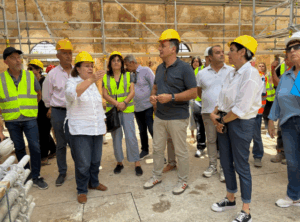
Inspection of the Bayezid Mosque, under restoration, in Didymoteicho, was carried out by the Minister of Culture Lina Mendoni, head of an official team, as part of a working visit to monitor the progress of the project, which is part of the Ministry’s strategy for the protection and demonstration of the cultural heritage of Thrace. According to today’s announcement by the Ministry of Culture, the project, with a total budget of about 12,500,000 euros, is financed by the Ministry of Culture with resources from the Recovery and Resilience Fund and the National Development Programme.
This is a complex and technically demanding restoration, with a strict implementation schedule, whose completion is identified in the first quarter of 2026, while, as the same announcement informs, the Mosque is being restored concerning its historical stratification, to highlight the architectural and construction characteristics of each phase, making its evolution over time readable.
As Lina Mendoni said. Since July 2019 until today, 70,000,000 euros have been invested in Evros in the field of culture. Culture for us is defence and this is best understood by those who live here on the border, the Evrites. The work on the Bayezid Mosque, which, according to the inscription on its entrance, was inaugurated in March 1420, is progressing at a very satisfactory pace, after a number of difficult issues that arose during the course of the project were resolved. A monument hides too many contingencies. In the case of the mosque, the unexpectedness was even greater, due to the time of its construction, the fire, the building material and the way it was built by its creators. The painstaking work of laying the wood for the roof has already begun. The project will be completed on the timelines set by the Recovery and Resilience Fund. Likely, the first quarter of 2026 will also be required, due to the multiple unforeseen problems that the monument has highlighted, to restore it to its best possible condition. And it is being done.”
According to a statement from the Ministry of Culture, the minister, climbing to the highest levels of the working scaffolding, which reaches 18 meters, had the opportunity to see the construction work on the wooden roof of the monument and the restoration of the minaret. This is natural pale oak timber, particularly large in cross-section and length – some beams have a cross-section of 0.35 x 0.45 and are 13.5m long – sourced from sustainably managed forests in France, Switzerland and Germany. The timber used in the reconstruction of the mosque’s roof was dimensioned and certified for strength by respective local sawmills, according to the specifications set by the approved study. Most of the timbers of the roof bearing on the roof of the walls and the first layers on the inner pickets of the monument have already been installed.
At the same time, the deconstruction of the minaret up to the crowning of the masonry is in progress, in order to complete its structural restoration, with the reuse of the material that has not been damaged by the fire, and its completion with new material. The Bayezid Mosque in Didymoteicho is an emblematic monument, one of the most important of the Ottoman Empire. It covers an area of almost an acre and consists of a square prayer hall and a minaret in the western corner. The fire that broke out on 22 March 2017 destroyed the roof of the Mosque, making it imperative that it be fully restored.
The minister was accompanied by MP P.E. Evros, Anastasios Dimoshakis, the General Secretary of Culture George Didaskalou, the Mayor of Didymoteicho Romulus Hatzigiannoglou, the Director General of Antiquities and Cultural Heritage of the Ministry of Culture Olympia Vikatou, the head of the Directorate of Byzantine and Post-Byzantine Monuments Themistocles Vlachoulis, the head of the Projects Division of the Directorate, Efi Chorafa, the head of the Directorate of Conservation of Ancient and Modern Monuments, Maria Mertzani, the head of the Evros Antiquities Ephorate Domna Terzopoulou and officials of the Ministry of Culture.
Presentation of the research project for the restoration and promotion of the Castle of Didymoteicho
Then -as the Ministry of Culture’s announcement points out-, the presentation of the research program prepared by the Ministry of Culture in cooperation with the Aristotle University of Thessaloniki, for the prioritization and methodology of the interventions for the restoration of the Castle of Didymoteicho, its protection and its functional interconnection with the urban environment, was held at the Byzantine Museum of Didymoteicho. Lina Mendoni noted that: “The Castle of the “Twin Walls”, the most important in the territory of Thrace, is located on top of the Kale hill, which dominates the city of Didymoteicho and is built on top of dozens of carved caves. It is not only its important geostrategic position, the pass on which it is located, but also its very high historical and archaeological value. Among the commitments we made was the preparation of a comprehensive management plan for the castle of Didymoteicho. It was something for which we felt that we could not intervene in isolation, point by point, without an organised plan, including from the historical and archaeological documentation of the monument, to the specific interventions that need to be made for its restoration and its reintegration into the urban fabric of Didymoteicho. With the cooperation of the competent services of the Ministry of Culture and the scientists of the Aristotle University of Thessaloniki, we developed this holistic strategic planning and at the same time, through it, specific studies emerged. The restoration of the entire Castle is a long-term and long-term project, which requires a great deal of resources. However, the first phase is starting immediately, as this study has provided all the information necessary for the Directorate of Byzantine and Post-Byzantine Monuments to put out to tender the first phase of the restoration with funds from the Regional Operational Programme for Eastern Macedonia and Thrace – NSRF 2021-2027. Once again, I thank my friend Regional Governor Christodoulos Topsidis for our excellent and constructive cooperation.”
In the first phase of the research project, applied research was carried out for the analysis, mapping and historical, architectural documentation of the entire monument, and examined the pathology of the monument at the level of the whole and its parts. In the second phase, priorities were identified based on a costed strategic plan for planning the required interventions to enhance the monument, with an emphasis on the sections with the most critical structural problems. The reconstruction of the site included the restoration of routes and the immediate surroundings.
Based on the results of the project, immediate interventions are being initiated at the two gates: Bridge Gate and Market Gate, and four towers: P1, P2, P3, and P4. The cobblestones on the paths between the two gates are being restored to improve mobility. Inside the Castle, cavities are being maintained, and spot restorations are being carried out on the walls, with priority given to sections where masonry collapses have occurred. A staging and viewing area is also being created towards Tower 1, also known as the Tower of Vasilopoula. At the same time, some expropriations and the management of abandoned structures are necessary.
In its present form, the castle dates back to the 6th century AD. In the Byzantine Empire, Didymoteicho was an important centre, commercial, administrative and military. Its important geostrategic position had been noted since ancient times. Its strong fortification, with thick walls that formed its enclosure, also contributed to this. The castle today is preserved along most of its length. A total of 24 towers are located along the 1,300-metre-long perimeter of the walls.
Within the castle’s enclosure there are scattered carved caves, which were used as parts of dwellings. According to historical sources, the walls of Didymoteicho were reconstructed under Justinian and reinforced in 751 AD, under Constantine V and later in 1303. In 1713-14, the castle of Didymoteicho was the semi-confinement residence of King Charles IV of Sweden. Inside the castle’s enclosure there is a small stone church and the present Armenian church of St. George (Surp Kevork). It is built on the site of the Byzantine church of St. George of Paleokastriti, where on October 26, 1341, John VI Kantakouzenos was crowned emperor.
The presentation of the research project, in the crowded hall of the Byzantine Museum of Didymoteicho, was attended by the Metropolitan of Didymoteicho Damaskinos, MPs P.E Evros Stavros Keletsi and Anastasios Dimoshakis, the regional governor of Eastern Macedonia-Thrace Christodoulos Topsidis, the General Secretary of Culture George Didaskalou, the mayor of Didymoteicho Romulus Hatzigiannoglou, the Director General of Antiquities and Cultural Heritage Olympia Vikatou, the head of the Directorate of Byzantine and Post-Byzantine Monuments Themistocles Vlachoulis, the head of the Evros Antiquities Ephorate Domna Terzopoulou, the heads of the research project, professors Konstantinos Katakalos and Sophocles Kotsopoulos of the Aristotle University of Thessaloniki, officials of the Ministry of Culture and a large number of people.
Ask me anything
Explore related questions