





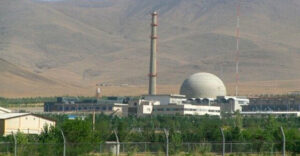
The Financial Times goes on to reveal that Russia is lending a helping hand to Iran in its nuclear weapons research, citing secret trips by Iranian experts to Moscow.
The FT’s investigation began with a trip on August 4 last year by 43-year-old nuclear scientist Ali Calvad.
He was accompanied on the trip, according to the paper, by four employees who, he claimed, worked for DamavandTec, a consultancy that runs a small office in Tehran. But according to the Financial Times investigation, it was in fact a cover story as the five Iranians had flown to Russia on diplomatic passports, some of which had consecutive numbers and were issued on the same day, a few weeks before the trip.
Among the five Iranians was a nuclear scientist who, according to Western officials, works for Iran’s SPND (the Defense Innovation and Research Organization), a secret military research unit that has been described by the U.S. government as “the direct successor to Iran’s pre-2004 nuclear program.”
Another member of the team was a former head of a company that has been subject to US sanctions for having links to SPND while another was, according to officials cited by the FT, an Iranian intelligence officer.
According to the US newspaper’s investigation, the Iranian delegation visited Russian scientific institutions that produce dual-use technologies – components with civilian applications but also related to nuclear weapons research.
Calvad also reportedly sent a letter to a Russian supplier expressing interest in obtaining various isotopes – including tritium, a material that can also be used to enhance the performance of nuclear warheads and is subject to strict controls under international non-proliferation rules.
The trip to Russia came at a time when Western governments had observed a number of suspicious activities by Iranian scientists, including efforts to procure nuclear-related technology from abroad.
Western intelligence agencies believe Iran previously had a secret nuclear weapons program – separate from its efforts to produce nuclear fuel – which Supreme Leader Ayatollah Ali Khamenei halted in 2003.
In May, the US imposed new sanctions on SPND, warning that it was working on “dual-use research and development activities that could be applied to nuclear weapons and nuclear weapons delivery systems.”
The documents do not say what technology or knowledge the Iranian delegation was seeking from these companies in Russia. However, many non-proliferation experts contacted by the FT say the backgrounds of the delegation members, the type of Russian companies they met with and the tricks they used during their trip are suspicious.
“It is troubling that people of this kind can have these kinds of meetings in Russia, given the situation that Russia and Iran are in,” says Pranay Vaddi, who until January 2025 served as senior director for nuclear non-proliferation at the US National Security Council.
“Regardless of whether the Russians share components or technology. [the SPND] is an organization that would use them specifically to build nuclear weapons,” he adds.
The role of DamavandTec
Citing correspondence seen, the Financial Times reports that in early 2024, Calvad received a request from Iran’s defence ministry to use his small company DamavandTec to organise a sensitive mission to Moscow.
The company presents itself as a cultural scientific consulting firm. On its website, it claims to have an “experienced team in the field of technology transfer” and aims to “develop scientific communication” between academic and research institutions.
Calvad is not the only one of the company’s leaders to have longstanding ties with Russia. The company’s chairman, 59-year-old physicist Ali Bakui, is head of the atomic and molecular physics department at Tehran’s Tarbiat Modares University. Bakui earned his doctorate from Moscow State University in 2004 and later served as the Islamic Republic’s scientific envoy to Russia.
Both Calvad and Bawi maintain close ties with Russian nuclear institutions. In 2016, they visited the Joint Institute for Nuclear Research, a renowned Russian atomic centre, while Kalvad attended a conference on particle accelerators in Novosibirsk in 2023.
Although DamavandTec outwardly appears to be the kind of consulting firm that many academics set up, it appears to have ties to Iran’s Ministry of Defense. DamavandTec’s director, Laleh Hesmaty, who is Calvad’s wife, is also chairman of MKS International, a company the US has sanctioned for secretly supplying technology for Iran’s ballistic missile programme on behalf of the defence ministry.
The contacts over four days in Moscow
The DamavandTec delegation that landed at Moscow’s Sheremetyevo International Airport stayed in Russia for four days.
During this period, the Iranian delegation visited Maslenikov’s Tekhnoekspert, as well as Toriy, a research facility located a short walk from the Polyus Institute of Science and Research facilities.
Tekhnoekspert is one of two companies owned by the Russian scientist based at the Polyus facility. Polyus is a subsidiary of the state-owned Rostec group and was sanctioned by the US in the late 1990s for supplying missile guidance technology to Iran.
BTKVP, Maslenikov’s other company also based at the Polyus site, is a supplier to the Russian Defence Ministry’s 18th Central Scientific Research Institute, according to court documents – an entity controlled by the GRU, the Russian military intelligence agency.
The SNPD
SPND is one of Iran’s most controversial programs and is closely monitored by Western intelligence agencies. It is a top-secret research facility under the control of Iran’s Ministry of Defence, which has been designated by the US as “primarily responsible for research in the field of nuclear weapons development”.
It was founded in 2011 by Mohsen Fakrizadeh, a physicist who, along with his close associate, Fereydun Abasi-Dawani, was punished by the United Nations in 2007 for “involvement in Iran’s nuclear or ballistic activities.”
Fakrizadeh was widely regarded as the architect of Iran’s pre-2003 nuclear weapons program, known as the Amad Plan. Iran has long denied the existence of Amad or any nuclear weapons activity.
In 2021, Abbasi-Dawani told an Iranian state-run newspaper that Fakrizadeh later founded SPND and managed to “resist and strengthen the organization.” The US and the UN’s International Atomic Energy Agency (IAEA) board of directors believe SPND has become Amad’s institutional successor.
In 2010, Abbasi-Davani escaped assassination when a man on a motorcycle planted a bomb in his car while driving to work in Tehran. A decade later, in 2020, Fakrizadeh was assassinated in a roadside ambush, widely attributed to Israel, using a remote-controlled machine gun with artificial intelligence.
After Fakrizadeh’s death, Abasi-Dawani pledged to continue his work. “We need to bring this science to universities and spread it to the whole society,” he told the state-run Iran newspaper. “In this way, it works like a functioning system – and no one can shut it down by killing people.”
In 2024, the Iranian parliament officially recognized the SPND for the first time under Iranian law, putting it under the control of the Defense Ministry and, ultimately, under the personal authority of Iran’s Supreme Leader.
The law, which stated that its purpose was “to continue and consolidate the work of the scientist, martyr Mohsen Fakrizadeh”, exempted the SPND’s budget from parliamentary control and gave it the legal authority to create commercial and academic subsidiaries.
Russia’s acquiescence
Experts say it is highly unlikely the Iranians would have visited the Russian facilities without the approval of the FSB, Russia’s main security agency. “You can’t go to places like that without the FSB knowing,” says Matthew Ban, who was a White House adviser on nuclear policy in the 1990s.
The research institutions visited specialise in so-called “dual-use technologies” – components with legitimate civilian purposes, but which can also be used to develop nuclear weapons.
For more than a decade, SPND has sought to secretly acquire such technology by circumventing Western export controls, according to the U.S. and public statements by intelligence agencies in Germany, the Netherlands and Sweden.
The technical offerings of the Russian companies they met with suggest the delegation may have been seeking information on diagnostic tools for nuclear weapons testing.
Documents seen by the FT also suggest that the delegation’s interest extended beyond technical expertise to something far more sensitive: radioactive materials.
In late May last year, Calvad sent a letter to Ritverc, a Russian supplier of nuclear isotopes, requesting on behalf of DamavandTec to procure three radioactive isotopes: tritium, strontium-90 and nickel-63, for research purposes.
Exports of each of these isotopes are strictly controlled. Tritium, in particular, is seen by experts as a red flag for proliferation because of its role in nuclear weapons, especially when interest comes from defense-related entities. In large quantities, it is a key ingredient in the creation of modern nuclear warheads, as it allows for a huge boost in the explosive power of the device.
Tritium has civilian applications in lighting, diagnostic medicine and fusion research, but its commercial use is limited and tightly regulated.
The few reactors in the world that currently produce it do so to boost nuclear warheads, according to William Alberg, former head of NATO’s Center for Arms Control, Demilitarization and Nonproliferation of Weapons of Mass Destruction.
“When someone asks for tritium, I automatically think of weapons,” says Alberg, now a senior fellow at the Pacific Forum. “With clusters I think of clusters: “Smart, it could be other things.” But if you add tritium, then it’s obvious.”
Even an unfulfilled tritium order linked to SPND would cause immediate concern to Western counterproliferation agencies, according to experts.
Two former Western officials told the FT that the US had identified evidence last year that SPND had been involved in transferring dual-use know-how with Russia, as well as supplying materials that could be related to nuclear weapons research.
Ask me anything
Explore related questions




