





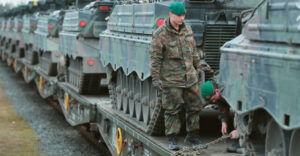
Europe is moving towards the creation of a “Military Schengen”, aiming to ensure the rapid transfer of military equipment in the shortest possible time. The need to move tanks, heavy-duty vehicles, and even medical equipment due to the war in Ukraine has revealed that today’s cross-border permits and bureaucratic procedures have delayed such transfers by up to three weeks—a time frame that, during crises, could prove fatal. The goal is to reduce this time from three weeks to just two or three days.
European fears regarding Russia have brought military mobility to the forefront of the EU’s long-term defense strategy, based on the principle of si vis pacem, para bellum (“if you want peace, prepare for war”).
Cross-border permits
The initiative includes infrastructure, permits, and means (such as specialized tank-transport wagons, heavy-duty vehicles, and medical transports) necessary to enable the fast, uninterrupted, and large-scale movement of troops and military equipment across Europe. From an initial €1.7 billion budget, the new plan will be funded with €17 billion.
The program is overseen by Greek Commissioner Apostolos Tzitzikostas, and the tenfold increase in available funds reflects the EU’s emphasis on this priority. Europe has realized it needs a network of roads, railways, ports, and airports that not only serve civilians but also meet military specifications, such as the capacity to support oversized or overweight vehicles. Instead of building entirely new infrastructure, the focus is on dual-use upgrades – infrastructure usable by both civilians and armed forces.
Beyond infrastructure
Beyond physical projects, the aim is also to extend the freedom of movement of people and goods in the EU to include military mobility, as today’s bureaucracy significantly slows military movements, especially when transporting hazardous or oversized materials.
“We must simplify these procedures. We want member states to commit to issuing diplomatic clearances within three working days. Armed forces must have priority access to infrastructure and transport means—both in peacetime and during crises,” officials noted.
This program is seen as a flagship of EU–NATO cooperation and has gained importance since last June’s NATO summit in The Hague, where member states pledged to invest 5% of their GDP in defense by 2035.
Four priority corridors
Working with NATO, the EU External Action Service, and the EU Military Staff, the Transport Commission has developed four priority corridors for military mobility. The next step is to upgrade these corridors for dual civilian–military use. A priority list of over 500 projects (from 2,800 submitted) has already been drawn up, in consultation with NATO and EU military experts who identified key strategic needs.
These projects include:
- Reinforcing bridges
- Widening tunnels
- Adding bypass lines
- Expanding ports and airports
- Creating military convoy support hubs
Projects will be selected based on readiness, not national quotas.
€17 billion for 500+ projects
The military mobility plan is managed by EU Commissioner for Sustainable Transport and Tourism, Apostolos Tzitzikostas, who told Proto Thema:
“Military mobility is now a strategic priority for Europe’s defense and security. This is reflected in the new EU budget proposal, where funding has increased tenfold—from €1.7 billion to €17 billion. To defend a continent, you must be able to move across it. This means upgrading infrastructure across the trans-European transport network.”
“Together with NATO and member states, we’ve mapped out four priority corridors and identified over 500 critical projects. Airports, ports, roads, and bridges need immediate upgrades, and our next step is rapid implementation—because the time to act is now, not during the next crisis.”
“At the same time, we must reduce bureaucracy and streamline procedures to cut the movement time for military vehicles, equipment, and troops from weeks or months to just a few days. We’ve already achieved freedom of movement for people and goods. It’s time to ensure the same for Europe’s armed forces. We urgently need a ‘Military Schengen,’ and we are building it.”
“These dual-use infrastructure upgrades will primarily benefit citizens, since they improve both civilian and military transport. Every euro we invest in military mobility is an investment in both our security and our economy.”
Photos: Getty Images / Ideal Image, EUROKINISSI
Ask me anything
Explore related questions




