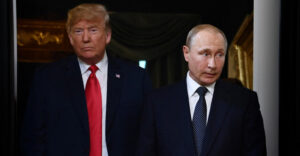
Although there is no news in August, the upcoming meeting between US President Donald Trump and his Russian counterpart, Vladimir Putin, on Friday in Alaska becomes, de facto, the event of the summer, if not the year, should the much-anticipated meeting usher in the definitive end of the conflict in Ukraine. However, expectations between Washington, Moscow, and Kyiv remain guarded as the Russian counteroffensive has been bloodily unfolding for the Ukrainian population in recent months, which has prompted Donald Trump to issue stern ultimatums and threaten new secondary sanctions.
Nevertheless, the White House has once again attempted, with the fifth consecutive visit of the American envoy to Moscow, to explore the possibility of resolving the Ukrainian issue, as in the case of success, the “Planetary Leader” will have boosted his international profile, registering a success worthy of even the Nobel Prize. At the same time, however, Paris, London, Berlin, and Brussels are on “red alert” as the blockade of the Ukrainian president, Volodymyr Zelensk,i from the meeting, as well as the “unclear” ceasefire plan so far, raises questions and uncertainty about security guarantees.
Significant difference
Although the Ukrainian President, Volodymyr Zelensky, was aware of the US President’s mediation project, as he briefed him by phone, as well as top European leaders in recent days, however any exchange or cession of territory to Russia would mean a complete change in the post-war status quo in Europe, a condition that European leaders have made clear to US Vice President J.D. Vance that cannot be tolerated in their absence. The fact, however, that Donald Trump has made both Kiev and most European capitals part of his peace effort represents, according to most analysts, a first and powerful shift in his strategy on Ukraine, leaving unilateral initiatives in the dust.
Besides, the 47th US President has made no secret of his frustration in recent times over the collapse of the Ukraine talks, which he attributed to the Russian side, despite his longstanding good personal relations with Vladimir Putin. This was the reason why he issued a strict ultimatum to Moscow for a ceasefire, threatening secondary sanctions against countries that heavily buy Russian oil, i.e. tariffs of up to 100%, targeting China and India. The hardening of Trump’s stance towards Moscow has, according to other sources, prompted the Russian President to request a meeting with his US counterpart during his three-hour meeting with Steve Whitcoff in mid-week. Already, hours after the meeting, the US President imposed an additional 25% tariff on India as punishment for imports of Russian oil, according to a document posted on the White House website.
Suspicion and sanctions
Given that Trump’s new ultimatum expired at the end of the week, a bilateral meeting between the “Planetary Leader” and Vladimir Putin could assuage White House anger over the Kremlin’s unwillingness to want a definitive end to the military conflict. Only this time, Donald Trump is acting more suspiciously, while Volodymyr Zelensky was quick to underline the element of possible misdirection as the motive for the meeting, describing it as being preceded by two bilateral meetings (US-Russia), to be followed by a trilateral meeting with his participation, judging by the outcome of the talks so far. Nevertheless, the White House has not categorically ruled out Zelensky’s presence at the Alaska meeting, which is being pushed for by France, Germany, Britain and Brussels, as well as by eight Northern European countries that have come out in favour of Ukraine in a joint text.
In any case, for Kiev, the Russian President is aiming for a diplomatic maneuver, although the “key” for Zelensky is still the “economy of war“, estimating that Moscow will not show a sincere willingness to back down as long as it finances operations from the turnover of fossil fuels. However, for Kiev this time “it seems that Russia is now more inclined towards a ceasefire”, as Volodymyr Zelensky commented, although the issue of substantial economic sanctions on Russia was emphatically reiterated over the weekend by German Chancellor Friedrich Murch.
Putin’s trap
In any case, the US president’s comments about “great progress” in ending the war in Ukraine do not overstate his condemnation of Moscow’s “disgusting” airstrikes on Kiev. In this light, even if Vladimir Putin chooses the path of delay again, the White House may seek a partial ceasefire in principle, especially of airstrikes hitting civilians, as a first step in starting a meaningful peace process. In such a case, its leadership profile and public image would be raised dramatically, revitalising the US’s eroded prestige in the international system. All the more so, when the last summit between the leaders of the US and Russia took place in Geneva in 2021 underJoe Biden, and since then, the two leaders have never met since the beginning of Donald Trump’s second term.
The common thread for analysts remains a dual opportunity, as if the Russian president abandons his delaying tactics, he could reinvigorate his key, strategic claim over Ukraine, which goes beyond the country’s percentage of territory held. It is, after all, no secret that Vladimir Putin wants Ukraine to return to the Russian sphere of influence, a commitment to exclude it from any NATO enlargement, but also to limit the radius of the North Atlantic Alliance to the Warsaw Pact countries. In a more forward-looking umbrella of claims, the Kremlin would welcome a new government in Kiev, more friendly to Russia, but also the demilitarization of the four “annexed” Ukrainian regions, the Donetsk, Luhansk, Kherson and Zaporizhia, as well as Crimea annexed since 2014. According to Politico, “other conditions include banning Ukraine from participating in any military alliances, limiting the size of the Ukrainian army, adopting Russian as the official language, and lifting international sanctions against Russia.” However, the annexation of Donetsk and Luhansk appears to be a first line of negotiation for Moscow, which is attempting to recognize the occupation without, for the moment, providing a clear plan as to a ceasefire.
As a counter-argument, the Kremlin could put on the table the updating of the nuclear commission and a bilateral, economic deal with Donald Trump, knowing in advance the “Planetary Leader’s” penchant for these kinds of sensational deals. According to Axios, the Kremlin cannot overlook the fact that any 100% secondary tariffs on countries that buy Russian oil would have a major impact on global oil markets and on China and India, which now seem quite ready to hold direct trade talks with the US. At the same time, former Russian Prime Minister Dmitry Medvedev called Trump’s “telegraph game” a “step towards war”, according to Russian state media, expressing the Kremlin’s hard line, but also a segment of Russian society, which has been watching an inconclusive conflict for three and a half years.
Win win
Given these facts, and only a return to the image of a handshake between the leaders of the two “planetary hegemons” could serve as a boost for their domestic audiences, when Donald Trump is also being squeezed by the inflationary crisis and the extreme polarization in the American political scene. In this context, for many analysts, “Trump is necessary to achieve Russia’s terms”, and vice versa, as the Kremlin was quick to send some “signals” on Ukraine, as the US White House envoy said after he met with Vladimir Putin.
Plan B
Already, with preparations for the Alaska meeting getting underway, the Russian stock market has risen more than 5%, with the main MOEX index reaching its highest level in two months, while the ruble has reached a two-week high against the US dollar and Chinese yuan, as noted by Reuters, although Russian bloggers such as Yuri Podolyaka, read behind the upcoming meeting a “masterful diplomatic game”, with Podolyaka noting that “it seems Vladimir Putin has managed to spin Trump on a ‘negotiating merry-go-round'”. At the same time, the threat of US secondary sanctions “locked in” Vladimir Putin’s late August visit to India, which follows China, as Beijing constitutes the largest importer of Russian oil, with purchases worth $62.5 billion last year. For this reason, the White House is keeping a bipartisan bill filed in the Senate that would impose tariffs of up to 500% on countries that continue to import Russian energy. Besides, Donald Trump has publicly stated that he is “very strongly” considering approving this bill, which has gained traction on Capitol Hill, but now holds serious reservations about Vladimir Putin’s real intentions.
Ask me anything
Explore related questions