The Morning of the Disaster
It was a quiet summer Sunday when the news broke like a thunderclap: a Helios Airways Boeing 737-300, operating flight HCY 522 from Larnaca to Athens (with Prague as its final destination), had stopped responding to radio calls and later crashed in the hills near Grammatiko.
All 115 passengers — including 22 children — and 6 crew members perished.
The Timeline of Flight 522
The aircraft departed Larnaca at around 09:07 local time, scheduled to land in Athens at 10:45. Shortly after take-off, a warning horn sounded in the cockpit — a signal the crew tragically misinterpreted. By 10:15, the plane had entered Athens airspace without responding to air traffic control.
Two F-16 fighter jets were scrambled from Nea Anchialos Air Base at 11:05, making visual contact at 11:18. The scene they encountered was chilling: the co-pilot slumped unconscious, the captain absent from the cockpit, oxygen masks dangling, and the flight deck empty.
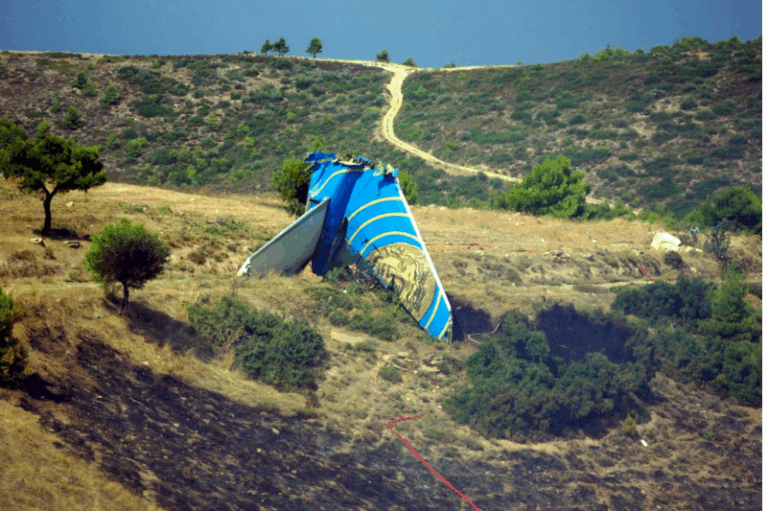
The only conscious person on board was a flight attendant, Andreas Prodromou, who had some pilot training. Using a portable oxygen tank, he entered the cockpit and desperately tried to regain control. At 11:49, the F-16 pilots saw him at the controls, but minutes later the engines flamed out from fuel exhaustion. At 12:04, the aircraft slammed into a hillside near Grammatiko.
The impact scattered wreckage and ignited a fire. Rescue crews recovered 118 bodies; three were completely incinerated. Autopsies revealed that the passengers still had heart activity at impact but had been in irreversible comas from hypoxia.
Causes of the Tragedy
The investigation, led by Greece’s Air Accident Investigation and Aviation Safety Board with Cypriot and international experts, concluded that the cabin pressurization switch had been left in the “Manual” position instead of “Auto” during pre-flight checks. A ground engineer had set it to Manual during a leak test and failed to reset it; the crew missed the error during their checklist.
As the aircraft climbed, cabin pressure dropped dangerously. The pilots misread the warning horn — identical in sound to a take-off configuration alarm — and failed to initiate an emergency descent or use oxygen masks in time. Within minutes, both were incapacitated.
The report also cited poor crew resource management and lack of training for cabin crew in such emergencies. Organizational weaknesses at Helios Airways, inadequate oversight by Cyprus’s Civil Aviation Department, and Boeing’s failure to address previous decompression incidents were all contributing factors.
Legal Aftermath
In Cyprus, five Helios executives were tried for manslaughter but were acquitted in 2013 due to lack of evidence. In Greece, however, four executives were convicted and sentenced to 124 years each (one year per victim plus three additional years). These were later reduced to 10 years, convertible to fines of about €80,000 per person.
Families of victims also sued the Republic of Cyprus, alleging negligence in aviation oversight. While the case eventually led to compensation settlements, the state never formally admitted responsibility.
Ask me anything
Explore related questions