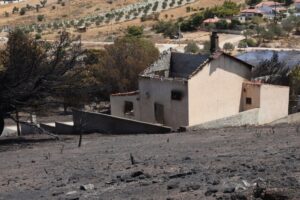
The recent wildfires across the country left behind burned forests, destroyed homes, and families forced to start over from zero.
The process of restoring a house after a fire is not simple: it requires structural inspection, cleaning, repairs, and, in many cases, financial support from insurance or the state. To a large extent, everything depends on the extent of the damage.
For those who lost their home, the first steps are critical and must be taken carefully. We spoke with Panagiotis Evangelou, an experienced mechanical engineer, who outlined the necessary actions, especially during the crucial first period after a fire, and shared useful advice.
Safety and Initial Inspection
The top priority is safety. The house must not be inhabited until a structural engineer checks its stability, since fires often damage load-bearing elements. At the same time, power, water, and gas supplies must be immediately shut off to prevent accidents. In some cases, the house may be declared uninhabitable.
Cleaning and Debris Removal
The next step is clearing out burned items, furniture, and plaster. Cleaning soot requires specialized crews and biological cleaning agents, since plain water often makes the problem worse. To eliminate strong smoke odors, ozone treatment can be used.
Technical Inspection and Repairs
Walls and the load-bearing structure must be checked for heat damage, while the roof often needs partial or total replacement. Electrical and plumbing systems usually have to be redone from scratch, since cables and pipes are altered by heat. Windows, frames, and insulation are also frequently destroyed.
Interior Restoration
Afterwards comes the renovation of interiors with new plaster, anti-mold and odorless paints, replacement of flooring, kitchen, and bathroom. All of this should only happen once a complete technical inspection has been completed.
Damage Recording and Financial Support
Those affected must carefully document the damage, keeping photos and receipts of destroyed items in order to claim compensation from an insurance company or state aid. Reporting the damage to the Urban Planning Office is also essential, so that an official habitability inspection can take place.
If the damage is minor, the home may be saved with cleaning and basic repairs. In more serious cases, partial or even full reconstruction is required. In all cases, the process demands patience, proper planning, and use of every available support mechanism so that victims can return safely to their homes.
Practical Guide
1. Safety First
- Do not enter the house until it is inspected by an engineer or the Fire Service.
- Shut off power, water, and gas.
- Use a mask and gloves—soot is toxic.
2. Damage Recording
- Take many photos and videos of all rooms and the exterior.
- Keep receipts for destroyed items (if available).
- These are necessary for insurance claims or state assistance.
3. Contact Authorities
- If insured: notify the insurance company immediately.
- If uninsured: check with the municipality/region for possible subsidies or restoration programs.
- Declare the damage to the Urban Planning Office so that an engineer can perform a habitability check.
4. Cleaning & Disinfection
- Remove burned materials and items beyond repair.
- Clean soot with special detergents (not just water, which turns it into sludge).
- For strong odors: request ozone treatment from specialized crews.
5. Technical Inspection
- Walls/Structure: Engineer checks for heat damage.
- Roof: If wooden or tiled, likely needs replacement.
- Electrical/Plumbing: Must be checked and often rebuilt.
6. Repairs & Reconstruction
- New plaster, painting with anti-mold coatings.
- Replacement of insulation, windows, flooring.
- For major damage: partial or full reconstruction.
7. Protection for the Future
- Create a “safety zone” around the house (clear vegetation 10–30 meters).
- Use fire-resistant materials for roof, frames, and insulation.
- Consider installing a water tank with pump or an automatic fire suppression system.
- Warning: Do not rush into painting or minor repairs before the technical inspection—time and money may be wasted if full reconstruction is later required.
By Panagiotis Evangelou, Mechanical Engineer

Ask me anything
Explore related questions