





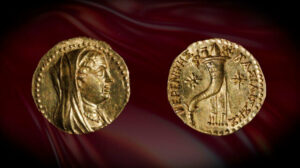
A rare coin depicting Queen Berenice II of Egypt, dating to the Hellenistic period in Jerusalem, has been discovered in the Town of David, the Israel Antiquities Authority announced yesterday, Wednesday, August 20.
Made of pure gold, the small object was minted some 2,200 years ago, during the reign of Ptolemy III, when Jerusalem was under Greek rule.
The find was discovered while sifting soil during an excavation within the City of David National Park. According to the Times of Israel, it is the first time such a coin has been found outside Egypt, which was the center of Ptolemaic power.
“Only 20 such coins are known, and this is the first ever found in a controlled archaeological excavation, which makes it a find of exceptional scientific importance,” said Robert Cul of the Israel Antiquities Authority and Haim Gitler of the Israel Museum, experts on ancient coins.
On one side, the coin depicts the wife of Ptolemy III the Benefactor, third monarch of the Hellenistic Ptolemaic dynasty. Berenice II of Egypt is shown wearing a diadem, veil and necklace. The reverse of the coin depicts the horn of Amalthea, a symbol of prosperity and fertility, flanked by two stars.
Engraved on the perimeter of the coin is the Greek inscription “Basilis Verenice”, which researchers consider an indication of her particular power and influence, a fact quite rare for women of the period.
The head of the excavation, Giftagh Salev, stressed that the discovery directly challenges the prevailing scientific view that Jerusalem was a poor, underdeveloped city after the destruction of the First Temple in 586 BC. “Jerusalem seems to have already begun to recover from the Persian period and was strengthened during Ptolemaic rule,” the expert noted, adding that the city “was not desolate and isolated, but was on a path of renewal, re-establishing links with the dominant political, economic and cultural centers of the time.”
The coin was minted in Alexandria, Egypt, and was likely offered as a reward to Egyptian soldiers after they returned from fighting with the Seleucid Kingdom during the Third Syrian War, according to researchers. Jerusalem was later captured by the Seleucids under Antiochus III, around 200 BC.
Rivka Langler, a member of the excavation team, spotted the coin while sifting soil. “Suddenly I saw something glowing. I picked it up and realized it was a gold coin. At first I couldn’t believe it, but within seconds I was running around the excavation site in excitement,” she says.
Ask me anything
Explore related questions




