





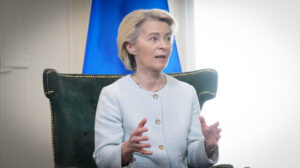
The European Union is working on “very detailed plans” for possible deployments of military forces to Ukraine, as part of security guarantees for post-war Ukraine—guarantees that will have the full backing of U.S. capabilities—said European Commission President Ursula von der Leyen in an interview with the Financial Times published today.
“President Trump assured us that there will be an American presence as part of the security mechanism,” von der Leyen told the FT, adding that “this was very clear and repeatedly confirmed.”
The deployment is expected to potentially involve tens of thousands of troops under European leadership, with U.S. support, including command and control systems as well as intelligence and surveillance assets, the report said. It added that the agreement was reached during last month’s meeting between U.S. President Donald Trump, Ukrainian President Volodymyr Zelensky, and European leaders.
European leaders, including German Chancellor Friedrich Merz, British Prime Minister Keir Starmer, NATO Secretary General Mark Rutte, and von der Leyen, will meet in Paris next Thursday at the invitation of French President Emmanuel Macron to continue high-level discussions on Ukraine, the FT reported, citing three diplomats briefed on the plans.
Majority of Ukrainians want a ceasefire
The majority of Ukrainians appear to support a ceasefire—but only if clear security guarantees are provided, according to a poll.
Of the 1,600 Ukrainians surveyed, 75% consider security guarantees from Europe and the U.S. a prerequisite for ending hostilities, according to the Ukrainian Rating Group poll.
Amid U.S. President Donald Trump’s efforts to pursue ceasefire talks, discussions are focusing on Ukraine’s calls for reliable security guarantees designed to deter Russia from launching a new attack on its neighbor in the future, should a peace agreement be reached.
According to the poll, 82% of respondents believe negotiations are a realistic path to ending the war. Of these, 62% support involving other countries to help reach a compromise, while 20% favor direct negotiations with Moscow.
Among participants, 59% support ending hostilities and pursuing a compromise, while 20% say they want the war to continue until the Donbas region and the Crimean peninsula are fully regained.
Only 13% support a return to the borders prior to Russia’s invasion on February 23, 2022, which would exclude Crimea and Donbas.
The Ukrainian Rating Group survey was conducted with a sample of 1,600 people in Ukraine between August 21 and 23.
Ask me anything
Explore related questions




