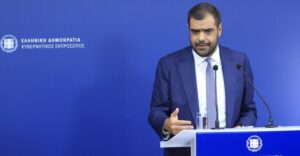
The imminent opening of four such institutions in Greece puts an end to the Greek exception of non-state universities, said Pavlos Marinakis, Pavlos Marinakis, assuring that the government’s top priority is to support the public university.
“We lost many years and deprived thousands of Greek students of the self-evident right to be able, if they want, to study in a non-state university, without having to emigrate from their homeland and we have finally stopped being a sad exception on the global educational map,” Marinakis said, while briefing the political editors.
“Above all, however, the government and the leadership of the Ministry of Education set as a top priority the support of the public university. In the face of those who reproduce stereotypes, distort reality and invest in stagnation and stagnation, we respond with facts: an increase in regular funding, historically high levels of support for student care, new projects in food, housing, equipment and research, an upgraded institutional framework that responds to problems without doing injustice to the people of the university and partnerships with major prestigious universities abroad, such as Harvard, Columbia and Yale,”
he added.
The details of Marinakis’ introductory statement:
.
Here is the entire introductory statement of the government representative at the briefing of political editors:
“The licensing of four non-state non-profit branches of foreign universities, namely Open University, University of YORK, University of Keele and University of Nicosia was announced by the Ministry of Education, Religious Affairs and Sports, following the receipt of the concurrence of the National Association of Higher Education Institutions of Culture and Education and the National Council for the Promotion of Sport. In particular, for parent institutions located in countries outside the European Union, the opinion of the Ministry of Foreign Affairs was duly obtained.
The evaluation process was based on strict standards set by the NIFAE in terms of quality assurance, the implementation of the academic procedures of the parent institution, the adequacy of staffing in terms of academic and administrative/technical staff, the completeness of infrastructure and equipment, the appropriateness of their organisational structure and the adequacy of their support services. Similarly, the EEAEP focused on the technical and building specifications of the facilities.
All the applications come from universities of renowned value from abroad, and their addition to the Greek academic map has only positive things to offer.
The licensing process of these four universities proves that the most stringent criteria were set by the Greek State. This does not mean that the universities that did not receive licensing now cannot receive it in the future, as long as they meet the criteria.
We have wasted many years and deprived thousands of Greek students of the self-evident right to be able, if they want to, to study at a non-state university without having to emigrate from their home country, and we have finally stopped being a sad exception on the world educational map.
The arrival of the first non-state universities in Greece will add value to our country as an education hub, create new jobs, lead to the inflow of financial resources from foreign students and contribute to the extroversion of Greek education.
Above all, however, the government and the leadership of the Ministry of Education make the support of the public university a top priority. In the face of those who reproduce stereotypes, distort reality and invest in stagnation and stagnation, we respond with facts: an increase in regular funding, historically high levels of support for student care, new projects in food, housing, equipment and research, an upgraded institutional framework that responds to problems without doing injustice to the people of the university and partnerships with major prestigious universities abroad, such as Harvard, Columbia and Yale.
Minister of Environment and Energy Stavros Papastavrou and Deputy Minister Nikos Tagaras presented the new Zoning and Urban Planning Code to the Council of Ministers.
For the first time, Greece is acquiring a single and comprehensive “guide of rules” for spatial and urban planning. This is a historical breakthrough, since all the provisions that have been scattered and often obsolete up to now are modernized and brought together in a modern Code.
In this way:
– engineers, lawyers and all citizens now have clear rules on building, arbitrary building, land use, urban redevelopment, etc..
They are now able to make use of the new legislation, to use it in a new way.
– public administration simplifies procedures,
– Legal certainty is enhanced and arbitrary building is reduced.
The Code does not introduce new rules; it clearly organises those that already existed. Until now, the rules regulating spatial and urban planning were scattered in dozens of laws and provisions, often outdated or contradictory, often irrelevant, in their general subject matter, to spatial and urban planning legislation. The new Code brings all the legislation together in one framework, with clear wording and simple language.
Minister of Rural Development and Food Costas Tsiaras presented the bill on sustainable fisheries to the Council of Ministers.
The subject of the bill is:
a) the amendment of the institutional framework for the control of fisheries and the regulation of aquaculture, recreational fishing and fishing activity,
(b) restructuring and strengthening the framework of administrative sanctions in the areas of food, animal health and welfare and the management of animal by-products and derived products,
(c) The regulation of matters relating to vocational training in the meat sector,
(d) amending the competent authorities for the classification and labelling of agricultural products and their active substances,
(e) supporting the operation and human resources of the services of the Ministry of Rural Development and Food,
f) the strengthening of the institutional framework of the Hellenic Agricultural Organization – DIMITRA and the Geotechnical Chamber of Greece, which are supervised by the Ministry of Rural Development and Food.
With the legislation of a comprehensive licensing procedure for regional television stations, we are putting an end to an institutional and legal issue that has been pending for years.
Through the bill we are promoting the following are achieved:
1. We put order in the television landscape at the regional level, as we did for the print and electronic press, with the operation of the respective Registers.
2. We are setting specific rules and clear conditions for regional television stations to be able to obtain a license from the National Broadcasting Council, and for their subsequent operation.
3. Establish a comprehensive licensing procedure on the basis of modern, transparent, objective and qualitative conditions and evaluation criteria.
4. We abolish the provisions of Law 4339/2015 and cancel the failed auction model, by which only a few were able to secure a license.
5. We create the framework to enable regional TV stations to broadcast programmes in high definition (HD).
6. We create and secure jobs.
7. We protect legitimate and robust television stations from unfair competition.
This is the third bill I have the honor of introducing in four months for the media industry. We aim to put in order the licensing landscape of regional channels, which has been unregulated for more than 20 years, in a way that protects healthy businesses that comply with the provisions of the law, respect their employees and create quality content for the television audience.
Before we move on to questions, I would like to express my sincere condolences to the family of journalist Katerina Zacharakis who lost her battle with cancer at the age of 53.”
Ask me anything
Explore related questions