





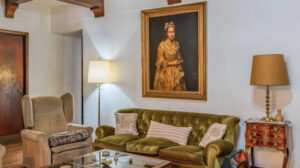
The heirs of an 18th-century painting, stolen by the Nazis from a Jewish collector in the Netherlands during World War II and resurfacing only days ago in Argentina, have been placed under house arrest.
Police in Argentina are continuing their search for the artwork, which remains missing.
The daughter of Friedrich Katgien, an SS officer who settled in South America after WWII and died in 1978, and her husband, will remain under house arrest for 72 hours while the investigation continues, the federal prosecutor’s office announced. “So far, the painting has not been found and has not been handed over to authorities,” it added, despite searches at various homes linked to the Katgien family.
The couple, who according to local media are accused of concealment and obstructing an investigation, will face court at a later date, prosecutors said without further details. Their lawyer insisted that heiress Patricia Katgien and her husband are cooperating with authorities but disputed the charge of “concealment of a statute-barred offense” and the jurisdiction of the courts over the painting’s fate. According to a source cited by Reuters, they are expected to be charged with “concealing theft committed in the context of genocide.”
From Nazi Loot to a Buenos Aires Home
The case was uncovered in late August when “Portrait of a Lady”, by Italian painter Giuseppe Ghislandi (1655–1743), was spotted by Dutch newspaper AD in a photograph posted online by a real estate agency advertising a property in Mar del Plata, a resort 400 km south of Buenos Aires.
The authenticity of the painting cannot be confirmed while it remains missing. Before WWII, it belonged to Dutch collector Jacques Goudstikker, whose collection was looted by the Nazis. The painting, which depicts Countess Colleoni, was one of about 1,000 works owned by Goudstikker, who died in 1940.
The federal prosecutor’s office noted that, in the course of the various searches of Katgien family properties, two other paintings—possibly dating from the 1800s—along with several sketches and engravings were seized. These works “will be analyzed to determine any potential link to paintings stolen during WWII,” it said.
Katgien had been a high-ranking official in Hitler’s government and settled in Argentina after WWII.
The Ongoing Investigation
Nearly half a century after his death, Katgien’s name has returned to the spotlight through this case. The painting is listed among those looted from the Goudstikker collection, which remains an open restitution issue for his descendants.
The sole heiress, Marei von Saher, has vowed: “My search began in the late 1990s and I will not stop. We want every stolen work returned and the family’s legacy restored.”
The real estate listing for Katgien’s daughter’s home revealed that the painting remained in the family until recently. Its sudden disappearance just days before the investigation raises questions about who holds it now and whether it will ever be returned to its rightful heirs.
A Shadow That Reaches the Present
The case highlights how many Nazi criminals managed to escape justice, finding refuge in Latin America. Katgien’s story is emblematic: a man who took part in looting the property of Holocaust victims, lived a wealthy life in Argentina, and died unpunished.
Today, the disappearance of a painting from his daughter’s living room is a stark reminder that history has not yet settled its accounts. The investigation continues, and the pursuit of looted artworks remains open, bringing back into focus the dark pathways of the Nazi past.
Ask me anything
Explore related questions




