





China welcomed leaders from countries opposed to the West yesterday as they gathered in Peking, showing their support for President Xi Jinping. The event, which will include a grand parade to mark the 80th anniversary of Japan’s defeat in World War II, is aimed at showcasing China’s military might and geopolitical power.
The strategic alliance between Russia, China, Iran and North Korea, also known as “the axis of unrest“, has become evident both on the front of the war in Ukraine and in the Middle East in 2025.
On Wednesday, however, China will take center stage, projecting itself as an alternative to the Western-led world order as the world’s second-largest economy and rising superpower emerges as a counterweight. China and Russia seek to redefine global power to their advantage, at the expense of the US and its allies.
China’s leader Xi Jinping launched an indirect attack on the United States on Monday, condemning its “intimidating practices” and portraying his country as a new leader in world governance at a time when President Donald Trump’s “America First” foreign policy is upending the global balance.
Russian President Vladimir Putin arrived in the Chinese capital on Monday evening from Tianjin, where he was attending the Shanghai Cooperation Organization summit. The Kremlin strongman will be received by Chinese President Xi Jinping and on Wednesday will attend the grand military parade marking the 80th anniversary of Japan’s capitulation that marked the end of World War II.
During the session, Xi Jinping pledged 2 billion yuan ($280 million) in grants for Shanghai Cooperation Organization (SCO) member states this year, and an additional 10 billion yuan ($1.4 billion) in loans to a consortium of SCO banks over the next three years.
The parade will take place in Tiananmen Square, and will bring together 26 heads of state, including leaders from Russia, North Korea, and Iran. Leaders from countries such as Myanmar, Mongolia, Indonesia, Indonesia, and Central Asian countries will also attend the display of a wide range of ready-to-use war materiel. Serbia and Slovakia are the only Western countries invited, the Chinese Foreign Ministry said.
Putin’s attack on the West and the war in Ukraine
Russian President Vladimir Putin yesterday defended his attack on Ukraine, once again accusing the West of provoking the conflict.
“This crisis did not erupt from Russia’s attack on Ukraine, it is the result of a coup in Ukraine, which was supported and provoked by the West,” Putin said at the Shanghai Cooperation Organisation summit.
The statement refers to the pro-European Maidan movement in Ukraine, which forced the country’s pro-Russian president to leave power in 2014. Moscow had then annexed the Crimean peninsula and backed pro-Russian separatists in eastern Ukraine, sparking a civil war.
“The second cause of the crisis is the West’s constant attempts to lure Ukraine into NATO,” the Russian leader added.
Putin made the remarks before his main allies – Chinese President Xi Jinping, Indian Prime Minister Narendra Modi and Iranian President Ebrahim Raisi.
Mr. Mudezh and Mr. Mudezh Peshawar, the President of India and Mr. Mudezh Mubarak.
“We highly appreciate the efforts and proposals of China, India and our other strategic partners, which are aimed at contributing to the resolution of the Ukrainian crisis,” the Russian president said.
Vladimir Putin also said that the understanding reached during the summit in August with US President Donald Trump paves the way for finding a solution to the crisis in Ukraine.
“I would also point out that the understanding reached at the recent Russia-US meeting in Alaska, I hope, will also contribute to this goal,” the Russian president added.
He said he had already briefed Xi in detail since Sunday on what was achieved in his talks with Trump and on the work “already underway” to resolve the conflict, adding that he would share more details in bilateral meetings with the Chinese leader and others.
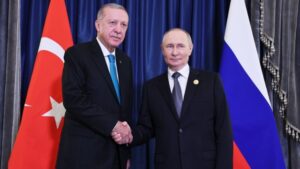
Putin meets Erdogan on Ukraine, Gaza and Syria
On the sidelines of the 25th Shanghai Cooperation Organization summit, Putin met with Turkish President Recep Tayyip Erdogan, who invited his Russian counterpart to visit Ankara.
According to a statement from the Turkish presidency, Tayyip Erdogan said relations between Turkey and Russia continue to develop based on mutual respect and common interests, and that the spirit of cooperation from the past continues in areas such as trade, tourism, investment and energy.
President Erdogan said Turkey’s efforts to end the war in Ukraine with a just and lasting peace are continuing and that he believes the Istanbul negotiations have contributed to the peace process.
He also expressed hope that negotiations between Azerbaijan and Armenia would lead to lasting peace and that stability in the Caucasus would be in the common interest of Turkey and Russia.
The two presidents exchanged views on developments in Gaza and Syria.
Putin thanked Erdogan for his diplomatic efforts
Turkey is a reliable and time-tested partner of Russia and energy cooperation between the two countries is “strategic”, the Russian president told his Turkish counterpart yesterday.
Putin praised Turkey’s role in efforts to resolve the conflict in Ukraine, saying there would still be demand for its “special role” in mediation efforts and diplomacy.
Last week, Yuri Ushakov, Putin’s diplomatic adviser, had said last week that the two leaders would discuss the conflict in Ukraine as Ankara plays “an important role” as a mediator.
The Turkish presidency said Erdogan told his Russian counterpart that Ankara was working for a just and lasting peace in Ukraine and that talks between the parties in Istanbul were contributing to peace efforts.
According to the Turkish presidency’s statement, during their meeting on the sidelines of the Shanghai Cooperation Organization meeting, Erdogan and Putin also discussed bilateral relations, peace efforts between Azerbaijan and Armenia, Israel’s attacks on Gaza and developments in Syria.
Putin’s “dear friend” and Modi’s ride in the Russian president’s limousine
Russian President Vladimir Putin addressed Indian Prime Minister Narendra Modi, calling him his “dear friend” and stressing that relations between their countries are developing dynamically, according to a video released by the Kremlin today.
The Indian Prime Minister, for his part, expressed hope to the Russian President that Russia and Ukraine would move forward to end the war between them soon.
The two leaders were holding talks in China’s port city of Tianjin on the sidelines of the two-day Shanghai Cooperation Organisation (SCO) summit being held there, days after the US imposed trade sanctions on India in retaliation for Russia’s oil purchases.
“Talks with him are always apt,” Modi commented in a post on his X social media account at the start of his meeting with Putin on the sidelines of the regional bloc’s summit in Tianjin.
India and Russia stand by each other even in difficult times, Modi also told Putin after he called him a “dear friend” and gave him a ride in his armoured limousine.
China and India are the biggest buyers of crude oil from Russia, which is the world’s second-largest crude exporter. US President Donald Trump has imposed additional tariffs on India for these purchases, but there is no indication that India or China will stop them.
During their meeting, Modi held Putin’s hand as they walked towards Chinese President Xi Jinping. All three smiled as they spoke, surrounded by interpreters.
Later, Modi posted a photo on X of himself and Putin in the armored Russian Aurus limousine used by the Kremlin chief.
“Even in the most difficult situations, India and Russia have always moved forward side by side,” Modi told Putin during their bilateral meeting. “Our close cooperation is important not only for the people of both countries but also for global peace, stability and prosperity,” the Indian prime minister added while addressing the Russian president.
The latter addressed Modi during their bilateral meeting in Russian as “Dear Prime Minister, dear friend.”
“Russia and India have maintained special relations for decades, friendly and trusting. This is the foundation for the development of our relations in the future,” the Russian president noted.
Modi added that he welcomed recent efforts aimed at ending the war in Ukraine, stressing, “We hope that all sides will move forward constructively. A way must be found to end the conflict as soon as possible and establish a lasting peace.”
On Saturday, Modi reaffirmed his support for a peaceful settlement during a telephone conversation with Ukrainian President Volodymyr Zelensky, according to the Indian Prime Minister’s Office.
“We had an excellent meeting with President Putin,” Modi told X after his talks with the Kremlin chief, adding that they discussed cooperation “in all areas, including trade, fertilizers, space, security and culture.”
“Our Special and Privileged Strategic Partnership remains a vital pillar for regional and global stability,” the Indian prime minister concluded.
Putin often uses Aurus on his trips abroad and occasionally offers to ferry other leaders on it. Sometimes he has even gifted his car, as he did with North Korean leader Kim Jong Un in 2024.
Putin – Pezzeskian meeting
.
Russian President Vladimir Putin also met with his Iranian counterpart, Massoud Pezzeskian on the sidelines of the Shanghai Cooperation Organization (SCO) summit in China, the Kremlin said.
“Vladimir Putin and Iranian President Massoud Pezheskian start a bilateral meeting,” the Kremlin said on Telegram, accompanying its message with a video showing the two men exchanging handshakes.
The Russian presidency had previously stressed that the meeting would focus on Tehran’s nuclear program.
Iran is suspected by Western countries of seeking to acquire nuclear weapons and faces threats from France, Germany and the United Kingdom to reimpose sanctions that were suspended a decade ago.
Tehran, for its part, denies its desire to acquire nuclear weapons and defends its right to develop a civilian nuclear program.
Russia, an ally of Iran, supports Tehran on this issue. On Friday, it called on the West to “come back to its senses and reconsider its wrong decisions,” warning of the “irreversible consequences” of its policy.
The two countries have come closest since the start of Russia’s invasion of Ukraine in 2022. In January, Moscow and Tehran signed a strategic partnership treaty aimed at strengthening their ties, particularly their military ties.
Iran has been accused by Kiev and the West of supplying Shahed drones and short-range missiles to Russia for its attack on Ukraine.
SCO condemns trade wars, attacks on Iran
The summit of the Shanghai Cooperation Organization (SCO), an alliance of non-NATO countries including China, Russia and India, expressed its opposition to trade coercion and condemned attacks against its members.
OAS member states reject unilateral coercive measures, including “economic measures,” the joint declaration issued by the group said, in an apparent criticism of US President Donald Trump’s trade tariffs.
Recently, Trump doubled tariffs on imports from India to 50% because of its oil deals with Russia. Beijing is still negotiating with Washington after both sides agreed in May to a temporary pause in a heated tariff dispute.
In addition, according to the joint communiqué carried by China’s New China News Agency, the organization “strongly condemns the actions causing civilian casualties and a humanitarian disaster” in the Gaza Strip and calls for a “full and sustainable ceasefire, as well as unimpeded humanitarian access” to the enclave.
Russia’s war against Ukraine is not mentioned in the joint declaration of the GCC issued after the summit in the Chinese city of Tianjin.
However, the 10 member states condemned the terrorist attacks in the Indian-controlled region of Kashmir on April 22 that claimed the lives of more than 30 people. This was followed by fierce fighting between India and Pakistan in May.
According to reports, a quote about the conflict caused disputes with the Indian side during a meeting of the GCC defence ministers. Pakistan is also a member of the GCC.
The GCC also strongly condemned the US and Israeli attacks on Iran’s nuclear facilities in June. Such acts of aggression against civilian targets and nuclear energy infrastructure violate the norms of international law, the text of the joint declaration said.
The Shanghai Cooperation Organization was established 24 years ago, ostensibly as a rival to the Western military alliance NATO, though economic issues have dominated most meetings.
The summit, held in the northern Chinese port city of Tianjin, was attended by the heads of state and government of Russia, China, India, Kazakhstan, Pakistan, Iran, Belarus, Tajikistan, Tajikistan, and Kyrgyzstan.
Ask me anything
Explore related questions




