





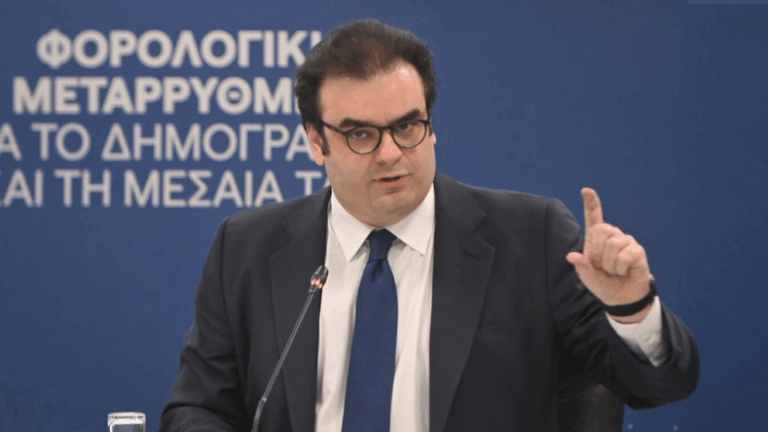
New tax reliefs announced by the Prime Minister at the Thessaloniki International Fair (TIF), and to be detailed today at 11 a.m. by the Minister of National Economy and Finance, Kyriakos Pierrakakis, will provide a “breathing space” of up to €5,000 per year for middle-class taxpayers—or even greater benefits for those with three, four, or more children.
The reductions focus on direct taxes, with an emphasis on families with children. However, VAT will also be cut by 30% on at least 20 remote Aegean islands. Thousands of property owners and income earners will also see tax cuts of up to 10 percentage points.
Tax-Free (Again) for Thousands of Professionals
Freelancers will also benefit from the new measures. With the new tax scale, those with three or more children will for the first time see a tax benefit linked to their family size.
Even professionals who were previously taxed under the imputed-income system may see all their extra burdens eliminated if they have three or more children.
Practically speaking, under the new tax scale that will apply from January 1, 2026:
Professionals with 3 children will gain €1,300 per year if taxed on an income of €20,000—covering a significant portion of the burden from imputed taxation. Those with 4 children will, from 2026, have a tax-free threshold of €20,000, whereas today they have “zero tax-free allowance.”
For salaried employees and pensioners, the benefit is even greater, since they will continue to enjoy today’s tax reductions per child. Thus, for 4 children the tax-free threshold will reach €27,100; for 5 children €29,000; and for 6 children it will exceed €30,000.
Therefore, even those who until recently declared zero income and remained untaxed—but due to POS (card payment systems) and imputed taxation ended up paying tax on “income” of €10,000–15,000—will see their burdens eliminated under the new tax scale, benefiting thousands of taxpayers.
A “New” Age-Based Tax Scale
For the first time, taxation in Greece will not only take into account how much someone earns, but also how old they are.
The Prime Minister announced a new income tax scale for young people.
In practice:
All young people up to 25 years old will not pay taxes in Greece, unless they earn more than €20,000 per year. This means that students and young workers will no longer be threatened by taxes or “imputed income” rules.
Young people between 26 and 30 will still be taxed, but will pay only half the normal tax. For this five-year period, income tax and payroll withholding will be reduced by up to 60%, since they will pay a 9% rate instead of 22% on their first €20,000 of income.
Additional details:
For those up to 25 years old, tax rates from €0 to €20,000 are reduced to zero.
For those aged 26–30, the tax rate on income between €10,000 and €20,000 will be 9%.
Broader Benefits for All Taxpayers
In addition, all taxpayers will benefit from the following new measures:
Reduction of basic tax rates by 2–5 points:
Benefit of €200–1,600 for a taxpayer without children (depending on income level).
- €400–2,000 benefit for those with 1 child.
- €600–2,400 benefit for those with 2 children.
- €1,300–3,800 benefit for those with 3 children.
- €1,800–5,300 benefit for those with 4 children, with even greater relief for larger families.
30% reduction of imputed values (for cars and housing).
Two-year exemption from imputed income for mothers who have a child.
50% reduction of ENFIA property tax for main residences in villages.
30% VAT reduction on 19+ Aegean islands.
50% reduction of imputed income for professionals in small settlements and villages.
Other Support Measures
Pension increases for those with “personal difference” (half in 2026, full in 2027).
New housing support programs.
Salary increases for Armed Forces personnel.
One month’s rent subsidy and a €250 payment to pensioners, to be given in October–November for the first time, and then permanently every year.
Fiscal Impact
According to estimates by the General Accounting Office of the State:
The new taxpayer relief measures announced by the Prime Minister will cost the state €1.25 billion in 2026 (mainly due to reduced payroll withholdings starting in January).
The cost will rise to €1.6 billion in 2027, once reduced assessments are issued for professionals on 2026 income.
Overall, the full Mitsotakis package will cost €1.75 billion in 2026, rising to €2.5 billion annually from 2027 onwards, when all measures are fully implemented.
Skertsos: The Tax Package Covers 4 Million Taxpayers
Minister of State Akis Skertsos stated on Monday morning:
“We are returning a dividend of growth, and this is being done within fiscal limits, without burdening future generations or exposing the country to surveillance risks.”
He added:
“When you announce the largest income tax reform package ever—returning up to two months’ salary to each worker—this boosts income and partly addresses the problem of high living costs.”
Almost 300,000 pensioners will receive the full 2026 increase due to the abolition of the “personal difference”
Pension increases at the end of this year are expected to be around 2.7%, based on current forecasts that see annual inflation closing at 2.9% and growth at 2.4%. According to the legal formula (inflation + GDP ÷ 2), the increase is calculated between 2.6% and 2.7%.
Until recently, the number of pensioners who would actually see the increases in their pockets stood at 1.9 million. However, following the Prime Minister’s announcements at the Thessaloniki International Fair (TIF) on the abolition of the personal difference in two phases, another 671,000 pensioners will now benefit.
Ask me anything
Explore related questions




