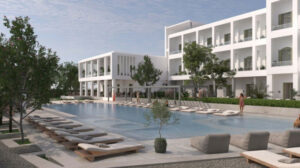
It was in 1836 that the royal architect Christian Hansen arrived in Kythnos, who drew up the plans for the complex of thermal baths with marble baths, and from 1845 Queen Amalia had been visiting the island for spa treatments.
Now, the restoration for the reopening of the existing thermal tourism center “Xenia Kythnos”, with the investment carrier Xenia Kythnos S.A, of the Israeli investor Abraham Ravid -as newmoney already wrote- aspires “to contribute decisively to the promotion of the monument and its history at an important time, as significant problems have been identified that pose an immediate risk to the safety of the existing listed monument”, as noted in the relevant Environmental Impact Study that was put to consultation for the project until October 24. The Israeli investor has secured a permit from the Department of Architecture, Building Regulations and Licensing (DAOKA) of the Environment Ministry.
More generally, the operation of the Kythnos Hostel after maintenance and restoration “wants to highlight both the complex itself and the historical and cultural elements of the wider area,” and given that the property is classified as a listed monument, all the necessary approvals have been obtained during the planning of the project.
The Environmental Impact Study (EIS) concerns the restoration and operation of the Medical Tourism-Hermalism Centre “Xenia Kythnos”. It is an existing property of 7,018 sq.m. that includes existing hotel facilities, a hydrotherapy centre, and support infrastructure. The Hydrotherapy Centre – Hotel “Xenia” in its existing form had not been environmentally licensed until today, as the legislation did not require it, while the EOT had discontinued its operation since 1999. The project under consideration includes “mild interventions and modifications for the maintenance, restoration, and operation of the complex”.
Specifically, as noted in the EIS, which is accompanied by the conservation and restoration study of decorative and morphological elements of the listed building, the proposed project involves:
-Works for the protection, restoration, and promotion of the unique characteristic elements of the wing of the Hydrotherapy Centre (listed building), preserving them unaltered, and remodelling of its interior for the reopening of the baths and creation of treatment and beauty areas. Indicatively mentioned are the dismantling and reconstruction of the tiled roofs, repair of floors of historical importance, structural reinforcements, restoration of facades, etc.
-Modernization and energy, and aesthetic upgrading of the hotel wing and the auxiliary wing.
-Construction of an outdoor swimming thermal wellness area.
–Construction of a new building for the construction of a thermal spa.
-Creation of a traffic network and parking spaces.
-Design of common areas and planting.
-Dismantling and reconstruction/modernization of all accompanying technical infrastructure (piping, electrical installation, E/M).
– Installation and maintenance of all electrical and mechanical installations, including the installation of the electrical and mechanical installations and the installation of all technical installations.
-Restoration, promotion, and protection of the spas and redesign of their route to the sea (final recipient).
Remediation and restoration of the water resources of the area, including the restoration and restoration of the water’s final destination (final destination).
What the project involves
The existing facilities and infrastructure of the complex include a wing of the Hydrotherapy Centre, a wing of the Hotel Xenia, a wing supporting the complex, a small concrete building (roofing) at the point of the Kakavou thermal spring’s fountain.
According to the investment plan, the complex of “KIT-TH Xenia Kythnos”, which, as it will be formed, will include the thermal treatment unit of the Agioi Anargyroi spring, the corresponding one of the Kakavos spring, the 5* hotel facility with a capacity of 96 beds, which, among other things, will offer professional non-medical wellness services. The hydrotherapy wing includes the building of the Hansen Baths and other buildings, also with baths and auxiliary uses.
The Hansens’ building was operational until recently, and the other buildings in the wing are inactive as parts have collapsed and some strengthening of the load-bearing masonry has been carried out. The north-eastern wing of the hotel consists of three floors, where the rooms are located. The ground floor contains 16 double rooms, while the 1st and 2nd floors contain 15 double rooms each.
The total capacity of the hotel was 92 beds, distributed in 46 rooms. In the 44 rooms, the floor area is about 15 sqm, while in the remaining two rooms it is about 50 sqm, and it concerns the royal suites, which are located in the centre of this wing. The support wing, although it appears in photographs of the complex from 1904, has undergone a series of interventions aimed at adding auxiliary spaces to its function, which have completely changed the original morphology of the shell.
“The potential impact of the maintenance and restoration works, as well as the operation of the Medical Tourism-Hermalism Centre, ‘Kythnos Hostel’, on the natural and anthropogenic environment is assessed as positive. The realisation of the project under consideration is expected to give the property the glamour of the past by reviving its history and the purpose of its creation from a modern perspective. The main concern is the preservation and reopening of the listed monument, the protection of the thermal springs, the enhancement of the tourist product, and the promotion of the natural wealth, history, and culture of the area and of Kythnos in general. In addition, the complex will operate within the framework of the existing environmental legislation, while the operating entity will implement plans and adhere to measures to prevent potential environmental impacts that ensure the protection of the environment and the long-term enhancement of the positive effects of the project,” the MPE states.
“The facility is harmoniously integrated into the topography of the area, and the restoration and maintenance works will improve the landscape characteristics of the wider area, indirectly contributing to the protection of the landscape character. Due to the type and scale of the project, as well as the nature of the activity, the operation of the Medical Tourism-Thermalism Centre is not associated with any form of intervention or alteration to the geological and tectonic characteristics of the immediate and wider area.”
The story
Kythnos has a long history of thermal springs and spa therapy. In more recent times, it took its second name, Thermia, from the hot springs which are located in the picturesque bay of Loutra, on the northeastern side of the island.
Historically, it is said that in 1836, the royal architect Christian Hansen arrived in Kythnos, who drew up the plans for the complex of thermal baths with marble baths, and from 1845 Queen Amalia was visiting the island for spa treatments, so the property is of great historical and cultural value. In fact, the construction of the hydrotherapy centre is estimated to have been carried out at the urging of Queen Amalia.
The facilities were modified by Ernst Chiller in the period 1871-1891 and have been classified as historical monuments, as they are remarkable examples of architecture, directly linked to the history of the Kythnos Baths. The last changes and additions to the building were made between 1964 and 1970.
Ask me anything
Explore related questions