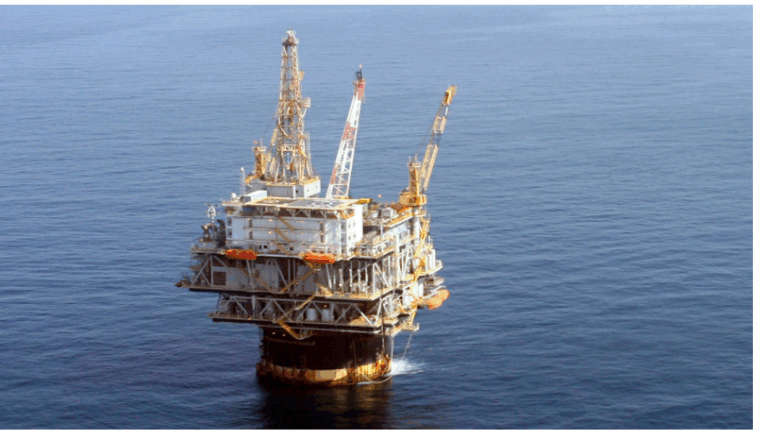
New developments in the exploitation of Greece’s energy resources, which could place the country firmly within the Eastern Mediterranean’s energy club while also strengthening Athens’ efforts to safeguard and exercise its sovereign rights, are unfolding with the confirmation of U.S. oil giant Chevron’s interest in joining Helleniq Energy in exploration of the offshore blocks south of Crete and the Peloponnese.
“I believe this is the best proof of how our government perceives the upgrading of the country’s geopolitical role. We are becoming an important energy player in the Eastern Mediterranean, recognized by both the EU and the U.S.,” said Prime Minister Kyriakos Mitsotakis. He is scheduled to meet tomorrow with U.S. Secretary of the Interior and Chairman of the Energy Sovereignty Council, N. Bergam, to discuss “how we are continuously upgrading our country’s strategic geopolitical energy role.”
Environment and Energy Minister Stavros Papastavrou, immediately after the tender closed, emphasized:
“A new chapter opens for the utilization of our nation’s offshore energy wealth. This is a development of hope and perspective for our country. Greece, with national confidence, is laying solid foundations for its energy self-sufficiency and leveraging its geopolitical position in the Eastern Mediterranean.”
The completion of the tender, which marks the starting point for Chevron and Helleniq Energy to acquire exploration and exploitation rights in these areas, is a landmark moment in Greece’s long-standing effort to tap into its energy resources. This effort has faced major geopolitical challenges, particularly with Turkey, which effectively froze such initiatives not only in disputed zones but also in the Ionian Sea and Central Mediterranean.
The tender for the blocks south of Crete is of critical importance. Though mapped more than a decade ago, they remained dormant because Greece had not exercised its sovereign rights there, despite the provisions of Law 4001/2011 (the “Maniatis amendment”), which unilaterally delineated the outer limits of the Greek EEZ/continental shelf by setting the median line as the boundary in cases without bilateral agreements.
The tenders for blocks west and southwest of Crete had already triggered Libyan objections. However, ExxonMobil’s entry into the region occurred before the Turkey-Libya Memorandum of Understanding, which attempted to impose faits accomplis against Greece.
Athens’ decision to launch the tender for the southern Crete blocks was a direct challenge both to the Turkey-Libya MoU and to Libya’s maximalist claims, which sought to shift the median line northward at Greece’s expense. Through Law 4001/2011 and now the new tender, Greece is, for the first time, creating its own faits accomplis by exercising sovereign rights—pressuring Libya and indirectly Turkey, since the area overlaps a significant portion of the EEZ that, under the Turkey-Libya deal, would have gone to Libya.
Libya officially protested with a note verbale to the UN (June 20), claiming the two blocks fell within its continental shelf. In another letter (May 27), Tripoli asserted maximalist maritime claims that, under the MoU, extended nearly to Crete’s territorial waters—covering almost the entire area of the two blocks.
Athens countered Libya’s claims. Following Foreign Minister Gerapetritis’ visits to Tripoli and Benghazi, talks on EEZ delimitation—stalled for ten years—were set to resume under the pressure Libya felt from the tender’s continuation and Greece’s adoption of a new national maritime spatial plan.
In this complex and sensitive environment, Chevron’s participation is the strongest response yet to challenges against Greek sovereign rights.
Of course, no company—however powerful—confers sovereignty. But the fact that Chevron accepts the Greek delineation of the blocks and the median line, despite intense efforts to dispute them, effectively consolidates Greece’s position. If seismic surveys and later exploratory drilling proceed, they will create a de facto American “security umbrella.”
Chevron has also expressed interest in entering Libya’s offshore sector. For now, this is not problematic, as Tripoli’s blocks offered for international tender respect the Greek median line, despite Libya’s formal objections at the UN.
Chevron executives even met with Turkish Energy Minister Alparslan Bayraktar on the sidelines of the Energy Conference in Italy, as Turkey seeks to entice foreign—and especially American—oil companies into partnerships. That meeting may not have been unrelated to Chevron’s subsequent announcement of participation in the Greek tender.
This development marks the first step on a long and difficult road, one that many hope will lead to the discovery and exploitation of deposits critical for Greece’s economy, its geopolitical upgrade, and the safeguarding of its sovereign rights.
Ask me anything
Explore related questions