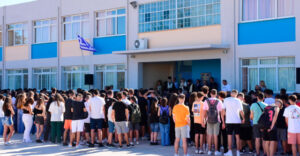
The new 2025–26 school year begins today, Thursday, for 1,370,000 students and 180,000 teachers, with the Ministry of Education launching a series of changes in both Primary and Secondary Education.
The timetable is being restructured, new subjects and institutions are introduced, and life skills are cultivated. From school gardens in elementary schools to career guidance in junior high, from the gradual rollout of the “multiple textbook” system and digital tutoring to the strengthening of special education and psychosocial support, all these shape the new “face” of school, while 12 new public Onassis Schools make their debut.
At the same time, the hiring of permanent teachers and the completion of the first phase of substitute recruitment are expected to cover daily gaps – though the number of vacancies remains considerable.
The Blessing Ceremony
Today, Thursday, September 11, 2025, the traditional blessing ceremony takes place. Instructions are given on the timetable and the general functioning of the school, students receive their textbooks and leave, as stipulated by the Ministry of Education circular.
Prime Minister Kyriakos Mitsotakis will attend the blessing for the new school year at the 8th Primary School of Nea Filadelfia. President of the Republic Konstantinos Tasoulas will travel to Telendos to attend the ceremony at the island’s Primary School. Minister of Education Sofia Zacharaki is in Xanthi, where she will also visit minority schools.
Classes will begin on Friday, September 12.
The school of “tomorrow”
New technologies enrich school life, while innovations become part of daily routine.
More specifically, 36,000 interactive whiteboards have already been installed in 7,000 schools, with another 2,900 to follow. This is a Recovery Fund project, as is the supply of 117,000 robotics and STEM kits to 11,146 schools.
To ensure their use, 150,000 teachers – including 35,000 in special education – are being trained in new technologies and interactive boards. By October, training will include artificial intelligence integration.
Computer Science is reinforced with new textbooks focusing on AI, while curricula and teaching content now orient toward interactive digital environments.
To help students familiarize themselves with new technologies, 13 Innovation Centers are being set up nationwide, giving access to AI and machine learning.
With a budget of €20 million, new equipment is being supplied to 1,500 junior high schools across Greece, and science labs are being upgraded.
Also planned: a special platform for career guidance, where experts provide counseling based on each student’s profile.
The new profile of Primary School
This year, the all-day program is being strengthened to better support families and cover educational needs. Students will be able to participate in additional activities, with extended hours and better-organized timetables.
Specifically, students in the upgraded all-day primary schools may leave at 15:50 after the second period of the second session, or at 17:30 at the end of the program. An additional departure option at 14:55 is available after the first period of the second session.
From Grade 5, students will have Social and Civic Education, introducing them to institutions, citizens’ rights, democratic function, responsibility, and active citizenship.
A new subject, Life Skills, is added, covering health, environment, digital literacy, and addiction prevention. It is taught cross-curricularly and experientially, tailored to age.
The new school gardens program starts this year in 2,267 elementary schools and 2,117 kindergartens. The Ministry will supply all necessary equipment. The program “School Gardens: thinking critically, working together, enjoying, creating” aims to combine sustainable development with pedagogy.
Economics in Junior High and new creative activities
This year, 9th graders will take the new Economics course, aimed at developing financial literacy – savings, income management, markets, entrepreneurship.
A new creative activities zone is introduced in junior high, addressing modern social needs and skills. Students will engage in group projects on volunteering, environmental protection, entrepreneurship, and new technologies.
Digital Tutoring
For the second year, Digital Tutoring continues. Already 3,500 hours of live online classes have been held. Options include subtitles and sign language, making lessons more accessible. By the end of last year, 146,000 users had participated.
Media Literacy
A new pilot program, “Cultivating Critical Readers”, is being introduced in 30 junior and senior high schools to foster critical thinking online and combat fake news.
It will last 12 months with a €350,000 budget. Students will gain skills for public dialogue, informed decision-making, and protecting their digital identity.
They will act as reporters, editors, photographers, and multimedia creators. Materials will focus on critical reading, understanding diverse perspectives, promoting professional journalism, and countering disinformation.
Multiple Textbook
As usual, printed textbooks are distributed at the start of the year. However, new textbooks up to 10th grade will soon be provided digitally to teachers via the Digital Library, who will prepare for final selection under the “Multiple Textbook” scheme by spring 2026.
New printed books will replace the current ones starting in 2026–27.
eVivlio
To boost reading, students will have access to full literary works in Literature class and to the eVivlio platform with both educational and literary e-books and audiobooks.
The 12 new public Onassis Schools
This year marks the debut of 12 Onassis junior and senior high schools in Attica, Macedonia, and Thrace, with more opening next year.
“Marietta Giannakou” School Renovation Program
So far, 431 schools – 29 of them special education – have been renovated under this program. Another 2,500 schools will follow. Works include painting, bathroom overhauls, new accessible toilets, ramps, basketball and volleyball courts, and playgrounds.
Strengthening Music Schools
Greece’s 52 Music Schools are upgraded with new instruments and equipment, a €10 million project.
Defibrillators in Schools
During 2025–26, 10,000 defibrillators will be distributed to schools, alongside first aid training, to safeguard community health.
Horizontal changes across all levels
- Student assessment: Modernized to combine exams, assignments, participation, and creative activities.
- Reading promotion: 21 books distributed across all levels.
- New teaching methods: Collaborative learning, digital tools, experiential methods, interactive materials.
- Teacher training: Focused on digital transformation, new pedagogy, and updated curricula.
- Curriculum changes: More flexibility, with mandatory and optional goals.
Strengthening Special Education
- 8 new special schools (primary & secondary).
- 2 new fields and 6 new specialties in Unified Special Vocational Schools (ENEEGYL).
- Record number of new Integration Classes: 3,448 nationwide, a 90% increase. Sharp rises in high schools (+600%) and vocational schools (+750%).
- Support by special education teachers added to all-day schools.
- Special education support in vocational labs.
- School nurses introduced, covering up to 2 nearby schools.
New Schools
- The primary school of Pserimos reopens with 2 pupils.
- New Art Junior High School in Drama and new General High School in Magnesia.
- First-ever vocational high school inside a prison (Larissa).
- 8 new Evening Vocational High Schools in Samothraki, Sapes, Volos, Argalasti, Skiathos, Zakynthos, Edessa, and Kranidi.
These aim to offer second-chance education to workers, unemployed, and adults, and meet local labor market needs.
Demographics and school closures
For 2025–26, 41 primary schools and 92 kindergartens in Central Macedonia are suspended due to low student numbers.
In total, 171 schools are closing in Epirus and Central Macedonia this year; around 700 schools nationwide remain closed annually for the same reason.
According to the Minister’s official decision: 9 primary schools and 9 kindergartens are abolished; 12 primary schools and 51 kindergartens merged; 5 primary schools and 8 kindergartens renamed; 3 new primary schools and 1 kindergarten established; 43 primary schools and 28 kindergartens downgraded; 14 primary schools and 15 kindergartens upgraded.
Teacher hires and staffing gaps
- 8,223 permanent teachers hired this year (5,627 general, 3,196 special education).
- 993 members of special education/support staff also hired.
- In 2020–25, a total of 48,653 teachers were permanently appointed.
- First phase: 18,566 substitute teachers hired.
- 6,225 additional special education/support staff recruited, plus 1,200 new social workers and psychologists.
- This year, 3,000 schools staffed with psychologists and social workers (5,750 total, vs 2,750 last year).
Despite this, unions (OLME & DOE) warn of thousands of vacancies, particularly in secondary schools and for national exam candidates.
Minister Sofia Zacharaki admitted: “It’s hard to have a year with no gaps. It’s a complex exercise,” promising a second recruitment phase by September 25.
She stressed: “Even with 10,000 new hires, there are still needs. From 2019, more than 48,000 permanent appointments have been made. But retirements, leaves, and housing problems for teachers in remote areas create challenges. We are considering support allowances for substitute teachers next year.”
Finally, support for Greek schools abroad has been strengthened by extending the special overseas allowance for Coordinators to 5 years.
Ask me anything
Explore related questions