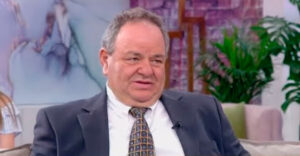
On Friday, Dimitris Lymperiadis, head of the Cardiac Surgery Clinic at Athens’ Hippocrates Hospital, will stand trial following charges brought against him by the Athens Prosecutor’s Office for the misdemeanor of bribery.
Lymperiadis was arrested red-handed on Tuesday (9/9) with marked banknotes, after a patient’s wife reported that he had asked her for a “fakelaki” (cash bribe).
According to the complaint filed by the patient’s wife with police, whose husband had undergone open-heart surgery, the doctor tried to reassure her by offering a “discount,” telling her: “I usually take €5,000, but from you I’ll only take €3,000.”
When the woman left the doctor’s office, Internal Affairs police officers immediately entered without anyone noticing and found the marked banknotes on the surgeon.
According to reports, during his arrest he allegedly told the officers: “I didn’t ask anyone for money. She gave it to me as a gift and put it in my trousers.”
The same reports suggest that the cardiothoracic surgeon systematically demanded “fakelaki” bribes in order to provide extra attention to patients he had operated on, with the cash in these envelopes reaching up to €5,000. He had previously been convicted at first instance for bribery and sentenced to a one-year suspended prison term, with his appeal still pending.
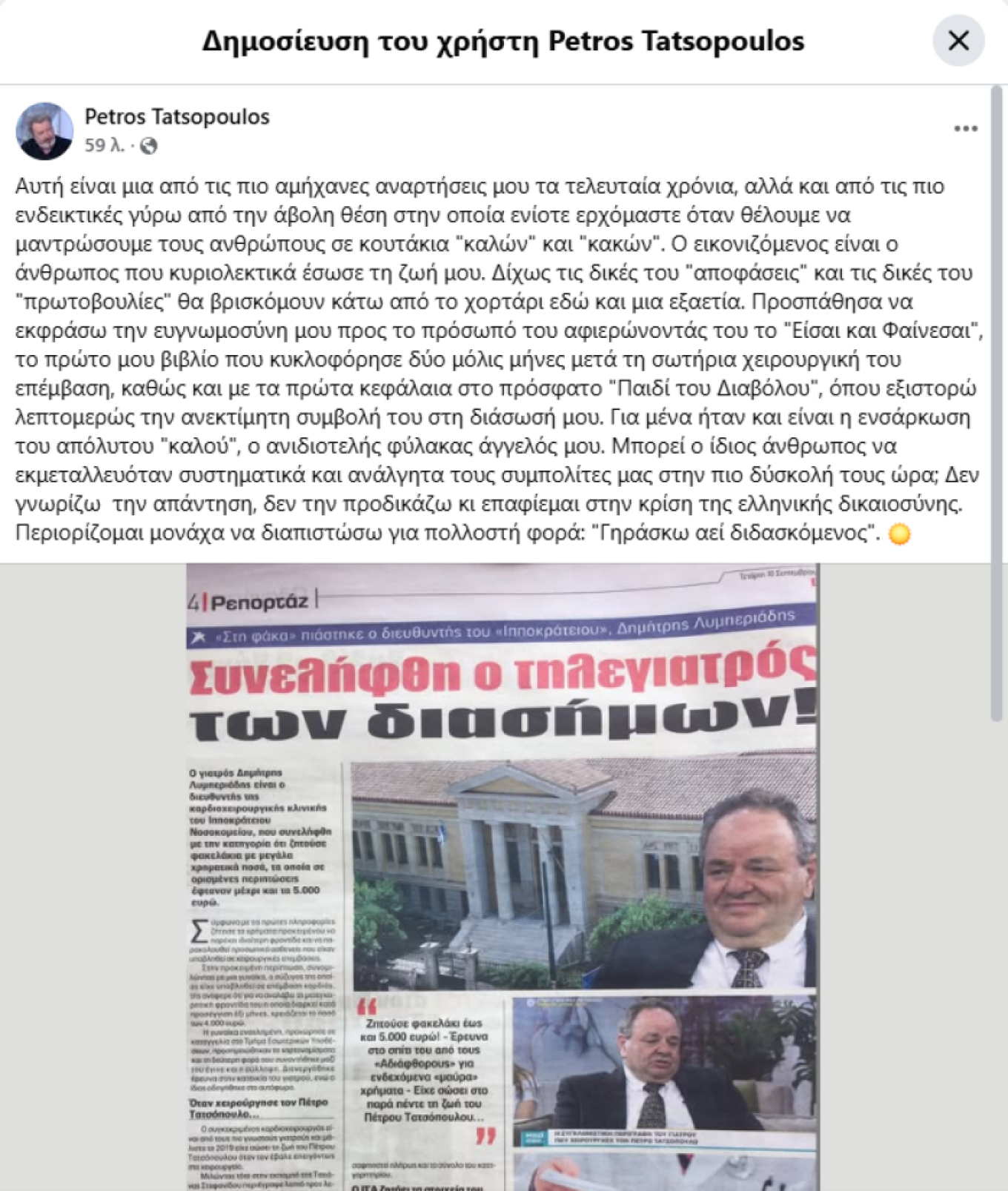
The Tachtsopoulos Post about Lymperiadis
Author Petros Tachtsopoulos, in a social media post, referred to the case of cardiothoracic surgeon Lymperiadis, recalling how in 2019 the doctor had rushed to operate on him at Hippocrates Hospital, effectively saving his life.
Tachtsopoulos admitted his statement was “one of the most awkward of recent years,” but described his personal experience, saying: “For me, he was and remains the embodiment of absolute ‘good,’ because without him I would have been under the grass for the past six years.”
Closing note from Tachtsopoulos’ post:
“This is one of my most awkward posts in recent years, but also one of the most telling about the uncomfortable position we sometimes find ourselves in when trying to box people into categories of ‘good’ and ‘bad.’ The man pictured is the one who literally saved my life. Without his ‘decisions’ and his ‘initiatives,’ I would have been under the grass for the past six years. I tried to express my gratitude by dedicating to him my book ‘You Are and You Appear to Be’—published just two months after the life-saving operation—as well as the opening chapters of my recent ‘Child of the Devil,’ where I describe in detail his invaluable contribution to saving me.
For me, he was and remains the embodiment of absolute ‘good,’ my selfless guardian angel. Could the same man have been systematically and ruthlessly exploiting our fellow citizens at their most difficult moment? I do not know the answer, I do not prejudge it, and I leave it to the judgment of the Greek courts. I can only repeat, once again: ‘I grow old always learning.’”
Ask me anything
Explore related questions