





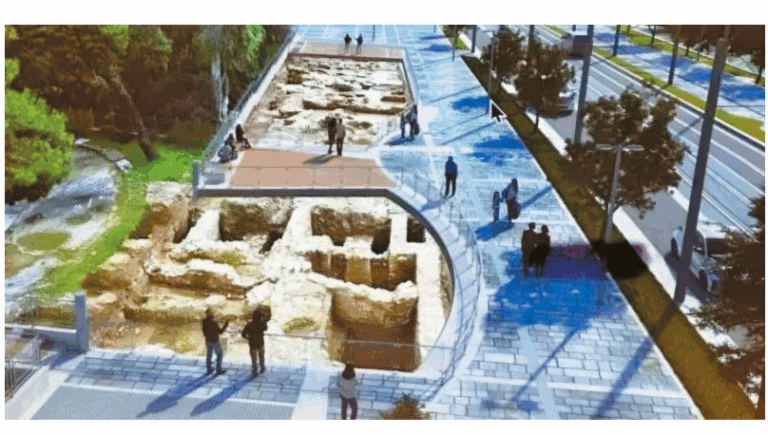
For decades, Vasilissis Olgas Avenue — bordering the National Garden, opposite the Olympieion, and within sight of the Acropolis — has been caught between two competing visions: a pedestrianized archaeological promenade or a functional traffic corridor. Officially, the Central Archaeological Council (KAS) has already approved a plan by the Ministry of Culture to transform it into a car-free route, integrating the ancient remains discovered in recent excavations into a walkable heritage landscape. But the road remains in limbo, generating fierce political confrontation.
A buried past revealed
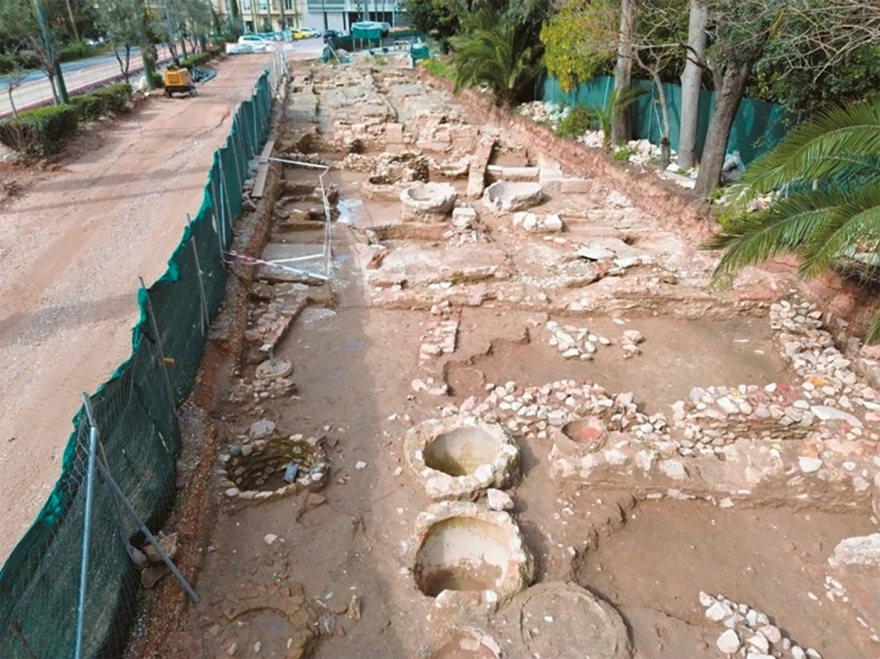
Archaeological interest in the site is not new. As early as 1888–1889, archaeologist Stefanos Koumanoudis uncovered parts of an imperial-era building in the area. Nearly a century and a half later, in October 2023, modern excavations beneath the asphalt of Vasilissis Olgas revealed the southern section of that same structure.
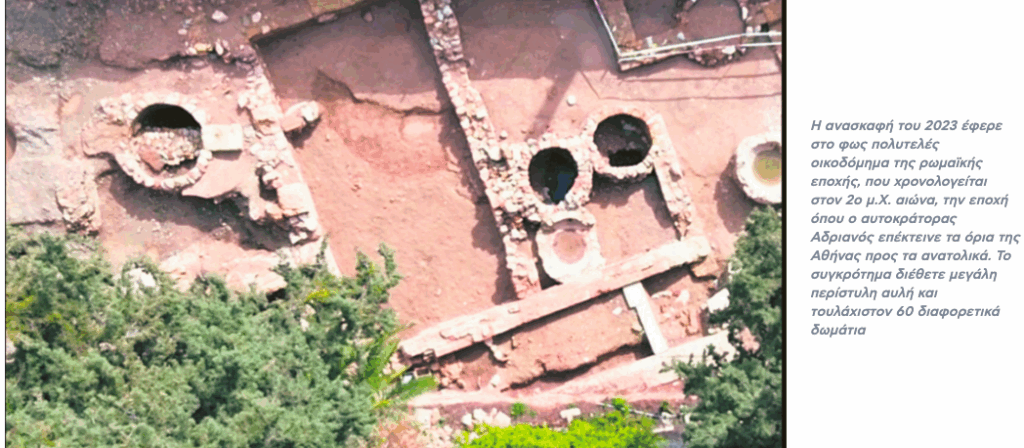
Findings point to a grand Roman complex of the 2nd century CE, when Emperor Hadrian extended Athens’ boundaries eastward. The building featured a vast peristyle courtyard and at least 60 rooms, their walls lined with marble slabs and their floors decorated with geometric mosaics. Successive building phases followed: one after the Herulian invasion of 267 CE, which left behind ceramic shards, glassware, and reused architectural fragments; and another, more modest, in later centuries, when Byzantine storage rooms occupied parts of the eastern sector.
Additional remains near the Zappeion may even connect to a large Roman bath described by Lucian.
The approved vision
In May 2025, KAS endorsed a plan for an archaeological park and pedestrian promenade, allowing visitors to walk alongside the ruins, with limited access for trams and emergency vehicles. The design includes landscaped strips, nighttime illumination of the antiquities, and elevated viewing platforms with panoramic sightlines toward the Acropolis, Olympieion, and Ardettos Hill.
A transparent fence would protect the site, and seven meters would be freed from current Zappeion facilities to open the northern edge of the excavation to the public.
A project mired in delays
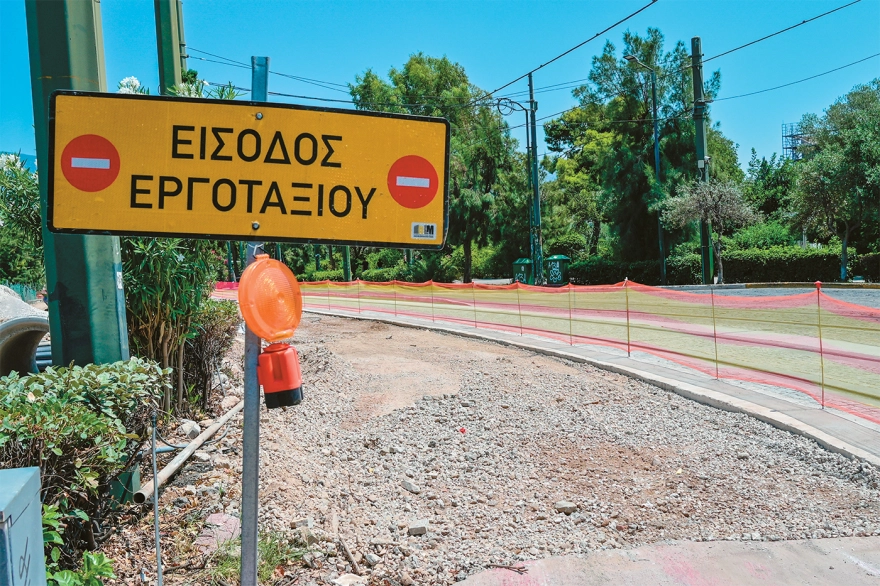
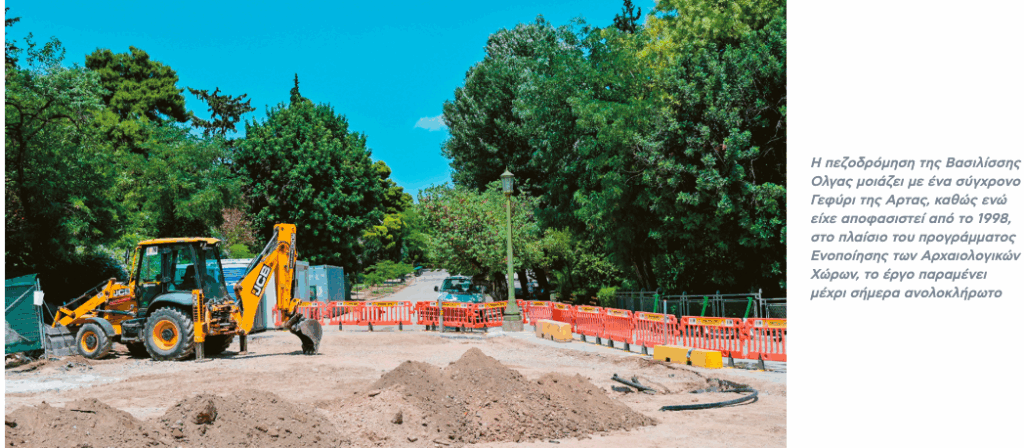
The pedestrianization of Vasilissis Olgas has been promised for nearly three decades. First approved in 1998 as part of the “Unification of Archaeological Sites” program, it stalled repeatedly — before the 2004 Olympic Games, again in 2014 during austerity-era cuts, and once more in 2020, when then-mayor Kostas Bakoyannis included it in Athens’ “Great Walk” initiative.
But the political tide shifted in 2023. Incoming mayor Haris Doukas pledged to reopen the avenue to cars, sparking clashes with the Ministry of Culture and archaeologists, who argue the site must remain car-free to protect its antiquities. “We cannot pave asphalt over ancient ruins,” Culture Minister Lina Mendoni stressed.
Today, five years after the avenue was closed for redevelopment, it remains disconnected from the urban fabric — neither pedestrianized nor restored to traffic.
Clash of institutions
Recently, Athens’ municipal council voted in favor of a “mild traffic” compromise: a two-lane road for cars, while maintaining some archaeological integration. Three ministries — Culture, Environment & Energy, and Infrastructure & Transport — immediately blocked the move, declaring that any such changes require new approvals, since the avenue lies within a declared archaeological zone. They warned that the city’s unilateral decisions “produce no legal effect.”
Doukas struck back, accusing the ministries of shielding his political rival, Bakoyannis, and of “ignoring the will of the people.” He promised to resist what he framed as central government overreach, even announcing potential protest rallies.
The road ahead
As delays mount and political rhetoric hardens, Vasilissis Olgas Avenue remains a modern-day Gefyri tis Artas — a project perpetually promised but never delivered. At stake is not only the flow of traffic in central Athens, but the balance between safeguarding the city’s ancient heritage and accommodating its contemporary urban life.
Ask me anything
Explore related questions




