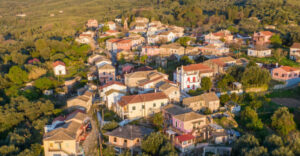
A two-cutter relief measure leading to the repeal of the ENFIA tax in 12,720 small settlements across Greece is being implemented. The first cutter envisages that all settlements in the Region of Attica are exempt, with the only exception being the Regional Unit of the Islands. The second cutter concerns the value of the property: if the taxable value exceeds 400,000 euros, the owner is not entitled to any deduction, even if the house is located in a village with a population of less than 1,500 inhabitants.
The provision of these two filters prevents the measure from becoming a tax “gift” for luxury properties. The debate heated up immediately after the announcement, as some believed that tourist destinations with small populations, such as Platys Gialos in Mykonos with 317 residents or Oia in Santorini with 477, could escape the tax.
In practice, however, the prices of properties there start from 4,000 to 7,000 euros per square meter, with the result that even a small house is valued at over half a million euros. Villas with swimming pools and luxury residences that dominate the Cyclades will see no relief, as they exceed the 400,000 euro threshold and their owners will continue to pay ENFIA, with a surcharge even when their total property exceeds 500,000 euros.
Instead, the real beneficiaries are the owners in thousands of small villages and towns in the province. From 2026 they will see their ENFIA reduced by 50% and from 2027 they will be completely exempt, as long as it is their main residence and they are registered as tax residents of Greece. This does not include holiday homes or secondary residences, nor residences of legal entities.
The measure is based on the 2021 census, which identified which settlements have less than 1,500 inhabitants and are thus included in the regulation.
According to estimates by the Ministry of Economy and Finance, the fiscal cost of the full exemption is estimated at around €75 million per year. The amount is considered relatively low compared to the total revenue from ENFIA, which exceeds €2.3 billion per year, and was therefore considered manageable. It is estimated that almost one million properties will benefit from the exemption, giving a significant boost to families living permanently in the region and facing the high cost of living.
The implementation is being done in two phases to avoid creating a fiscal shock. First will come a 50% reduction in 2026 and then, from 2027, the full exemption. In this way, the state is signalling support to small villages and their permanent residents, seeking to halt population shrinkage and enhance regional cohesion.
At the same time, however, with the two cutters it sends the message that the regulation is not for the haves and have-nots on luxury islands or in Attica, but for residents who live permanently in small villages and have lower property values.
In this way, the government is attempting to balance the need for social support with the need to maintain tax fairness. For households across the country that will see their ENFIA reduced and eventually zeroed out, this relief will mean a substantial boost to the family budget. For areas with excessively high values, the two cutters keep the measure targeted, preventing any chance of it appearing as a gift to the powerful.
Ask me anything
Explore related questions