





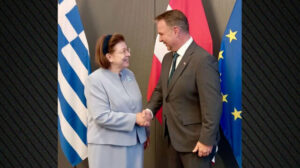
A working meeting was held in Vienna between the Minister of Culture, Lina Mendoni, and the Vice-Chancellor and Minister of Housing, Arts, Culture, Media and Sport of Austria, Andreas Babler.
The talks mutually confirmed the excellent bilateral relations between Greece and Austria, as well as the close cultural ties between the two countries. Lina Mendoni referred to the excellent relations between Greek and Austrian archaeologists, from 1898, when the Austrian Archaeological Institute was established in Athens, until today. There was a detailed discussion on the institution of the European Capitals of Culture, as Greece and Austria had the recent experience of Elefsina in 2023 and the Isle of Salzburg in 2024, respectively. Extensive reference was made to the Austrian-Greek Music Summer, a successful institution of musical events, organized for a decade by the Embassy of Austria in Athens, under the auspices of the Ministry of Culture of Greece. The Music Summer 2025 was dedicated to Mikis Theodorakis and included more than 30 concerts.
Lina Mendoni focused on the importance that Greece and the Ministry of Culture attach to the definitive reunification of the Parthenon Sculptures in the Acropolis Museum and asked the Vice Chancellor to cooperate in order to enable the return to Athens of the two Parthenon fragments, which are currently on display at the Kunsthistorisches Museum in Vienna’s Kunsthistorisches Museum, analyzing the example of the Fagan fragment. Andreas Babler expressed the intention to initiate a technical discussion between the two sides, as, at present, the appropriate institutional framework does not exist in his country. The bilateral meeting was attended by Greek Ambassador to Vienna George Iliopoulos and Ambassador Thomas Zehetner, foreign policy advisor to the Vice-Chancellor, and colleagues from both sides.
World premiere for the TIF at the Musikverein in Vienna
The Thessaloniki State Orchestra, as part of its policy of extroversion, for the first time in its more than 65 years of presence, appeared in the iconic Golden Hall of the Musikverein in Vienna, with the world premiere of the work “Ballad of Ephesus,” which was written for orchestra and ancient Greek lyre. Culture Minister Lina Mendoni, who attended the concert, said: “The appearance of the Thessaloniki State Orchestra, in one of the most iconic music venues in the world, is a top cultural event, and at the same time a moment of special pride for our country. The Golden Hall, which is inextricably linked to the world musical tradition and to Greece, as it bears the stamp of the Greek benefactor Nikolaos Doubas, welcomed, for the first time in its history, the sound of the ancient Greek lyre, through the performance of Dr. Nikos Xanthoulis. The fact that the KOTH presented itself before a demanding and educated audience, winning its acceptance and enthusiasm, confirms its quality performance. Greece is on the international cultural map, not only for its cultural heritage but also for major productions, through the cultural organizations of the Ministry of Culture, winning international praise, thanks to the dedication of the artists, who work hard for the extroversion of contemporary Greek culture. The appearance of the Thessaloniki State Orchestra is strong proof of the vision of extroversion and internationalization that we have been consistently serving in the Ministry of Culture in recent years. Our goal is to bring Greek culture to the forefront of the major world stages. Congratulations to all the contributors for this historic moment.”
The Musikverein’s Golden Hall, inaugurated in 1870 by Emperor Franz Joseph, is considered one of the most famous and sought-after concert halls in the world, particularly famous for the Vienna Philharmonic’s New Year’s Eve concert. The Greek-born benefactor Nikolaos Doubas (1830-1900) was instrumental in its construction, adding symbolic weight to the appearance of the Thessaloniki State Orchestra. Originally from Vlastis in Kozani, he was a philosopher and friend of leading musicians and artists such as Strauss II, Wagner, Brahms, and Klimt, and a great benefactor of Austria and Greece. The street in front of the Musikverein is honourably named Dumbasstrasse.
Ask me anything
Explore related questions




