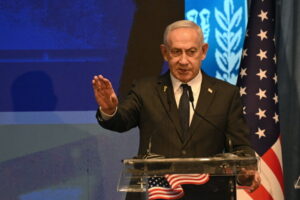
Benjamin Netanyahu revealed a lot—indeed, he was very revealing—about the future of his country and its relations with allies, friends, and both long-standing and new enemies. The Israeli Prime Minister, for the first time in a while, spoke in economic terms, and it appears not only that Tel Aviv will persist in the war, but also that it is fully ready to expand the “fan” of involvement, insisting that the strike on Doha was a necessary action for Israel, with nothing questionable about it. The subsequent consequences, which are not directly linked to bombs, fighter jets, and exchanges of fire, are part of an equation for which answers and solutions will come from him and his government.
Super Sparta and Qatar
During his speech to economic and other stakeholders, Netanyahu made a comparison that did not surprise his audience but sounded somewhat strange to others. Listing the ways Qatar was attempting to respond multilayeredly to last week’s strikes, he noted that his country would “break this barrier as Sparta did—or, more precisely, we will be a Super Sparta.” Netanyahu, like any politician in Israel’s short-lived but conflict-filled, tension-laden, and unpredictable political landscape, is a serious student of both contemporary and ancient history, and any reference or analogy he uses is never random or disconnected from his plans. His choice of Sparta as an example arguably reveals with precision how he thinks, especially regarding confrontation—not only with the “neighborhood” but also with the European West, which has begun applying pressure and creating challenges.
Netanyahu’s comparison is not only about the famous military prowess of the Spartans but primarily about Sparta’s insistence on imposing its will—its power and desires—through a heterogeneous yet often unified mix of force and strict diplomacy. For Netanyahu, the reference to ancient Sparta can, at a surface level, be seen as a morale booster for the armed forces, which have been fighting across many different fronts for nearly three years. Fundamentally, however, it embodies his vision. Netanyahu clearly knows that Sparta was the great victor of the Peloponnesian War and that its military strength was key in defeating even the Persian Empire. Yet, this analogy should not mislead anyone: he also knows that it was the Athenian democracy that ultimately became the model of governance and a beacon for global civilization, not the purely militaristic grandeur of Sparta.
Next steps
As usual, after “Black Saturday,” Israel seems to have “read” the developments and is unlikely to be caught off guard again by any extreme action. Conversely, taking the day when the country recorded its highest number of deaths since the Holocaust as a starting point, Israel appears to move closer each month to fulfilling a plan that—regardless of its name—will create the conditions for the Israel of the next 20 years (or perhaps much longer).
Netanyahu envisions an Israel that is larger, militarily and economically stronger, and decisively “free” from internal and external threats. To achieve this, he is proven willing to take actions that, 30 months ago, would have amounted to the start of a war. The bombing of Tehran, strikes in Lebanon and Syria, and even the complete leveling of Gaza—if all revealed together even in a “highly classified” report by a reputable Western outlet—would provoke more smirks than study.
Ask me anything
Explore related questions