





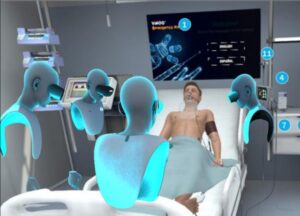
A hands-on operating room experience will be available to medical students of the Aristotle University of Thessaloniki in the coming period of time through the immersion cube, a space that introduces them to a unique multi-sensory learning environment. “It is a space in which one lives in virtual reality, without wearing glasses or masks. It is a room equipped with special projection screens, which in this way can be ‘disguised’ in any other space, providing an experience to its visitor,” Director of the Laboratory of Medical Physics and Digital Innovation of the Department of Medicine of the Aristotle University of Thessaloniki, Professor of Medical Physics and Informatics in Medical Education, Panagiotis Bamidis.
“Imagine being able to convey the image that the heart surgeon sees inside this room, and it’s like living the whole surgery room being there,” Bamidis said on the occasion of the presentation of the immersion cube a few days ago at the 89th Thessaloniki International Fair. “We want to use this obviously in our training to transform the workshops and some parts of the lectures, demonstrations through a user experience rather than through a simple two-dimensional slide presentation or a description of a speaker. That’s our goal educationally: as early as this semester to be able to put it into the educational process once it’s completed.”
At the next level, the immersion cube can be used in patient rehabilitation and training of other health professionals in general. For example, Bamidis pointed out that “the space can be used for the restoration of perception, speech, etc,” and added: “We will see how rehabilitation from aphasia or from strokes is done. These are our interests, at least, as well as the sensory stimulation of people to improve their physical and mental health and therefore their well-being.”
The Director of the Laboratory of Medical Physics and Digital Innovation of the Department of Medicine of the Aristotle University of Thessaloniki mentioned, besides, the purchase of a new instrument with the support of the Hellenic Foundation for Research and Innovation (ELIDEK), which is located in the new magnetoencephalography unit of AHEPA and can detect the magnetic fields of the brain, thus recording its function every millisecond. The masks connected to the machine were also presented at the Thessaloniki International Fair in order for the public to see them up close and express interest, if they wish, to participate in the measurements that will be made in the coming period. “These measurements will take the fingerprint of the brain network of the participants, and based on a multi-year study that we are starting, we will be able to have data on the overall physiological footprint of Thessaloniki. Then with this, we will make comparisons with other pathological conditions,” he said, and added: “people expressed quite a lot of interest and there was quite a positive response.”
Ask me anything
Explore related questions




