





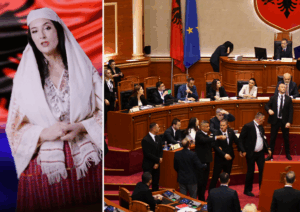
Although it was one of the rare occasions when Albania surprised the global audience with an act of pioneering innovation, the idea of a robot in the role of a minister did not exactly thrill its Albanian “colleagues,” as was clear from yesterday’s turbulent parliamentary session.
Specifically, Diella—the first robot with Artificial Intelligence appointed as a minister for the oversight of public contracts—divided parliament. The situation soon spiraled out of control in the Albanian assembly, with two MPs throwing copies of the Constitution and the parliamentary Rulebook over the head of the country’s Prime Minister, Edi Rama.
The sequence of events
During the session, Mr. Rama was to present Diella, which addressed parliament via a screen. In the end, the robot’s speech lasted no more than 20 minutes, even though, according to Albanian media, the Prime Minister made an extended reference to the first AI Minister, noting that she would be supported by a new structure called AI4. This would be an “artificial intelligence accelerator” with an active role in public administration, aiming to reduce bureaucracy and increase efficiency.
Seemingly surprised by the reactions, Rama said: “I regret the reactions against Diella as a member of the new cabinet and the misunderstandings about her role. This is my responsibility, and her speech in parliament was the only way she could be expressed.” He explained that the goal is to create companies in which the state will hold shares, positioning Albania as a country with ambitions in AI-driven governance.
However, Rama’s grand plan was not received in the same way by all MPs, with tensions flaring inside the chamber when opposition deputies began banging on their desks and shouting: “Don’t make a mockery of parliament.” Rama warned MPs that if they did not return to their seats, the voting process would begin immediately—which it did, resulting in the program being approved with 82 votes in favor.
The international experience
At the same time, more and more countries are moving toward an “AI Minister”—that is, the integration of Artificial Intelligence into policymaking and crisis management—with Canada long holding the lead in developing such infrastructure. It is no coincidence that Jensen Huang, CEO of global tech giant Nvidia, refers to Canada as “the epicenter of modern invention,” saying that businesses should feel further vindicated in their decision to integrate AI into their operations.
In Greece, however, Prime Minister Kyriakos Mitsotakis has recently hinted at the broad scope of Artificial Intelligence applications—even in the governance of the country—saying last July that there are nations already using an “AI Minister,” meaning that they arrive at specific decisions each time based on Artificial Intelligence and its analyses. Already, the Swedish Prime Minister has made use of AI in problem-solving, while the United Kingdom has established a Parliamentary Undersecretary for Artificial Intelligence and Digital Governance.
Meanwhile, the Minister app—also known as mst.ai—has become extremely popular. It is a free online AI art generator that uses advanced artificial intelligence technology to instantly create realistic images. Users can generate various kinds of artwork, such as fantasy pieces, movie and photo-style visuals, buildings and backgrounds, realistic visions, and much more. The platform offers a wide range of AI diffusion-based art models, officially provided and shared by users. It supports the use of multiple models to present works in different styles and allows users to train personalized models or share high-quality models with the community—according to the platform’s designers, who playfully tie the concept back to the idea of a “Minister.”
Ask me anything
Explore related questions




